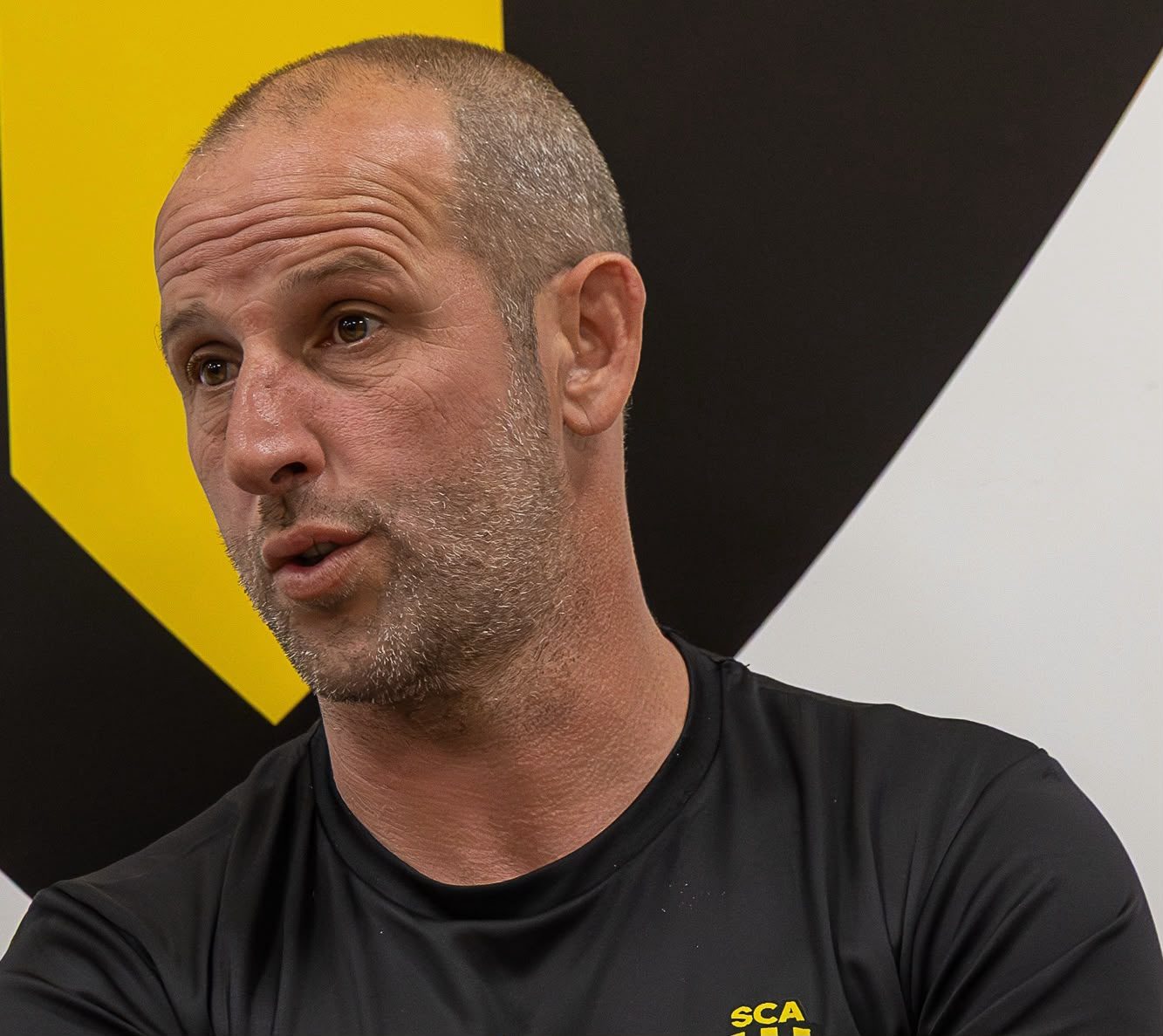
Beaten 41-23 at Massy on Saturday 17 October, Albi slipped back in the Nationale standings: fourth after eight rounds, with six wins and 30 points. Their coach, Kévin Boulogne, is looking beyond the table.
Albi host second-placed Chambéry on Friday 30 October in round 9. Before that, their coach talked about rugby, player development, money and reform.
“I want the players to step outside the framework more”
Surname, first name, age, qualities?
Boulogne, Kévin, I’m 40, and let’s say my qualities are being loyal and consistent.
Has the start of the season matched your expectations?
In terms of the way we play, I expect more. I want the players to take more initiative, to step outside the framework more, to enjoy what they do and not just recite a game plan.
But for that you need leaders in the squad, I imagine. Do you have them? Or do you have players to develop?
We own it: since we arrived last season with my staff, we already had players, we’ve signed new ones, and of course there are players who need support and development. That’s the club’s project. But I also have a group of great human quality, and of very high rugby quality. It’s just that the group is so good that sometimes the players are a bit too collective! I’d like those players to come up with something out of the ordinary, to carry everyone with them and get the team back on track when things aren’t going well.
“Settling for small wins is not our culture”
So what you’d like is a kind of “reasonable madness”.
I was never the kind of player who could be pigeonholed in a game plan and follow it from A to Z. I think the strength of any project is the people driving it, the group. If the group believes in the project and lives it, that’s what will make the players good and the results positive. And when we talk about results, it’s not at the expense of how we play. The staff and the group set ourselves one key: the result is only the consequence of the ingredients we put in place.
The danger, and it can happen, is developing a settle-for-little mentality. That’s not our culture and it hasn’t been for more than a year. The players buy into it because they are frustrated themselves after some games, even when they’ve won. Win or lose, we want better players, players who take initiative, who take the lead, who go into battle together and know who they can count on out there. We’ve all seen squads that looked strong on paper but whose results were disastrous because they didn’t enjoy playing together. Today we want a balance between rugby, team spirit and the collective, and above all to go and get results with a sense of a job well done.
Kévin BoulogneThe result is only the consequence of the ingredients we put in place.
“By the end of February, 80% of our squad is already set”
December and January are crucial for many developing squads doing well in the second, third or fourth tier. The “big” clubs come shopping. Has that started?
It started last year, there’s a little this year too, but it’s just a natural progression. Today we are a development club. If we manage to develop players and they have the level to go higher, we clearly support them, we’re not going to hide them, it’s their future too. Their departures also attract other ambitious players, so our recruitment is made easier that way. We work in the interest of the club and in the interest of the player.
It means our squad-building happens much earlier. In November and December, we’ve already set the groups of players we want. By the end of February or early March, 80% of our squad is already in place. So the players have peace of mind. That’s the game: those who aren’t kept know early so they can find something else, and for those leaving our club, we need to know early so we can react. It’s just how rugby works, and we accept it.
“We have all the constraints of professional rugby”
You knew the not-so-distant days of Fédérale 1 as the third tier. Today it’s the Nationale and Nationale 2, and the competitions are being overhauled. Do you have any visibility over the next two or three years, given how deep a transformation this is?
It’s clearly a transformation. You can see it this year: for me the competition is a little distorted, but it’s not dramatic either. Lots of teams that would have been fighting relegation are playing from everywhere. They counter-attack from their own 22, things they would never have done with relegation at stake. It distorts match strategies a bit, the game itself, respect for the game, and that’s a bit annoying. In sporting terms it’s not necessarily a change, because things change all the time: the pools, the distances, the travel.
What I see is that the Nationale, for me, is a bit… how can I put it… To put it crudely: “we’re the cuckold”. Why? Because we have all the constraints of professional rugby. We train every day, we can’t have players with a job on the side, but we don’t have the financial support to offer attractive contracts like the Top 14 or Pro D2, which have TV rights, big budgets and high visibility.
In Nationale 2, the players have other jobs. They work during the week, often earning between €1,500 and €2,000, and on top of that they get envelopes from the club, contracts of €800, €1,200, €1,400 for some, for three evening training sessions and a weekend match, plus travel. Add it all up and you quickly reach €3,000 or €3,200. Today in the Nationale, contracts are well below that. Some players prefer Nationale 2 for the money. With us, they really come for the sporting ambition. So of course we’re expecting a lot from the overhaul of the competitions.
“The only truth is what happens on the pitch”
Albi in the Pro D2: wishful thinking or a genuine ambition?
It’s an ambition, of course. Every team in the Nationale should tell themselves at the start of the season that going up to the Pro D2 is an ambition. But there’s ambition and there’s reality on the pitch. What we went through in the past at Albi, I’m talking about six or seven years ago when people said “we’ll go back up in two years”, the real question was: did we have the squad for it? It’s a real issue, because from the first defeat it could feel like the players’ heads were in the bucket, that they’d lost their season.
We, the coaching staff, bought in 100%. If we deserve to go up, we’ll grab the chance with both hands, we’ll take responsibility, because every player is a competitor, every player is on a mission. But it’s the season that will decide whether we go up or not. What’s the point of announcing objectives that can’t be reached? Yes, we want to go up. Will the group have the strength to get there? You reap what you sow, as we always tell them. The only truth is what happens on the pitch. You can have the biggest budget, the smallest budget, the most star contracts, and you see it’s not necessarily them who make it. Today it depends only on the group.
Any message you’d like to get across?
Every year the rules change, there are differences every year, clubs go under every year, other clubs perform, and there’s no real stability. I think that rather than thinking up sporting, structural and financial overhauls and feeling our way, one day we’ll have to sit around the table and try to find a real solution.
Key figures
4th Albi's position in the Nationale after eight rounds, on 30 points
6/8 Albi wins in the first eight rounds of the Nationale
41-23 Defeat at unbeaten leaders Massy on 17 October (round 8)

Comments