
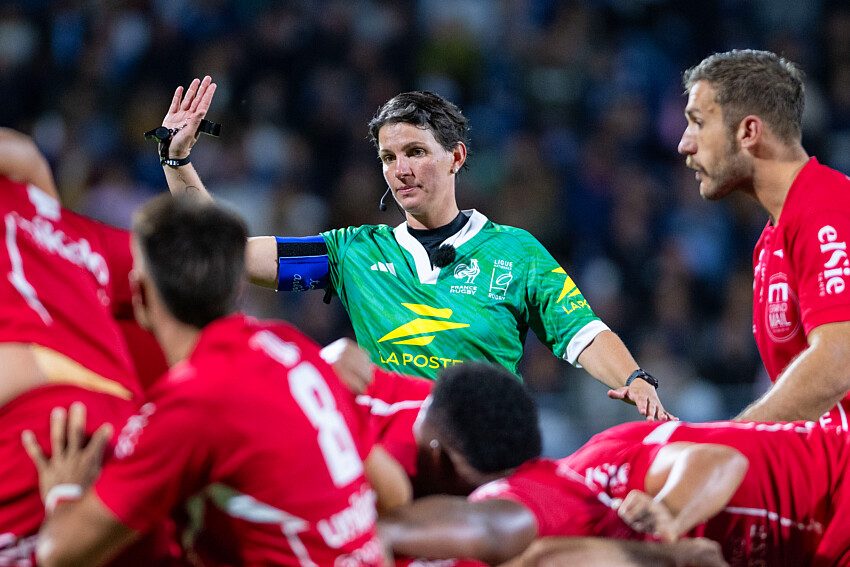
On Friday 9 October, Aurélie Groizeleau refereed Agen v Dax in Pro D2, a 49-30 home win. The day before, the Nouvelle-Aquitaine referee spoke to It’s Rugby during France’s Referee Days (6 to 15 October) and Pink October, the breast cancer awareness month.
Before heading to North America for two Tests between Canada and England, in Toronto on 16 October and Ottawa on 23 October (local time), the former international looks back on her career. She has been refereeing for more than fifteen years.
“Without a referee, there is no match”
Name, age, occupation, please?
Aurélie Groizeleau, 37, rugby referee, Nouvelle-Aquitaine league.
This is Referee Days week in France, from 6 to 15 October. What does it mean to you?
It is a period that honours the role of referee and helps give it more value, when it is criticised far more often than praised. It is one week a year when people at least talk about us positively, about what we do, and show how important our role is in sport. The cliché we always repeat is “without a referee, there is no match”, but it is still the truth. Today we can see that abuse is increasing, especially in amateur rugby, and the referee is the one most affected. I think these days are also there to put things back in their place, and to show the importance of the referee and of respect in sport in general.
Pink October, “a fight we must not stop”
There is a second cause this month, one that concerns everyone: Pink October, in which rugby is heavily involved…
Yes, there are several initiatives through rugby for Pink October. It is undeniably something that touches us as women: we know more and more women are affected by this type of cancer, and younger and younger. If I take the example of my South African colleague, who is 39 and fighting breast cancer when she was with me at the World Cup a few months ago, it automatically resonates very strongly. You realise nobody is safe. It is a fight we have to lead, we have to talk about it, because these women feel isolated. It is a major change and we have to show them all our support. We have to keep fighting because, unfortunately, the battle is not always won in advance. It is a fight that is not going to end any time soon, and we absolutely must not stop it.
Refereeing, “a spare wheel”
Reading your biography, refereeing was not a choice for you, but something forced upon you…
Exactly. I had health problems that came to light when I was 19 (five caps for France in sevens, editor’s note) and forced me to change direction. I was expected to have a fine playing career, and then it all stopped. I had to rebuild, start again from scratch and take on new challenges. I have been passionate about rugby since I was a little girl, so finding another way to stay in the game seemed obvious. At 19 you still want to be at the heart of the action and keep moving. Refereeing was a kind of “spare wheel” that let me stay in rugby. Then, little by little, I started to enjoy it, I got hooked, I set myself new goals, and that is what got me where I am today.
“Rugby was a man’s sport”
How were you accepted in a world that remains very macho, even conservative?
Things changed a great deal over my career. I have been refereeing for more than fifteen years. At the start, I admit my acceptance was very difficult, with a lot of sexist remarks: “rugby was a man’s sport”, “women had no business on a pitch”, that in any case “I didn’t understand anything”, and that I couldn’t understand anything because I was a woman. It was really hard to live with.
Fifteen years ago, the crowd was very male. Today the rugby audience has really changed, and that has brought an overall shift: there are more and more women in rugby, more female players, and my place as a referee has changed too. You also earn that place through perseverance and competence because, in the end, over time I became known and recognised, and that is what eased my path to the top level.
Today, in the professional game, I don’t have any particular problem, because I have been at this level for a long time and the players and clubs know me. Overall it is well received, and I even get some positive comments saying there should be more female referees at the top level. Let’s say things are moving in the right direction, little by little.
When Italy’s captain praised the refereeing of your colleague Hollie Davidson during the last Six Nations, that was a real step forward…
Yes. Hollie is one of the pioneers, the ones leading the way, and she has huge visibility today. She is clearly showing the way. And being congratulated by the Italy captain in a post-match press conference gives it even greater value. As I said, we are on the right track in terms of progress.
Aurélie GroizeleauYou also earn that place through perseverance and competence.
Canada v England, “a rerun of the last final”
What is your programme for October?
Agen v Dax in Pro D2, then I’m off to Canada for the W15 Series, where I referee Canada v England twice, a rerun of the last women’s final, which should be a great contest.
A bit like New Zealand v South Africa in the men’s game?
Exactly.
And farming: have you had to step back from it?
Yes, I had to. When I have a bit of time I give the family a hand, but I don’t have much: I have a big international period with this competition and little time to devote to my former job. But when I can, I help them out.
Key figures
49-30 Agen v Dax, her latest Pro D2 match, on 9 October
2 Canada v England Tests to referee in October, in Toronto and Ottawa
33-13 Score of the 2025 Women's Rugby World Cup final, won by England against Canada


Comments