
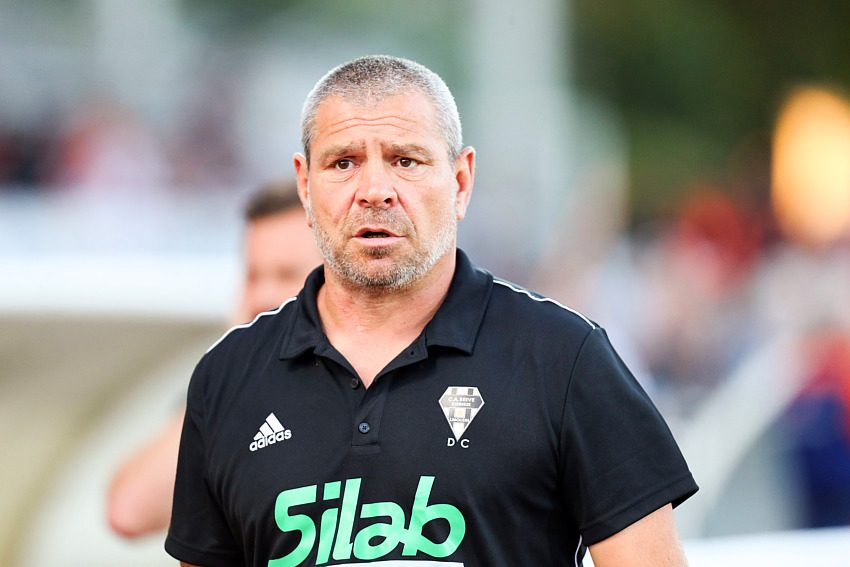
A smaller budget, 15 to 20 new players and a season without relegation: Périgueux coach Didier Casadeï takes stock of his club and of the economics of the Nationale.
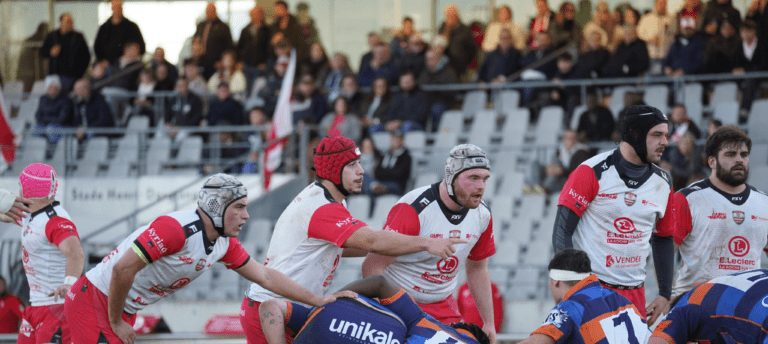
Two wins in five rounds, at Rennes (24-17) and at home to Bourgoin (27-23), and two five-point defeats, at home to Massy (20-25) and at Suresnes on Friday (27-22): Périgueux have started their Nationale season with a largely new squad. They host Orléans on Saturday 3 October before travelling to Carcassonne. Their coach, Didier Casadeï, a former loosehead prop for Brive and France, talks budgets, player development and the calendar. Interview.
How are things at Périgueux?
We’re in the thick of the start of the season. There’s a run of 14 matches between now and mid-December, and I think we’ll only be able to draw a first assessment at the end of that period. There’s been a lot of movement this season, with a fairly significant budget cut and a group that was a bit at the end of a cycle, one that had started out in Nationale 2, with some players who were getting on a bit. So we had to rebuild the squad, because it was necessary, and also because we had no choice.
“The Nationale’s economics aren’t viable”
That’s the case for quite a few Nationale clubs, in the end…
The economic situation of Nationale clubs is extremely difficult, in the sense that you get no help from the Federation, the League or a broadcaster. You have constraints and very little money coming in. Add to that a very tough economy at the moment… So clubs are struggling to make ends meet. We’ve obviously also been burned by Blagnac, Carqueiranne, Tarbes and Niort. Today, the economics of the Nationale aren’t viable for clubs, and you need people who commit themselves, like our president Francis Roux has done for many years, and who keeps working to fill a budget that stays balanced. Hats off to him.
Sowing seeds and finding those who slip through the net
What’s rugby life like in the tricky triangle formed by Toulouse to the south, Bordeaux to the west and Clermont to the north-east?
Today, player development is quite tricky. Apart from Ross, who came through in the Dordogne, very few players have been developed in this region, and among them there was Bosviel, for example. It was possible. We need to get much better at developing players, so we can bring through youngsters good enough to play in the Nationale. It’s a lot of groundwork, with the coaches too. And it’s up to us to perform by taking young players who aren’t kept on by professional clubs and trying to raise them to a good level through daily training. The challenge is twofold: first the long term and development, sowing seeds that may sprout in five, six, ten years; then being smart and sharp enough to go and find the ones who slip through the net.
“The Nationale, I insist, is good rugby”
You saw the start of professionalism and your playing record speaks for itself: how do you see rugby over the last 30 years?
Let’s say that in the Nationale I’m living a bit of what I lived through in 1996 or 1997, when rugby went professional. Some made that choice, others preferred to keep a job and earn a bit on the side at neighbouring clubs. I’d say those lucky enough to become internationals made the right choice, and those who fell a bit short made the wrong one. Today I find exactly the situation we were in 30 years ago. Lots of players come through professional academies, but in the end few will get the chance to play at the level they hoped for at the start.
And those players have to make choices. Tell themselves: “Right, today I’m not good enough to play in the Top 14 or Pro D2, I’m choosing to try my luck in the Nationale”, with really very low salaries and one- or two-year contracts. Or tell themselves they’ll work, train for a future job, and play rugby as amateurs. I leave the choice to my players, and I never lie to them.
That said, there are players able to bring the commitment, the intensity and the standards of high-level rugby, because the level in the Nationale is still very good. Having been lucky enough to coach at every level, Pro D2 and Top 14, there’s clearly a gap between each of them, but the Nationale, I insist, is good rugby. Today the level is so high that it’s impossible for a player to hold down another job. You need players who are 100% committed, that’s for sure. I like my players to have dreams, because you need dreams in life, it’s important, but also to try to do everything so that the dream has a chance of coming true.
“Rugby is first and foremost a combat sport”
With this unusual season without relegation, what is Périgueux’s ambition?
It’s hard to say today, with 15 to 20 new players at the start of the season. I’ve had to pay for academy players out of my budget so they can come and train with the first team, that has to be taken into account too. But the real objective goes beyond results: it has to be doing everything to make better players every day. That’s the truth.
High-level rugby means paying attention to every detail: the physical side, the technical side, studying the opposition, daily standards, and knowing what you bring and what the opposition will bring. Then add a very strong team mentality. That’s what we’re trying to work on, with enjoyment too, because the truth is players have to be happy doing what they do, but in a rugby competition. It’s first and foremost a combat sport, a lot of people tend to forget that: rugby is first about wanting to get past your opponent. I have plenty of players who’ve had extraordinary careers without huge physical or technical gifts, but who had the mentality.
Five months without income
Didier Casadeï, any message you’d like to get across?
I’ve got something to get off my chest. I can’t understand why the Nationale starts before the Pro D2 and the Top 14 when we have fewer matches to play than them. We’re forced to start on 20 August when players’ contracts begin on 1 July. I’ve found this calendar totally absurd for four years. We finish with a match in April, and clubs find themselves in difficulty, with no money coming in during April, May, June, July and August. Five months!
Key figures
2/5 wins for Périgueux after five Nationale rounds, at Rennes and against Bourgoin
15 to 20 new players in the squad at the start of the season, after a budget cut
14 matches to play by mid-December, according to Didier Casadeï
20 August the start date imposed on the Nationale, for contracts that begin on 1 July
5 months without income for clubs, from April to August
Comments