
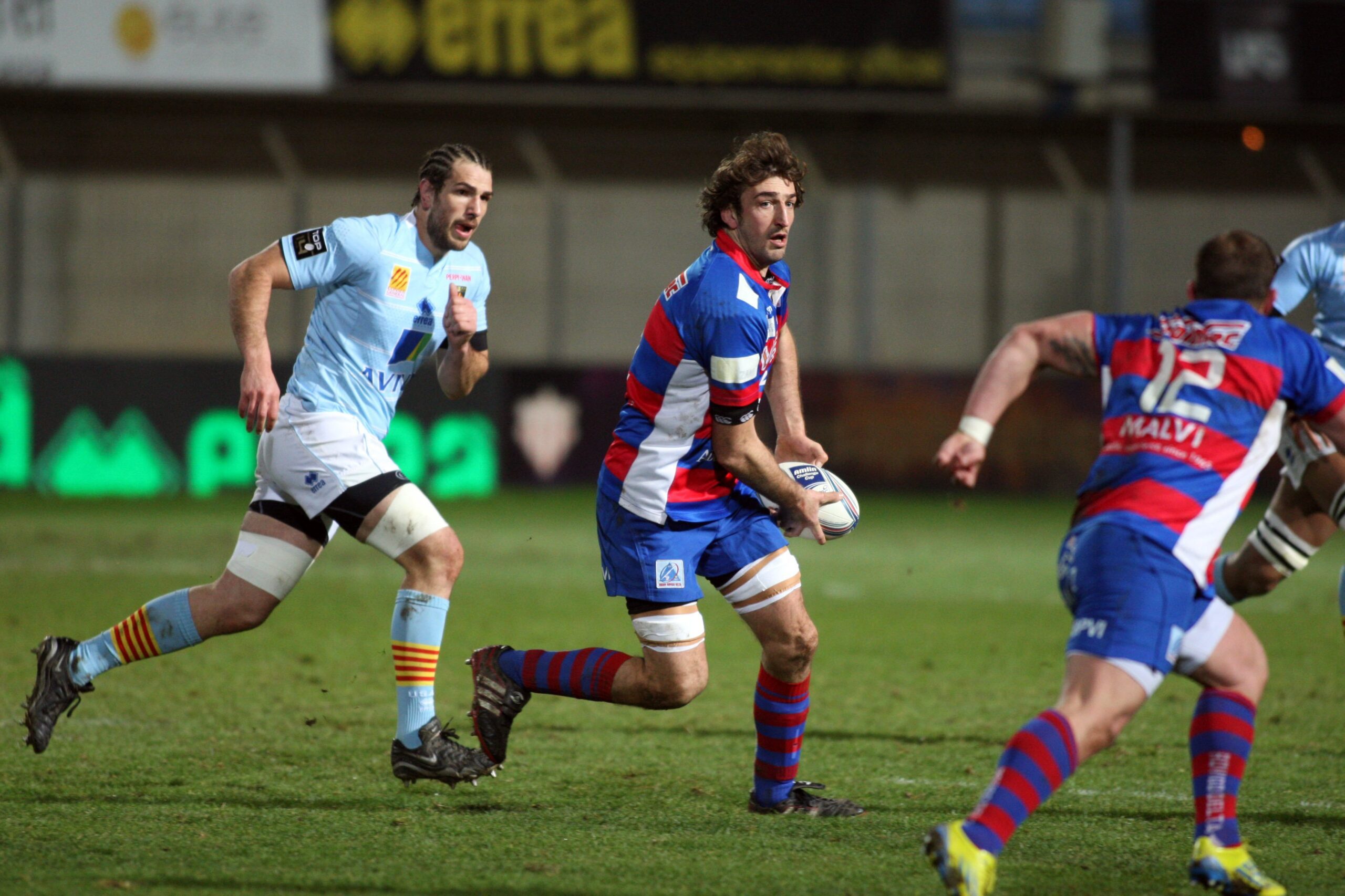
What are you up to now, Jean-François Montauriol? A former Stade Toulousain player and Italy international, Jean-François Montauriol knew professional rugby in France and in Italy before going back to his roots, in the Gers. Now coach at Lombez-Samatan, he measures every week what separates the rugby of professional clubs from that of villages and small towns.
Modern rugby may have gained in speed, in preparation and in spectacle, but he believes certain values (solidarity, passing things on, the bond between generations and the attachment to a territory) remain the cement of the game. In this interview with ItsRugby, the former second row and back rower looks back on his memories, on how he sees the transformations of rugby, and on what country clubs still have to teach today’s players.
You started out at a small club in the Gers before joining Stade Toulousain, then you spent fifteen years in Italy. How did that path come together?
I started rugby at Rieumes (in the Haute-Garonne). Then Stade Toulousain called me. I spent eight years there. My mother was Italian. A French coach, Christian Gajan, was leaving for Italy and asked me whether I fancied an experience out there. Why not? I went, and I stayed a few years in Italy. I played there and I also coached there. Then I came back to France four years ago. I coached at Rieumes, in Fédérale 2. After that I went back to Italy for family reasons.
Then I came back here and coached at Rieumes again. Then Lombez-Samatan contacted me several times during the season. I met the presidents and I liked their plan. It is an ambitious club, with good players and real values. It is also very well organised. My father had played for this club back in the day, with my uncle. It is a club I have always liked. So there is a return to my roots in it too. It is a pleasure to find yourself somewhere with people who have values.
You have known amateur rugby, Stade Toulousain and international rugby. When did you realise rugby could become your job?
At the time, I was young. But when I arrived at the Stade (Toulousain), I discovered the set-up. We started training every day. I was in the academy and we trained more and more. It was a kind of sport-study programme. I was training with the professionals. I played in the Crabos and Reichel age-grade sides, then in the Espoirs. After that they gave me a professional contract. I was completely into it. I told myself I loved it. Rugby has always been a passion for me. Then everything followed on from there. But when you arrive at Stade Toulousain, you quickly realise where you have set foot.
“When you arrive at Stade Toulousain, you quickly realise where you have set foot”
Your time in Italy counted for a lot too…
It was a life experience. Italy was very good as well, at Rovigo, at Treviso. We played the Celtic League, the European Cup. It was a very high level. It was great and, above all, they were clubs that matched my values. They really were family clubs. That side of things matters to me.
When you think back to the young player you were, what surprises you most about the player you then became?
When I was young, I had grown quickly, but I could not really put on weight. I remember Guy Novès telling me I had to get past 110 kilos. At the time I was 95. I thought I would never manage it. In the end I got to 112 kilos. By working at it, training, sometimes more than the others, it was a real satisfaction. I was happy to have reached a certain physical level. (Guy) Novès used to tell me that was what I lacked compared with the others.
At the time, when you are 18 or 20, it is hard because you are told to put on weight, you try, and you do not necessarily get there. By working at it, doing the conditioning, being serious and living properly, I got there. I will say it again, I got there. I would never have thought I would weigh 110 kilos. Even my father told me I would never manage it. In the end, it worked.
“Even my father told me I would never manage it”
Today’s rugby is more powerful, better prepared. Is it also more exciting to play? What do you miss about the rugby of your era?
At professional level, players do nothing else, every day. It is quicker and there is far more training. Conditioning has reached another level. There is more speed, more impact. That is good for the spectacle. In my day, all of that was starting to be put in place. It went a bit slower. Now it has reached another level. Every year the league moves forward. At professional level, conditioning has become the key.
Staffs are bigger and bigger, ten or fifteen people: the lineout specialist, the scrum, the kicking game, defence, attack, a nutritionist, conditioning, mental preparation… Mental preparation has become important, precisely. I studied it on my own account and I realised it really could make the difference in how you approach matches. I also brought in mental coaches for some of the teams I coached at amateur level. It worked well. Sometimes certain phrases, certain psychological aspects, beyond the physical, get inside players’ heads and make them move forward together at a given moment. It is interesting.
“I also brought in mental coaches for some of the teams I coached at amateur level”
You still follow the Top 14. The game seems more attack-minded today. Do you see that too?
Yes. The laws are written to favour attack more and more. They have changed quite a few in that direction. They are after a spectacular game. And that brings in the crowds and the television channels. It is a good thing, it is more enjoyable to watch. At one point we were seeing locked-down matches with low scores. Now we see plenty of tries, and not only from UBB or Toulouse. Defences may well be organised, attacks still find a way through. There are a lot of internationals and big individuals in every side, and that makes the difference. In my own area, which is the lineout, I find it goes quicker as well. I really appreciate the precision, the speed of execution, the throws and the lifts. Every last detail is crucial.
It is like a perfectly oiled clock. To take Stade Toulousain again, where I know Jean Bouilhou, who is very particular about it, I know they work hard at it and that it has become an undeniable launch platform. Even the scrum is built around attack now. The attacking game has also been favoured over the kicking game. The laws have changed. With the 50:22, for instance, you end up with a side able to attack inside the opposition 22. That favours attack again. All of it was done so the game would become more and more spectacular. I think that is a good thing.
“Defences may well be organised, attacks still find a way through”
There is a lot of talk today about development, talent identification and performance. Is there a risk of manufacturing players before giving them time to fall in love with the game?
Yes, I agree with that. In youth selection, people often look at the physique above all. That may be a mistake. Players who are physically very developed at 17 can then hit their ceiling quickly. Whereas thinner, lighter players, but with more instinct and more technical quality, can become very good indeed.
Look at Louis Bielle-Biarrey, he is not two metres tall, he does not weigh a hundred kilos, and yet he is very good, he has a spark. He is something of an exception. It is good for a young player today to see that and think: “I am not tall, I am not big, but I am quick. I can do it too.” That matters.
“Thinner, lighter players, but with more instinct and more technical quality, can become very good indeed”
You are also seeing Italy produce important new players…
Indeed, the Italian clubs have been playing in the Celtic League for some years now. They no longer play the Italian championship, they face Irish, Scottish or Welsh sides every weekend. That allows players to progress. When you go to Leinster, Glasgow or Munster, those really are high-level matches. And gems come through at the same time. There was Parisse, Perugini, Castrogiovanni, Ongaro… There were players who took off elsewhere, at Treviso or in France, and pulled the Italy side upwards. The latest is Tommaso Menoncello, at Toulouse, who has extraordinary quality…
You are now at Lombez-Samatan. What does a player still learn at a small club that he will never learn in a big academy?
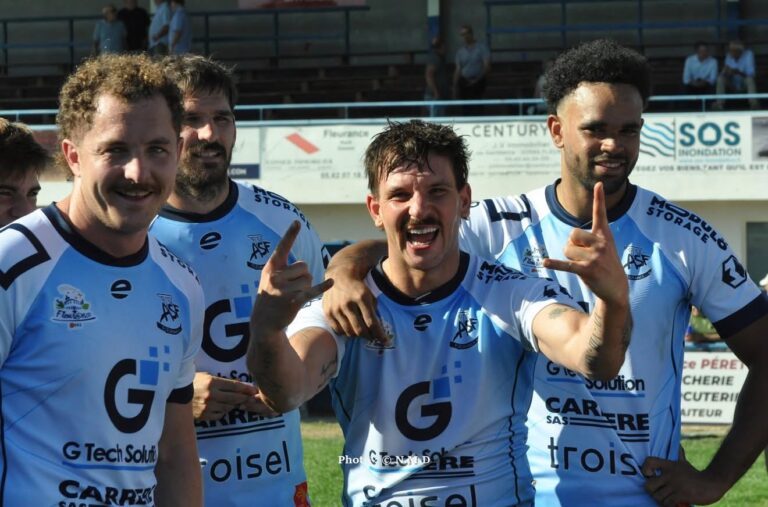
Contact with the volunteers. Here at Lombez-Samatan there are the grandads, the grandmas, the people who are around all the time. They cook us a meal after every training session. They watch us, they are happy, they always have a word for you. The club runs eleven bingo nights a year. That is huge in keeping the club going. It is lots of small things. There are grandads who carry our shirts, the water, who are always ready to listen. All those small details count. We eat together. It is very much a family.
“Here at Lombez-Samatan there are the grandads, the grandmas, the people who are around all the time. They cook us a meal after every training session. They watch us, they are happy, they always have a word for you”
At a professional club, inevitably, there is not much of that, because it is a bit of a company. There is less contact with the volunteers or the committee. It is more professional, more structured, inevitably too because there is training every day, morning and evening. It is another dimension. At these small clubs, in Fédérale 2, that is what makes them strong: wanting to come to training, coming with pleasure, seeing people who say to you: “All right? If you need anything, you have got everything you need. ” That is what makes the difference.
Has French rugby lost something by moving away from its villages, its small towns and its amateur clubs?
Attitudes have changed a bit. In my day there were none of these social networks. Back then there were no mobile phones. And yet we were more human, more connected to each other. I remember that when I finished playing and came back into the changing room, a lot of us would talk to each other. Today plenty of lads are on their phones. Back then we talked to each other. We created a changing-room atmosphere.
Now the mentality of the young players coming through has changed a little with all these social networks, which do not bring only good things. It is up to us, the coaches, to do something. For example, during rugby camps, I ask the players to leave their phones. We take a bag and we stay together for two days. Apart from those who have children or an emergency… it is not the end of the world to be without your phone. The idea is to talk, to get to know each other better, to bring the new lads in and to work on the mentality of the group.
“Today plenty of lads are on their phones. Back then we talked to each other. We created a changing-room atmosphere”
On the subject of phones, they are being banned in schools, but do they not also have an impact in the changing rooms of any sport? How do you see the place of the phone in teams today?
I think being on your phone too often pollutes the atmosphere a bit. We do not necessarily talk about it in sport, but it may be a real issue. I think certain slots should be set aside for phone use.
Is rugby, in the end, a reflection of some of society’s ills?
Yes, a little. There are fewer values, or at least they are unfortunately being lost. There is less humility towards the club’s efforts or towards performances on the pitch. You often have to pull certain players back into line. To tell them: “Just because you had a good match does not make you world champion. Stay humble, you have not won anything yet. ” In my day there was less of it. Now there is a bit more. Perhaps it is simply the way society is going.
You now have players aged 20 to 35. Does the mix of generations remain important?
Yes. That is what is good about it. There is the young lad starting out, the one who already has children, the one who has his house. That mix is important. In a rugby team, it is a bit of an education. The older ones pass things on to the younger ones. That is what is good about a team too. If we lose that, we lose rugby.
“The older ones pass things on to the younger ones. That is what is good about a team too. If we lose that, we lose rugby”
If you were fifteen today and starting rugby at a small club, would you still want to make it your life?
Yes, I would still want to do it, because rugby is the school of life. It really is about people. Whatever your build, you can play rugby. I still run into lads I played with twenty or ten years ago and, when we see each other, we are delighted. We go back over what we lived through: the matches, the moments when we suffered together, the wins, the defeats, the unforgettable moments.
When you push in a scrum, when you play big matches, big away trips, when you win an important away game, when you were under pressure, when you were nervous, when you nearly lost but won… Those things stay with you for life. For some of those lads, for that alone, for the bond we created, I would do it all again. Absolutely all of it.
What will today’s player probably never know of your rugby?
In our day we were more united, together more often. As there was none of what phones offer today, we had to create our own atmosphere among ourselves. We did simple things. We were happy to go and eat something together without measuring ourselves on a phone, on websites or on social media.
“We did simple things. We were happy to go and eat something together without measuring ourselves on a phone, on websites or on social media”
We took photos, videos, selfies, but it was still simpler. My father says the same thing about his era. There is always a twenty-year gap. I have children too, one of them twelve, and it will be the same. It is a bit of a shame, but it is also how time and customs move on. You have to live with your era.
Do you think rugby could be in danger with this evolution?
Yes, a little. Sometimes what goes on on websites and social media is a bit of an illusion. It is up to managers and coaches to preserve the values, the group’s focus, and to remind everyone of the essence of this sport. Young players also have to be warned.
And deep down, what does Lombez-Samatan give you that professional rugby no longer gave you?
It is much healthier. You can talk freely about anything. It is healthier. I do not know how else to put it, but it is much healthier. The values of our sport are perhaps more marked here. Or at least they show in a different way. There is less pressure, of course, far less at stake. But on another level, we still want to do things together and to respect this club for its history.
“Here, these are the club’s lads, the local lads. They live here. They have more of that bond with the territory”
There have always been big players at clubs like this one. But there are also a lot of farmers, builders and tradesmen in these sides. I try to remind them of brotherhood, of fighting together, of defending the territory together. And among the professionals, that exists less. Here, these are the club’s lads, the local lads. They live here. They have more of that bond with the territory. At a professional club, the players are not necessarily the ones who live in the town where they play.
You have known the biggest clubs. Now here you are at Lombez-Samatan. Is this, in the end, a return to your roots?
Yes, a little. A return to my roots, that is exactly it. The circle is complete. I will say it again, I insist, it is a pleasure to find yourself somewhere with people who share the same values, who are heading in the same direction. I feel in the right place.
Read also: our report from Lombez-Samatan, two towns, two pitches and a single club
Comments