
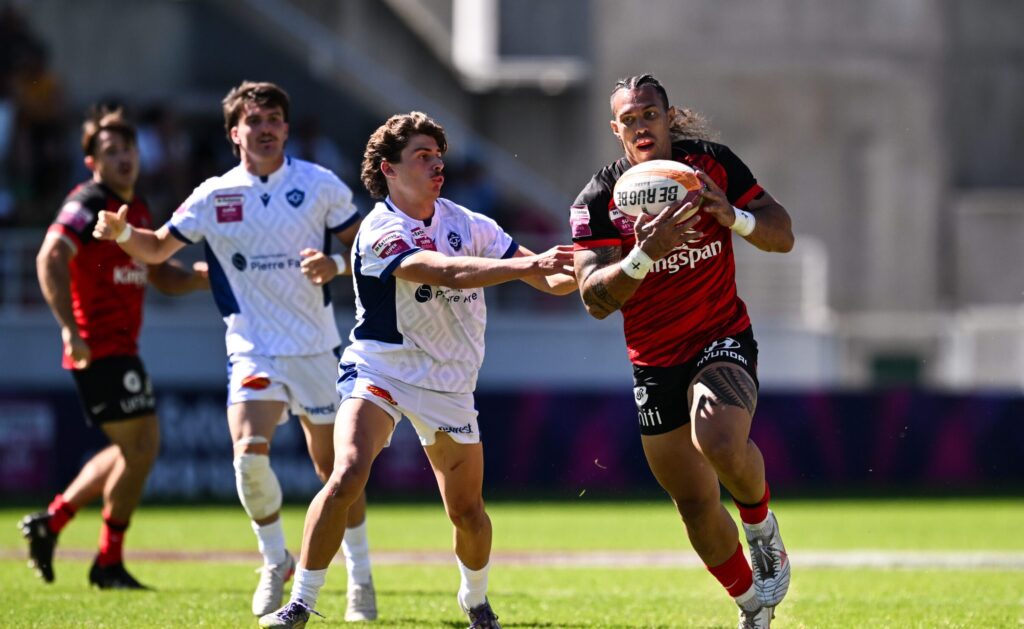
Four years after his last professional match, Teiva Jacquelain is still out of the spotlight. A product of Toulon, who went on to play for Grenoble, Bayonne and Mont-de-Marsan, the 32-year-old wing has been through a long period of doubt and anxiety. Now “stronger than ever”, the powerful back has an unmistakable “hunger for revenge”.
Pushed out by Bayonne for reasons he says he still does not know, then struck down by a very serious injury, the Tahiti native has never given up. He keeps working on his fitness and still handles a ball, but his phone has stopped ringing. Toulon gave him some visibility again during several legs of the Superseven. Jacquelain has only one goal left: getting back to the top level in fifteens. Will he make it? The player wants to believe so.
For It’s Rugby, the wing looks back on his long spell in the wilderness, the strength he draws from his faith, his restorative trip to Fiji (with an incredible story) and above all his promise to give everything to the club that puts its faith in him. Interview.
IT’S RUGBY. – Teiva, what are you up to these days?
Teiva Jacquelain: I’m doing well. I played in the Superseven with Toulon to get some visibility and show clubs that I’m alive and in good shape. I’m also getting some game time around Toulon, at La Valette. Honestly, I don’t enjoy it much, because it’s not my level. Sometimes I feel like I’m shutting myself away there. But it’s a way to get my hands on the ball and keep some rhythm. Most of my work, I do elsewhere. I do a lot of strength and conditioning and I also do athletics, a sport I’d already done before turning professional. It helps me get the feel back, the top-speed bursts. I keep my workload as high as it would be at a club, so I can live up to my ambitions. If a club calls me tomorrow, I don’t want to be caught out by the workload or the fatigue.
Bayonne, from the Pro D2 title to the break-up
Your last club was Bayonne. How did you end up there?
Yannick Bru brought me in. The plan was to go up to the Top 14 and we did it. We were champions, a year after losing to Biarritz in the promotion play-off. We had a score to settle. The relegation of BO was still very much felt in the town and at the club, almost like a bereavement. We had set ourselves very high goals and a very heavy workload, and we achieved them. Unfortunately, Yannick Bru no longer got on with the president and he left.
How did it go when the new coaches arrived?
From the start, I felt something wasn’t right. In the few meetings I had with the new coaches, Grégory Patat and Gerard Fraser, I found that what they were telling me didn’t add up. I could feel it wasn’t going my way. I was lucky because there were injuries in my position and I got to start the season. I was happy to get going, especially as the first match was in Toulon, a special club for me. I had a good start to the season. I often say it was my best season since turning professional. That doesn’t mean I had worked harder or was better prepared, but everything clicked for me and the bounces went my way.
And then?
We had just won at home, at Jean-Dauger. Patat asks me to come to his office. Walking behind him, I’m thinking it’s going to be good news. I was out of contract, my performances spoke for themselves, there was no reason for them to tell me anything else. Once in the office, he tells me I don’t fit into the game plan. I really didn’t see it coming. When you’re bad on the pitch, you know it. You don’t need a coach, the media or the fans to tell you. You put your head down, you tell yourself you’re the one who got something wrong, and you tell yourself you’ll bounce back. This wasn’t like that. It really hit me hard, especially as the reasoning was vague, and it wasn’t true. I had done good things in the weeks before that announcement. I found it hard to accept that something I thought I deserved was taken away from me overnight. A decision like that affects your whole life: you have to move house, it hits your goals, your career. You’ve found a club where you feel good, where you’re thriving, and you have to leave, just because someone decided so. If they had really judged what I deserved, it would have gone differently.
The knee injury and the two cyclops lesions
Then came an injury…
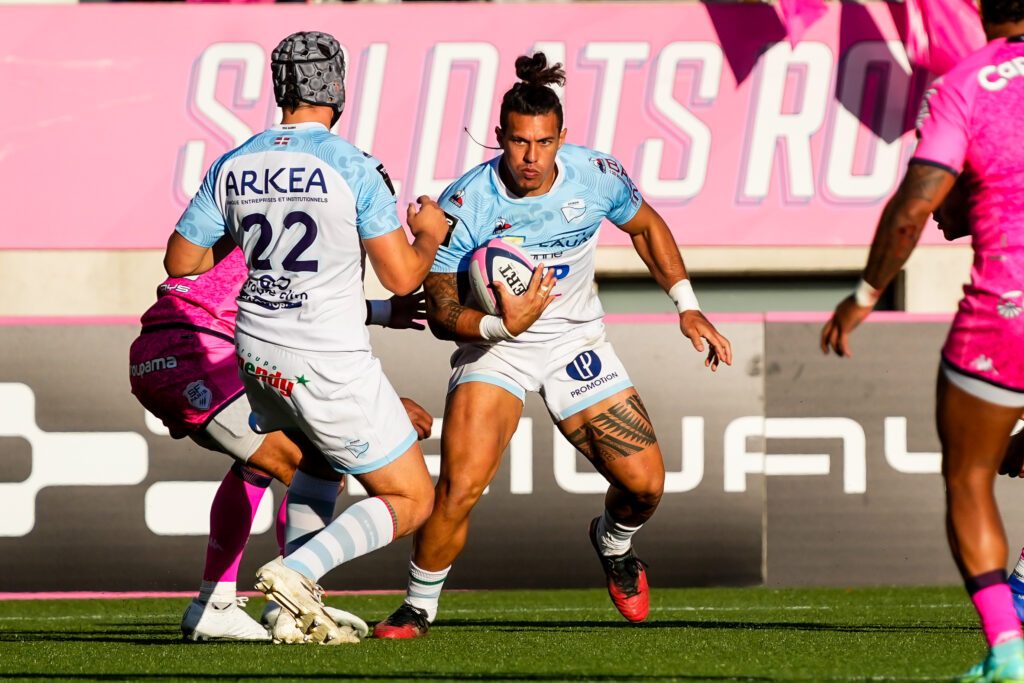
We were playing the Scarlets. I think my body followed my head. I remember the warm-up. I was feeling pretty good, I was giving it everything, I didn’t want all that to get to me. And I hurt my knee. The consequences were serious. A long-term injury when I was out of contract. What club is going to come for you if you’re injured, and pay you for a season without playing? Without knowing what medical follow-up I would get, I handed back the car and packed my bags. I wondered where I was going, what I was going to do. My partner was pregnant at the time. Even the birth wasn’t a calm experience. It was hard. We went back to Tahiti and I tried to treat myself on my own, with no professional set-up, no physio, no conditioning coach. That’s already hard in those circumstances, so this was even harder. I became a dad, which was another source of stress.
Once you’d recovered, nobody came for you?
No. Even my agent at the time, who I had messaged to test the water, replied: “Oh, you want to come back to mainland France?” When I had never said I wanted to end my career. It’s sad to finish like that, after everything I’ve been through and sacrificed.
Your rehab on your own was complicated…
During that period, I developed two cyclops lesions. It’s a ball of fibrous tissue that forms in the knee as it heals, and it stops you progressing in your rehab, from getting past 50% of your capacity. At the time, I didn’t know that. It was picked up late, simply because I had plateaued. The surgeons and physios never really managed to explain where it came from. I was told it’s common in judokas or some athletes, that it’s either because you work too much or not enough. That’s how I gradually disappeared. I was on work injury leave for quite a long time. My injury, which should have lasted eight months, lasted a year, a year and a half, because of the two cyclops lesions. They’re small operations, but they’re still operations, and they delay your return. And as I was no longer at a club, I was handling my appointments and my rehab on my own.
At Bayonne, they tried to bury me. Some people there will know who they are
Going back to Bayonne, what were your coaches telling you?
Grégory Patat didn’t say much in video sessions, it was mostly Fraser who talked. But one-on-one, he might tell me, for example, that I wasn’t playing at the weekend because so-and-so was ahead of me. He talked in particular about the arrival of a young player, Victor Hannoun, who at the time hadn’t played a single professional match. He often tried to break me like that. I told myself he was wrong and I stayed positive. But when you no longer have your coach’s backing, you end up spinning your wheels. Fraser compared my performances and goals to Cheslin Kolbe’s. And I have a completely different profile. He did it when he was going through tactical patterns. At Bayonne, they tried to bury me. Some people there will know who they are. I gave a lot to that club. I deserved better. I was one of those who restored Bayonne’s pride after the defeat to Biarritz, which had hurt the whole town. We went back up to the Top 14, the goal was achieved.
And almost everyone who got the club promoted was shown the door. For what I had given, I deserved a one-year extension. I could have taken a pay cut. If the club didn’t need me as a starter, I would have understood and not made a fuss, but they might have needed to rotate the team, in the Challenge Cup for example. I find that sad. I don’t even have a keepsake jersey from my time in the Top 14. I want to say that there was one coach at Bayonne who came to see me every week to tell me what he was hearing about me. He helped me stay beyond reproach during the week and at weekends. He knew what was being plotted around me was unfair. He helped me. I was a seed that kept growing all that time, even if you couldn’t see it. Today my roots are solid, they’re huge. I really want to prove people wrong, I’m hungry for success. I’m not worn down by these past years, unlike some players my age who are tired. I’m fresh. And I think my style of play is a profile clubs look for.
France Sevens and the Olympic dream
You were also aiming for selection with France Sevens. Where were you with that?
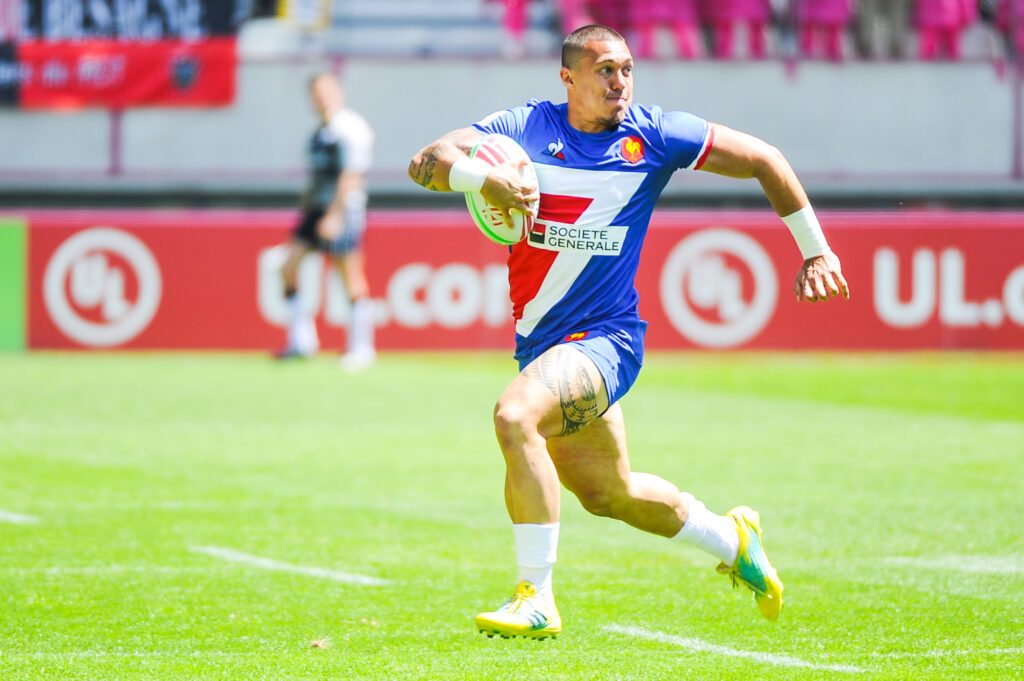
I was on the list for the last Olympic Games, and it meant a lot to me. I had played for France Sevens alongside my fifteens career, and I was called up every year. Unfortunately, the team didn’t qualify at the repechage tournament for the Tokyo Olympics. I was still on the list at that point, and since the coaches knew me well and I had a profile they didn’t have, I knew I had a chance if I kept going to camps and warm-up matches. Sadly, I didn’t manage to get back on board.
How did you end up coming back to France?
Sacha Valleau got in touch. We had played together for France Sevens and he had ended his career at Vannes to coach their sevens team, at the time the club was going up to the Top 14. He was entering a team in the Superseven. They had qualified for the final and called me to take part. That’s how I came back. Unfortunately, that’s when my second cyclops lesion was detected. The first one had been operated on and rehabbed in Tahiti. This one was found after the tournament, because it was bothering me. I played anyway, not at my best, without knowing. Scans followed, and I had another operation, with rehab at the CERS.
The Superseven with Toulon, a first step towards a comeback
Last summer, you played Superseven after Superseven. How did that come about?
Toulon called me to play the Superseven with them, across all three legs. Today, I see it as a bit of a mistake. When the coach called me, I told him I had only just come out of the CERS, that I hadn’t finished my rehab, that I hadn’t ticked off everything I needed to, that it was a bit early. He reassured me, saying that at least it would show clubs I was alive, that he would manage my game time, that there were unlimited substitutions and that everything would be fine. I listened to him, but looking back, I may have given a bad impression of myself, when he wasn’t even my coach. I have a few regrets about that.
All I'm asking is for someone to give me a chance, to let me come in on trial for a week or two days, and to see that all the lights are green
What Teiva Jacquelain wants from a club today
You said you were hungry for revenge. In concrete terms, what are you looking for from a club today?
I won’t cost much. My situation means I won’t have much say in the negotiations, so it’s all upside for the club that takes me on. All I’m asking is for someone to give me a chance, to let me come in on trial for a week or two days, and to see that all the lights are green. If after that they don’t want to put their trust in me, that’s no problem, but at least they’ll have seen that I’m ready to go.
Would you be ready to join an ambitious Nationale club, for example?
I’d think about it, for sure. I’ve been out of the game for four years now… So my next decision is crucial, and that’s why I’m being particularly demanding in my search. A Nationale club near the top of the table, with a plan to go up and the means to do it, that deserves serious thought. Throughout my career, I’ve seen players arrive as medical jokers at the clubs I played for. I’m still hopeful. The lift took me very low, but I know it can take me back very high. If a club opens the door, I’ll prove myself. For now, I’m looking more for a club in Pro D2 or even the Top 14.
How have you handled money during all this time without a club?
I haven’t splashed out, except on my kids. I have two little ones, a 3-year-old girl and a 10-month-old boy. I buy myself boots, we do the shopping, and that’s it. What helped me was being paid, even partially, while I was on work injury leave. Today I’m on unemployment benefit but that runs out in December. If I haven’t found something by then, it’s going to get harder for me. But it’s a choice I made, so I have no regrets. If I end my career, I’ll turn the page with a lighter heart, knowing I gave everything, without telling myself I should have gone further.
Have you approached clubs directly yourself?
Yes, I do it with the ones I have contacts at. For example, I did it with Yannick Bru, telling him I would come even without playing, just to be part of a group or train for a few weeks. But then he has the best wings in the world in his team (laughs). Even joining an environment I know, with a work ethic that suits me, would be fine by me, even without playing. I had also tried, by message, to make Patat understand my situation, even though it’s largely down to him and Fraser. He didn’t even look for a solution and he didn’t try to help me either.
I’ve reached a stability, a self-belief, a confidence I maybe didn’t have before. Of course, there will be a bit of match rhythm to get back. Even if I work very hard, there’s always rhythm to regain. But apart from that, I have experience. I’ve been a champion, I’ve been through relegation battles, I’ve played very big matches for France Sevens, in the Top 14 and in Pro D2. I have a mix of experience and freshness. And above all, with so much to prove on so many fronts, I feel strong and ready. That’s all I’m waiting for. For someone to tell me “We need a guy like you, you’ll bring us something”. And that helping hand, that trust someone gives me, I’ll repay a hundred times over.
Fiji, faith and a sign from fate
You also went to Fiji to rebuild yourself. What happened there?
Yes, it was a great adventure. I’ve been through so many things in my life, good and not so good, that I feel like I could write a book (laughs). When I was in Tahiti, I did a bit of coaching at my club and with young players. Then a coach from France, Franck Boivert, came over with two Fijian players, and one of them recognised me. Over there, a professional rugby player is almost a hero, a Superman. I explained my situation to him and he told me about Fiji and its best-known story: that of All Black Waisake Naholo, who recovered in record time just before the 2015 Rugby World Cup. There are lots of stories of players who healed like that, him included. Every time we saw each other, he reminded me. When he left, I took the first ticket, and a week later I was in Fiji, staying at his home.
It was funny to connect the image I had of them as a professional player with what I saw there. I often wondered how they always take things so well and keep smiling. Once I was there, I understood, and I want to get to know them even more, because they don’t really have much. It’s a poor country and their only way out is rugby. Just having a pair of boots is already a lot for them. And yet they gave me everything. I went to church with them and the priest prayed for my recovery, with his wife. They told me they had already felt this in people they had seen heal. They told me I would play again, get my career back, that it would be OK. At the time, I didn’t feel anything special but I was happy to hear it, it warmed my heart.
So my comeback happened on a pitch I know well, alongside the son of the man who had prayed for me. That day, I saw it as a sign
That story had an unexpected sequel, didn’t it?
I didn’t know it yet at the time but I already had my cyclops lesions. About a year after my trip to Fiji, I was called up for the Superseven with Toulon. On the Thursday, a day before leaving for the tournament leg, a Fijian player arrived at training to bolster the squad. He was the son of the pastor who had prayed for me in Fiji, on the other side of the world. So my comeback happened on a pitch I know well, alongside the son of the man who had prayed for me. That day, I saw it as a sign.
Did your faith and your belief in God also help you a lot through this difficult stage of your career?
Completely. You hit rock bottom so hard that you don’t understand why. You tell yourself: “But I’m not a bad guy, why is this happening?” Like we said earlier, your phone stops ringing, you’re left to fend for yourself. And in the end, the only one holding out a hand and waiting for you to take it is the Lord. When I understood that and reached out in return, my life started to change. And that’s the biggest positive in this whole story. I was already a believer, but a bit like everyone else. Not really practising. It completely changed my life.
And have you ever thought about giving up rugby?
I won’t hide it, after what happened at Bayonne, I was sickened. I was fed up. I told my partner: “I’m going to stop. I’m fed up with giving so much for so little and sacrificing my body for nothing in return.” I would at least have liked some recognition or support. But little by little I got my fire back. And when I held my daughter in my arms, it gave me some motivation back. Rugby is pretty much my whole life. It allowed me to become someone, to make something of my life, which was hard when I was younger. And knowing I’ve never played in front of her, and now in front of my son too, I tell myself I can’t stop on a failure. After what they did to me at Bayonne, I can’t stop like this and have that taste in my mouth for the rest of my life. Or hear my kids say: “Dad, rugby was his whole life”, when they’ve never seen me on a pitch. I want to come back and I’ll fight for it.
Comments