
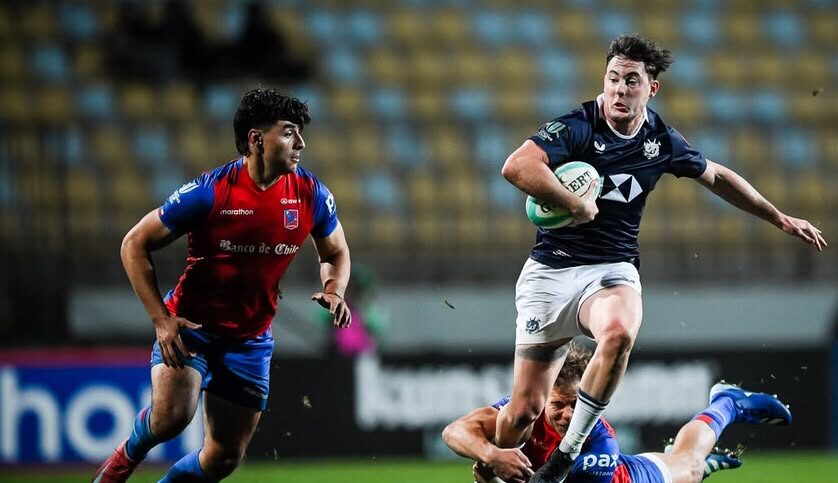
Born in Thailand, raised in Hong Kong, with spells at Bath, Clermont, Dijon then Chambéry, Paul Altier has taken a path unlike anyone else’s. A little over a year out from the World Cup in Australia, the full-back and fly-half looks back on a South American tour full of lessons, on the rise of Hong Kong rugby and on a life spread across several continents. Interview.
IT’S RUGBY. – Now that the Nations Cup is over, what do your next few weeks look like ?
Paul Altier: We’ve just finished a month on tour in South America, with the three Nations Cup matches. We’ve now got a month off before pre-season starts in Hong Kong, where I’ve been based for almost two months. We’ll all come back together, meaning every player contracted to the Federation.
So you’re not attached to a club?
No, the Federation decided not to have us play club rugby. That way they can control every minute we play. Instead we’ll play warm-up matches against teams from the region, like Japan or Australia “B” sides, for example.
What’s your assessment of this Nations Cup, personally and for Hong Kong?
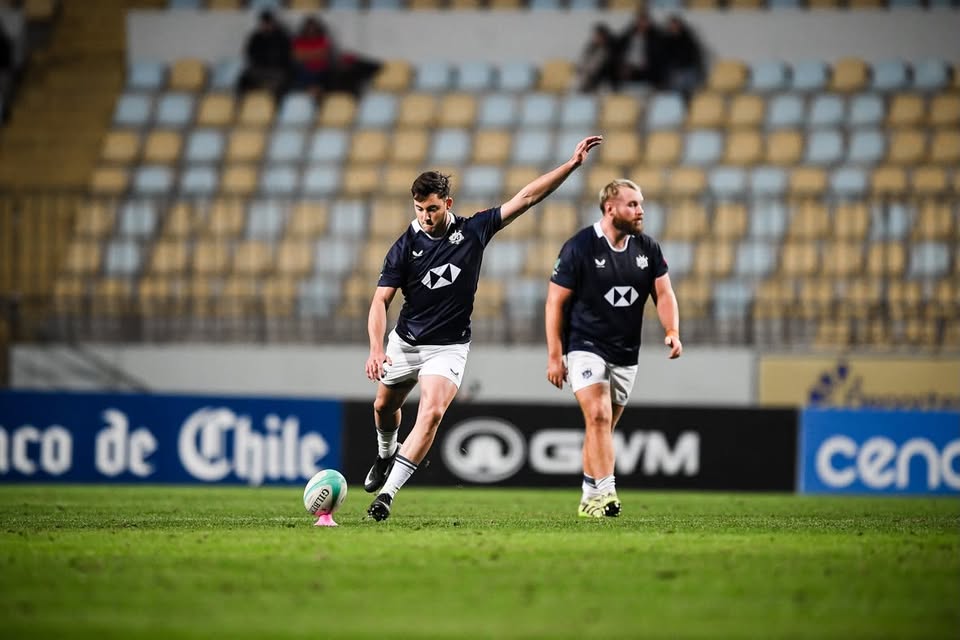
As a group we wanted one win before the competition started. We didn’t expect to beat the best of the three! Even so, we were very disappointed with our first test against Samoa. We never turned up, and defensively we were well short. The second match, against Chile, was much the same story, but that time it was discipline, with a stack of cards. We were very disappointed, all the more so because Chile will be one of our opponents at the World Cup next year. Against Uruguay, though, we put in a far more complete performance. We stayed in touch all game before winning it in the closing stages. Personally, I’m delighted. I played three straight 80 minutes, at full-back for the first two matches, my favourite position. Normally I’m not the goal-kicker, but our usual fly-half was injured. I took the role on and it went pretty well. Against Uruguay it even made the difference. I’m very happy with my tour.
We imagine the win over Uruguay led to a proper celebration…
Yes, definitely! On top of that we only left the following day, late in the evening, so we had time to recover properly after Saturday night. It was all the sweeter because we’d been on tour for a very long time, almost a month, with a week in New Zealand then three weeks in South America. It was good to let go together, with nothing getting out of hand. A great night.
How do you view the way Hong Kong rugby is developing?
I think the group is improving. The players have been training full time with the Federation for a little over a year. Before that we lived in a semi-professional set-up: players worked during the day and trained in the evening, or in the morning. I never went through that myself because I was in France. I was playing in Nationale and travelling back and forth to play for the national team. There were six or seven of us in that situation. Today, the fact that we’re all together, training every day, is a real strength. I think our game is getting better and I believe it will be an advantage at the World Cup, because the other teams don’t come together very long before matches. Samoa, for example, had only been together two weeks before they played us. It’s a huge advantage for us, and we absolutely have to make it count.
Speaking of the World Cup, does it feel real yet that you’re going to play in one?
Bit by bit, yes. For two years we knew the team that won the Asian championship would qualify directly. As soon as we heard that, we knew we had a huge opportunity to take, especially as we’ve won that championship seven times in a row since Japan stopped taking part. We did what we had to do to qualify. Now we’re right in it. We train together every day, we’re already going through video of our World Cup opponents. It’s getting more and more real.
I don't want to disrespect our forwards, but we all know we'll never be the biggest team. We build our game more on speed and moving the ball
More broadly, as someone who knows the context well, where do you think Asian rugby needs to improve most?
What we’ve lacked over the last five years is the level of the opposition we faced. We’d played very few matches against teams in the world’s top 20. Since we qualified and took part in this Nations Cup, the matches we play are genuinely going to serve as an apprenticeship. That’s one area, for sure. Then I’d say physical size. I don’t want to disrespect our forwards, but we all know we’ll never be the biggest team (laughs). We build our game more on speed and moving the ball. That said, since we turned professional the forwards have done a huge amount of work on the scrum and on close-quarter play. They’ve really improved.
Can you go back over your personal and sporting path, which is easy to call unusual?
Yes, I’ve had a very different journey to the ones you see in France (smiles). I was born in Thailand, then moved very quickly to Hong Kong, where I spent almost my whole life growing up. My father worked for Bouygues Travaux Publics and had been posted to Thailand and then Hong Kong. That’s where I started rugby, at the age of 7, at the Valley Fort rugby school. I then went through every level with the national team, from under-14s to under-20s, before moving up to the seniors. At the time there was an under-20 tournament called the Junior World Trophy, which no longer exists. It was my third year in that competition when an agent spotted me. We stayed in touch while I went to university in England. Just before that I’d done a month’s trial at Clermont, with the academy, which didn’t lead anywhere. That’s why I went to the University of Bath, in England, where I spent two years.
With Covid, I went back to Hong Kong, where at the time there was a full-time fifteen-a-side set-up with the Federation. But Covid stopped everything and I had to find somewhere to land. I joined Stade Dijonnais, thanks to the agent who had spotted me in Hong Kong. I’d signed there for one year plus one, but we finished bottom in the first season. They offered me an extension, but I preferred to be released from my contract so I stayed available for the national team. That year in Dijon helped me enormously, because I played 21 matches as a starter.
I then went to Chambéry, where I arrived injured for my first season. In the second year we qualified for the play-offs, but lost to Carcassonne. In my third and final season there we lost in the final to Carcassonne again, by a single point. At that point I wanted to go back to London to be with my girlfriend and sort out hip problems. I put rugby on hold for six to nine months, then finished the season with Richmond, a second-division English side, not professional at all. I played six matches with them at the end of the season, before signing with Hong Kong through to the World Cup.
Sevens is huge in Hong Kong, so how do you end up in the fifteen-a-side game?
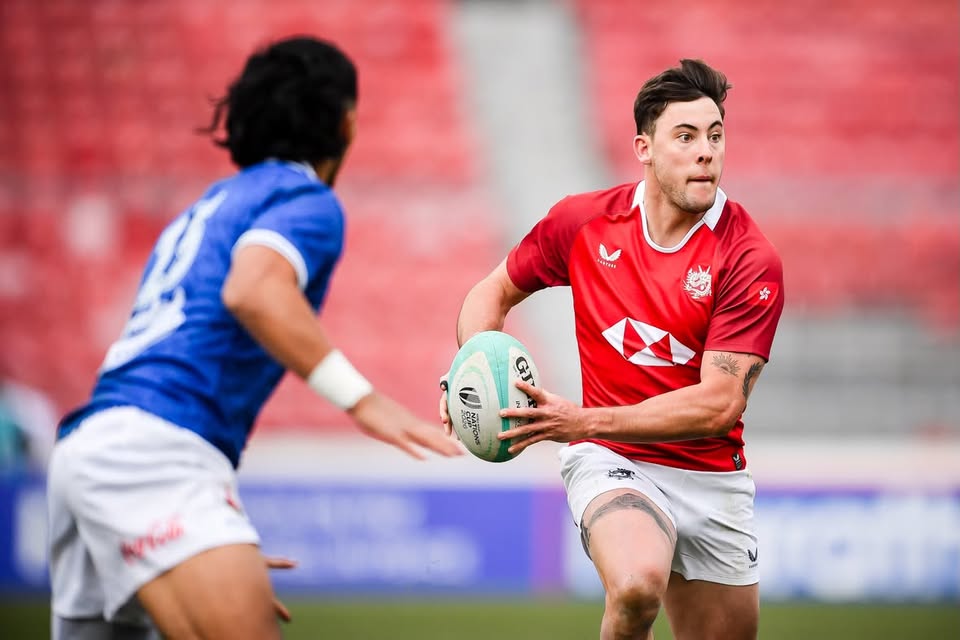
It’s true that sevens takes up an enormous amount of space there, with the tournament held every year. For my part, I did both with Hong Kong. I first spent a year with the sevens team, during my gap year straight after school, but it didn’t really work out. They then sent me to the fifteen-a-side team, and that’s where I played my first international, against South Korea. After that I threw myself into fifteens, partly because I knew I’d be going abroad. To play sevens for Hong Kong you have to be based there, whereas in the XV I could build my career elsewhere and come back whenever I was selected. That’s a big part of why I chose that route.
You mentioned Dijon and Chambéry: is there a memory from France that stands out?
My best memory is my second league match, against Angoulême, who had just come down from Pro D2. We managed to win away there. That’s the finest memory I keep from that period, despite the relegation we ended up suffering. Then at Chambéry there are the derbies against Bourgoin, which mostly went our way over my three seasons there. There’s also that play-off semi-final against Rouen, at home, where I started and we won. And then, even though it was a defeat, there’s the final against Carcassonne, played in Narbonne in front of 8,000 people. It’s a good memory even if I knew it would be my last year at Chambéry, unless we went up and I was offered a contract. As we lost the final, we played the promotion match against Aurillac, which we lost heavily. It had always been my dream to play a Pro D2 match, and it turns out that one officially counts as one. I even scored a try (smiles).
Despite my French nationality and the fact that both my parents are French, I never played in France during my academy years. So I'm classed as non-JIFF, which makes things a bit more complicated
Do you think playing a World Cup could open doors, maybe one day in Pro D2 or even higher?
Playing the World Cup will definitely put us more in the spotlight. I know it’s still complicated. Despite my French nationality and the fact that both my parents are French, I never played in France during my academy years. So I’m classed as non-JIFF, meaning I didn’t come through the French development pathway, which makes things a bit more complicated. But first of all I have to be selected for this World Cup, play well there, and then we’ll see whether any clubs are interested. For now the door is closing slightly in France. I’m staying focused on Hong Kong and I’m not looking too far ahead for the moment.
You’ve lived in quite a few cities and countries: is there a life, a culture you preferred, or that you prefer today?
I lived there for twenty years, so Hong Kong is especially close to my heart. I spent my whole childhood there, I still have plenty of friends there and that’s where I met my girlfriend. Outside Hong Kong, I’d name Chambéry and the Savoie region, which will stay with me a long time too. I loved the mountains around it, and Lac du Bourget just next to Chambéry. I spent three very good years there.
Comments