
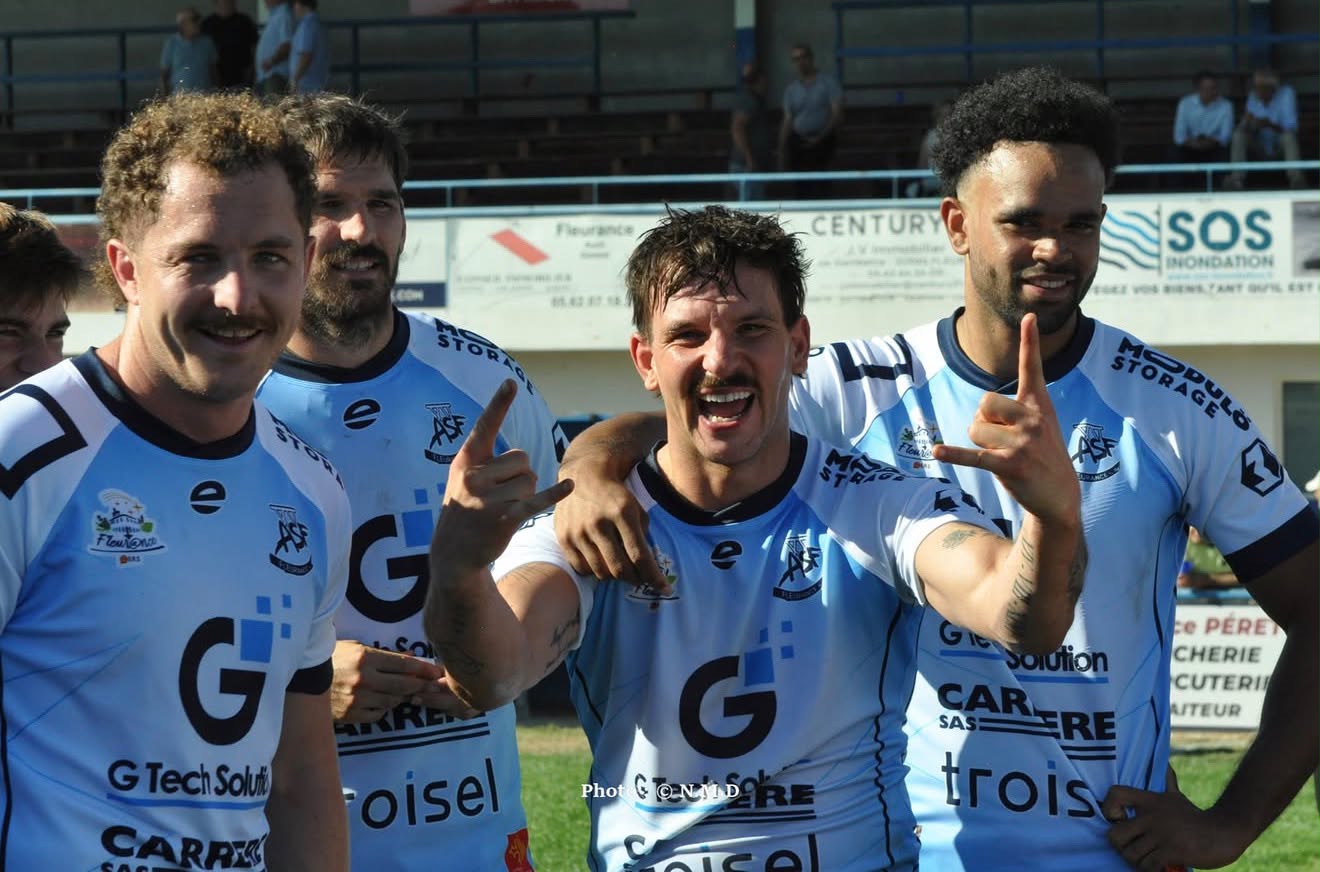
He came for two years. He is now starting his sixth season. At Fleurance (Nationale 2), Axel Ducellier has “fallen in love” with the club, after knowing only two professional sides before that: Soyaux-Angoulême and Dijon. The full-back gave It’s Rugby a long interview about what his club stands for, about being “the sort who gets stressed before matches“, and about his passion for cooking. A straight-talking interview well worth your time.
IT’S RUGBY. – Axel, how did the weekend go for Fleurance?
Axel Ducellier: Really well. It was the third match in a block of three. We had put in a big performance at home against Peyrehorade. Then the lads went to Saint-Jean-de-Luz and pushed them close away from home. We lost, unfortunately, but we still delivered a good first half. And then we were hosting Nîmes, one of the heavyweights in the pool. We played a great match and came away with a fine win.
Fleurance, an amateur club that is “very human”
What is the players’ status at Fleurance?
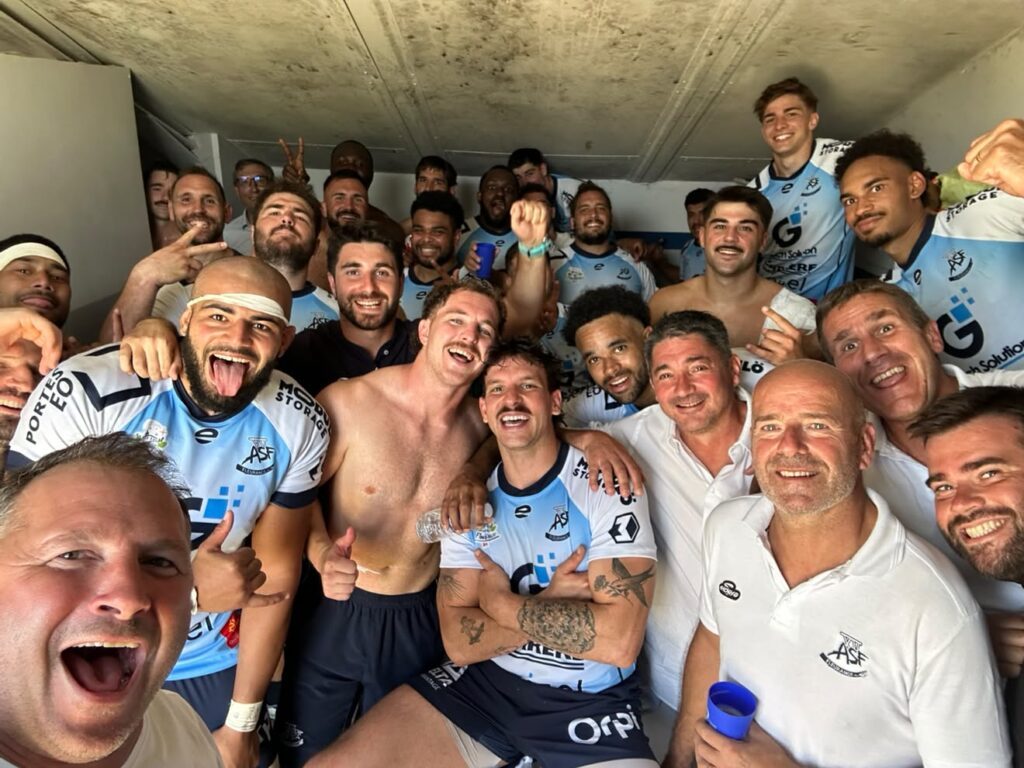
We all work alongside rugby. There are no professional contracts. Above all we are a bunch of mates. There has still been plenty of turnover since I arrived, six years ago now. Not many of the players who were here when I came are still around, and they are starting to get old (laughs). But the ones coming in have the same mindset as us, the old guard. It is a very human club. The volunteers are everywhere and they do a lot for us. We also have great coaches, who put people first too. Everyone gets on well, even when you play in the same position. The competition is very healthy. We all want to play, obviously, because we are competitors, but it stays healthy. The atmosphere is great.
When I first dropped my bags here, I thought: 'Right, where have I landed?', because it is a bit out of the way
You are starting your sixth year at Fleurance. You are part of the furniture now… Is that a sign of loyalty, or even love for this club?
Honestly, yes. I came to Fleurance from Dijon, after a spell at Angoulême. I had not moved around much. When I first dropped my bags here, I thought: “Right, where have I landed?”, because it is a bit out of the way (smiles). I fell in love with this club. It is magic here. You come out of working days that can be draining. You can be shattered and you can really not fancy training. But in the end you tell yourself: “Go on, you are going to have a good time with your mates”, even if we have to be very serious about it. You know you are going to enjoy yourself. The people around the club are brilliant, the weekends, the supporters, the committee… It is great. It really is a wonderful club.
From Dijon to Fleurance, a dual career that worked
Did the move also come at the right time? Things had been complicated at Dijon…
It was what I was looking for. At Dijon, it ended badly. I had played in Nationale and in Pro D2, and I had no intention of going back. I had turned the page. It is easy to take the lift down, but very hard to ride it back up. So once you have accepted that, you look at your plans differently. My father pushed me a lot to study, to have a dual career. I had reached the point where it had to become real. And Fleurance came along at the best possible moment. The club offered me a job that matched what I had studied. And on top of that, a good standard of rugby.
Did it take time to juggle the two at first?
God, yes! The first year, I really struggled. The rhythm was hard. In the second year I picked up a lot of injuries. When you are no longer professional, with training every day and muscle to look after, it is down to you to take charge, 100%. I had not really taken that in during the first year. Inevitably, the injuries followed. From then on something clicked. I managed to find time for the gym, for my job and for rugby. Today it comes naturally and it suits me very well.
You still have a few years left to play, but do you picture ending your career at Fleurance?
I do not know. Plenty of things in life can send you to the other end of the country. I could also stay. A lot of factors come into it. If I had to name the ultimate dream, it would be to finish where I started rugby, at Tours. But life being what it is, that is not something you can really plan. I originally came to Fleurance for two years only. In the end it will soon be six (laughs). For now, I am going with the flow.
Nationale 2 seen from the inside
How do you rate the standard in Nationale 2?
I have played in Nationale, Nationale 2, Fédérale 1 and Pro D2. What is good in N2, with so many pools, is that the standard is more even. For example, in my first year at Fleurance, the year we went up, it was not even at all. There were matches where you could put 60 points on a side, and the following weekend you could struggle against a team at your level. Today, if you look at the standings at the end of the season, it takes very few points to climb two or three places. Apart from the bottom two, who are usually cut adrift, winning one or two matches puts you in the top five, and losing one leaves you almost in relegation trouble. It is far more even, which makes for far more interesting matches. There is something at stake every weekend.
And in terms of play, intensity, physicality?
Yes, it hits hard. That is because a fair few former professionals end their careers in these divisions. There are also players who have been through the professional game, who are not necessarily at the end of the road but who have a dual career like me. Sometimes you come up against sides made up of very good players and you wonder what they are doing in Nationale 2. The standard is very good. It is fast, it is tough, it is interesting. Then again, as soon as you go up a level, everything speeds up, physically and in the way the game is played.
We know very well that the club will not be able to go up financially, and that is not a problem
For a club like Fleurance, is there not a dilemma between going up, which is what we all play rugby for, and settling, knowing that financially it could crack at some point?
The club’s plan is always to finish as high as possible and to play in the knockout stage. Promotion has never been the club’s idea. But reaching the knockout stage, going as far as possible, of course. We know very well that the club will not be able to go up financially, and that is not a problem. What we want is the knockout stage, the best possible finish, and to give the people who come along at weekends something to enjoy. Because if we play rugby, it is not to play matches in winter, in December, in the snow, fighting to stay up.
You said the aim was to go as far as possible. I imagine you also want to play as much as you can this season?
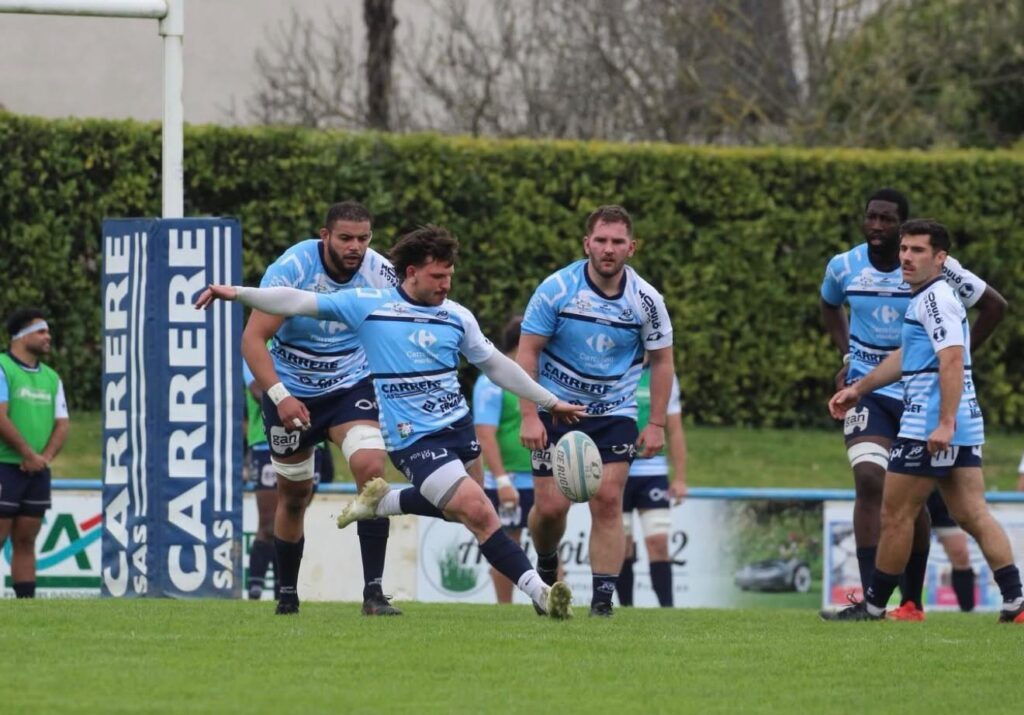
Yes! The goal is to play in as many matches as possible. We have a great squad, with very good players in every position. There will inevitably be rotation. I will not be able to play every match, as a starter or as a replacement, but the aim is to play as much as possible. I have been here six years now and I also want to make myself more of a fixture in this team. I want to push the others, I want everyone to push each other, and to be one of those who drive the group forward.
On the pitch, “the sort who gets stressed” and likes to moan
On the pitch, how would you describe yourself?
On the pitch, I tend to have a strong character. I like to moan. I always want to win, I hate losing. I do tend to moan and sometimes it can be a bit much, even for my team-mates. I admit it (laughs). But in real life I am calm. I am not as mad as I am on a pitch.
Do you have a story that has stayed with you?
There are plenty of funny stories, I cannot tell them all. We had a coach at Fleurance who came out with a quotation before every match. It made my team-mates laugh a lot, and it has always stayed with me. We still use them today because they are extraordinary. There was the David and Goliath one, where he said that today “we were going to be the stone in Goliath’s boot”. There were loads of things like that, really funny. If my old team-mates read this, they will laugh… (smiles).
Do pre-match team talks really fire you up?
I have a real problem with that, it does not work for me. When I was young, only one man managed to fire me up. His name is Jordan Villate. It was a match in the Alamercery age-group. He is the only one who ever really struck a chord with me by speaking. Otherwise, team talks are not really for me. I lose the thread. I need to be in my own bubble.
What is your routine before a match?
I am already the sort who gets stressed in life, and especially before a match. I listen to music. I need to laugh, to let it out to get rid of that stress. It has always been my thing. But I cannot do it with everyone. There are some lads who, if you start laughing with them, that is it, they cannot concentrate any more. One of my best friends is called Marius. I played with him when I was young. We worked the same way on that. We needed to laugh, to mess about. It is not to avoid concentrating, it is to let out that knot in your stomach. I know it has annoyed a few coaches (smiles).
Cooking, Axel Ducellier’s other passion
Away from rugby, you also shine in the kitchen… Is that something new?
No, I have had it since I was small. My father was never a chef but he cooks very, very well. I think he passed the passion on to me without meaning to. I love cooking for a crowd, which may sound a bit odd, because when I am on my own I cannot be bothered to make myself anything (smiles). And when you like eating, you generally like feeding other people.
@axelducellier # 🦆 MAGRET DE CANARD, SAUCE MIEL-BALSAMIQUE & FRITES CROUSTILLANTES 🍟 Le combo parfait pour un dîner de resto… à la maison ! Recette pour 2 personnes 👇 — ## 🛒 INGRÉDIENTS (2 pers.) 🦆 2 magrets de canard 🧅 1 oignon + 1 échalote 🍯 1 c. à soupe de miel 🖤 Vinaigre balsamique (une bonne rasade, environ 4 c. à soupe) 🧂 Gros sel, poivre noir & poivre blanc 🥔 Pommes de terre pour les frites — ## 👨🍳 LA RECETTE **1️⃣ L'assaisonnement** Pile au mortier du gros sel, du poivre noir et du poivre blanc. Quadrille le gras des magrets au couteau, puis masse-les avec ce mélange. ✨ **2️⃣ Les frites au air fryer** 🍟 Rince et sèche bien tes frites, puis direction l'air fryer : **200 °C pendant 18-20 min**, en secouant le panier à mi-cuisson. Résultat : croustillantes dehors, fondantes dedans ! **3️⃣ La cuisson du magret** 🔥 ⚠️ LE secret : démarre à la poêle FROIDE, côté peau, puis allume le feu. ▶️ 6-7 min côté peau (vide le gras au fur et à mesure et garde-le, c'est de l'or ! 🏆) ▶️ 6 min côté chair Ensuite, enroule les magrets dans du papier alu et laisse reposer **5 min**. La viande sera ultra tendre et rosée. 🤤 **4️⃣ La sauce miel-balsamique** 🍯 Dans la même poêle (avec les sucs du canard !), fais revenir l'oignon et l'échalote émincés. Déglace avec le vinaigre balsamique, ajoute la cuillère de miel et laisse réduire jusqu'à une sauce sirupeuse. **5️⃣ Le dressage** 🍽️ Tranche le magret, nappe de sauce, ajoute les frites… et régale-toi ! — 💬 Dis-moi en commentaire si tu testes la recette ! 💾 Enregistre ce post pour ton prochain dîner 👉 Abonne-toi pour plus de recettes maison #magretdecanard #recettefacile #airfryer #frites #faitmaison ♬ son original – Axel Ducellier
So by that logic, you would rather set up tries than score them…
Exactly! (smiles)
With the cooking, and with you being on Instagram and TikTok, do you feel there is something to build there?
I do not know. I am not doing it for influence or for the hype. People often told me: “Go on, make some videos”, because I was posting photos of my recipes. One day I told myself: “Right, here goes.” The very first one did really well. I thought that was cool. People enjoy it, so why not carry on. After that, I do not know how it might develop, I am not planning it. I am not doing it to make it big or to chase a name for myself. It really is just for the pleasure of it.

Comments