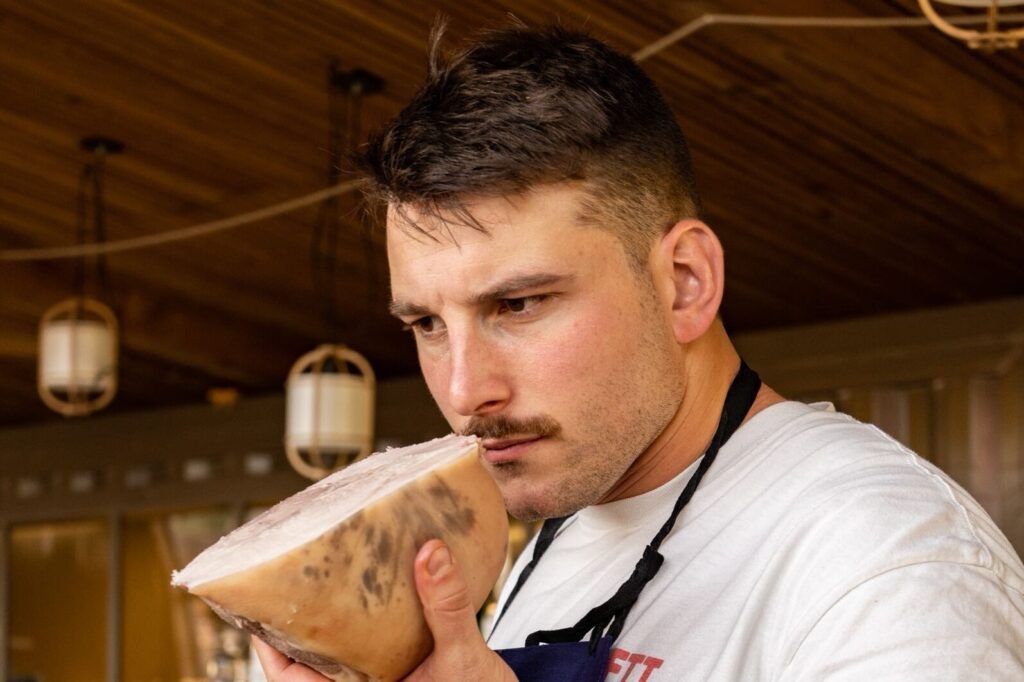
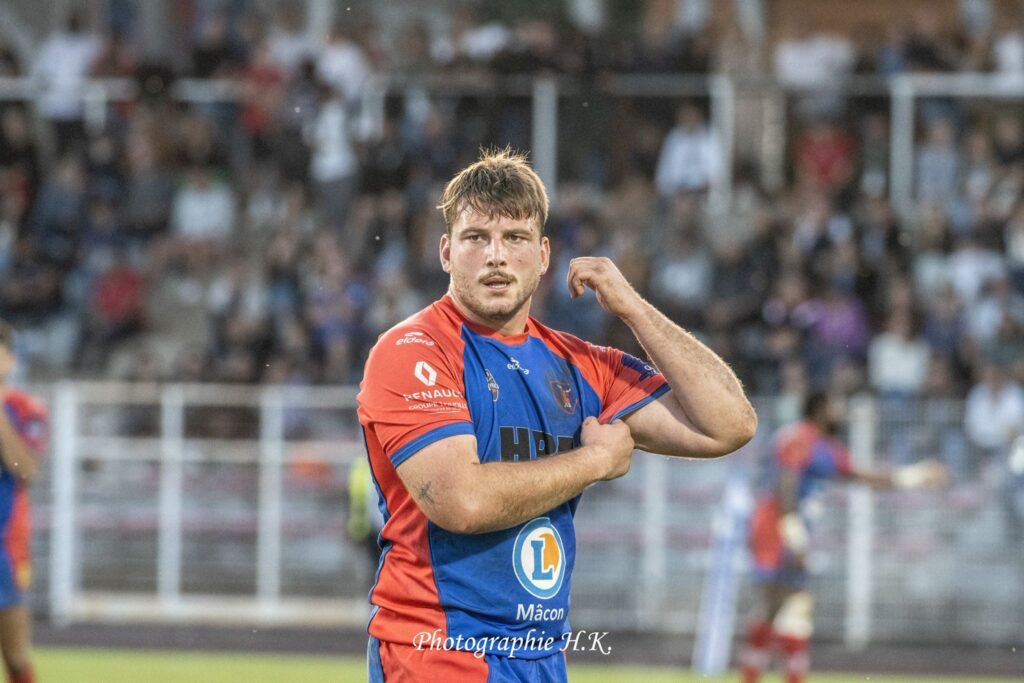
Marius Bernini is a calm, thoughtful man with a huge appetite for curiosity. Yet the former player, brought through at Lyon before spells at Suresnes and Mâcon, went through hell for months on end. In a match against Albi, the prop was illegally cleared out at a ruck.
He came close to losing the leg altogether, and the Rhône native went through a very long rehabilitation before making it back onto the pitch. The first medical opinion pointed the other way… But the former Lyon man’s courage, mental strength and hard work brought him back.
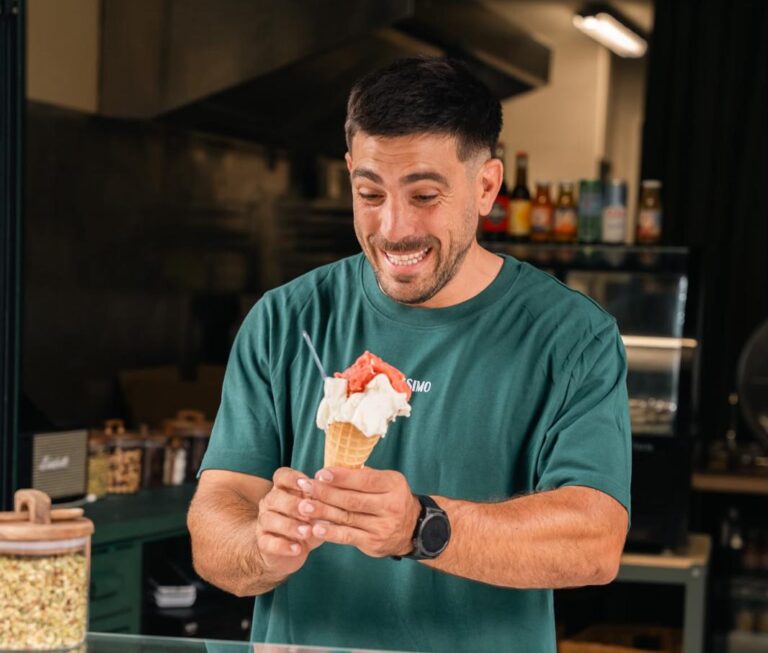
Recently, though, he decided to end his career and devote himself to his own projects. The latest of them: a sandwich shop called Miett, due to open in Paris in a few days’ time. A sharp take on professional rugby, on his serious injury, on what he does with his time… An interview with a man stronger than ever.
IT’S RUGBY. – Wasn’t the sudden end of your rugby career too hard to take?
MARIUS BERNINI. – No, not at all. It was almost a relief. I’d been pushing too hard for five years. What was really hard was the injury I picked up in 2020. It pushed me to breaking point.
Can you tell us about that injury?
One of my legs got twisted round in a ruck. These days it’s banned and penalised. Back then it wasn’t. It was during a Nationale match with Suresnes against Albi. Their tighthead prop twisted me right round and my foot stayed stuck. The result was that my ankle bone ended up against my backside. The whole leg twisted round. It caused a complete femoro-tibial and femoro-patellar dislocation. My kneecap was off to the side and the tibia and fibula were no longer lined up with the femur. The physio put the kneecap back straight away out on the pitch, but that evening I went to the emergency department. They even moved me to another hospital because I wasn’t in the right unit. They didn’t know what to do with me. So they rushed me to the Ambroise Paré hospital in Boulogne, where my sister was. There they announced that they were going to amputate and take me into theatre, convinced that my femoral artery had been severed and that too much time had passed to repair it all. The next morning I knew nothing about what had happened during the night or what they had done to me. I woke up, my sister came into the room and lifted the sheet to check whether I still had both legs. I did. I was a little taken aback by her doing that. In the end they put the bones back in line with one another and I was operated on a month later for a quadruple or quintuple ligament reconstruction: anterior cruciate, posterior cruciate, medial collateral and lateral collateral. My menisci and cartilage had taken a hit too. It was a very big operation. I spent three months as a full inpatient at a rehabilitation centre called LADAPT, then fifteen months as a day patient. Eighteen months of rehab in all.
Did you find out more about the amputation afterwards?
Because the leg had folded completely to the side, they saw on the X-ray that the tibia and fibula were sitting underneath the femur. Normally that’s where the femoral artery is. So they thought it had been severed in the impact, like every one of the ligaments. But it hadn’t. It was just about the only thing in that joint that held.
After the first operation, what did the doctors tell you?
I was told I’d never play rugby again. I remember the first surgeon I met. He walks in, says hello and barely a minute later asks me: “What’s your plan B?” No cushioning at all. I was in denial about my injury. My job was playing rugby, training and lifting weights. I told myself he didn’t really grasp what I did. But in reality I was the one who hadn’t grasped how badly injured I was. So I changed surgeon, telling myself it was better to be operated on by someone who believed a comeback was possible. The second surgeon told me it wasn’t certain, but that it was possible.
You still feel alone. I filtered a huge amount between what the doctors were telling me and what I passed on to people, because I didn't want to see pity in their eyes. I lied all the way through my rehab. To everyone.
It’s worth remembering this was during the Covid period, with lockdown. The support of those close to you was vital…
My sister came when she could. My mother too. (visibly moved) My father may have come before the operation but travel wasn’t allowed. They weren’t in Paris so coming often wasn’t possible. I spent a lot of time on the phone with them. Some friends came to the hospital too, since at that point it was a partial lockdown. But you still feel alone. I filtered a huge amount between what the doctors were telling me and what I passed on to people, because I didn’t want to see pity in their eyes. I lied all the way through my rehab. To everyone.
How did your club at the time, Suresnes, handle the situation?
They reacted really well. One of Suresnes’ two presidents at the time, Olivier Pouligny, who was president alongside Laurent Piepszownik, actually came to see me in hospital the day after the first operation. Other clubs wouldn’t have done the same. They also fronted the extra fees charged by the second surgeon. The coaches called me from time to time to check in, but we never talked about rugby at all. I’m still grateful to them for that.
You couldn’t see yourself giving up rugby?
I told myself I was just injured and that I had to train hard to come back and show the doctors I was going to defy the odds. I wanted to come back at the same level, or better. That was the goal. It didn’t work out that way, but I’m already hugely proud to have played rugby again, even without the physical capacity I had before.
To be able to play again, the physical and mental work you had to do is hard to imagine…
On the mental side, there was a psychologist at the rehabilitation centre who was used to treating severely injured people. She dealt with road accident victims, with stroke patients left with heavy after-effects… It helped me put my injury and what it meant for my life into perspective. And it helped me talk about the pain. Because that was something I told nobody. I think she’s the first person I ever told that I was hurting. After the screams on the pitch, which the whole ground heard, I never once said I was in pain again. The psychologist got me past that and we worked on the return to competition, step by step. First running, then training, then non-contact rugby, then contact. I followed that with a game in Espoirs, and finally with the first team. I still had apprehensions and I still have them today. They faded little by little. And they weren’t where I expected them to be. I thought I’d be afraid of tackles, of collisions, of rucks. Not at all. I was afraid of being hit while running. I simply didn’t trust my legs.
Even today I have no feeling in my left shin. I can't feel it when someone touches it. The instinctive footwork, the little last-second changes of direction... It's not that I'm afraid, it's that I simply can't do it any more. I feel as if I have far less control over my left leg than before. If I go and play football with friends, one touch with the left and it's a disaster.
Were you still in pain? In the scrum, for instance?
Oddly enough, the scrum was fine. But even today I have no feeling in my left shin. I can’t feel it when someone touches it. The instinctive footwork, the little last-second changes of direction… It’s not that I’m afraid, it’s that I simply can’t do it any more. I feel as if I have far less control over my left leg than before. If I go and play football with friends, one touch with the left and it’s a disaster. It feels like I’ve got a breeze block where my leg should be. Strength and speed, I worked hard on those. But psychomotor control of the joint is much harder to get back.
Has your injury changed the way you see rugby?
Completely. It scares the life out of me. I look at these guys and think they’re completely mad! Just for playing rugby. Never mind twisting someone up at a ruck. I think attitudes are shifting bit by bit. Thirty years ago you were allowed to spear-tackle someone. Now everyone stops. So much the better.
At the end of that season, what happened?
At that point I was out of contract. I spent all my time at the hospital, and a good part of my rehab, telling myself I was going to have to find a club. I thought I wouldn’t be kept on. What worked in my favour was that I was a tighthead prop, that I was 23 and that I hadn’t been bad. On top of that, I really wasn’t expensive. The club extended me by a year, with no guarantee at all that I could play again. I was on sick leave. So they weren’t risking much financially. Once I came back off sick leave, my salary was going to drop again. And it wasn’t high to begin with… The only thing I could see was that I was at a Nationale club and that I had the chance to try to play again at that level. I’m grateful to Suresnes.
Very soon, one of your projects comes to fruition with the opening of a restaurant…
Exactly. I had to learn everything. To help us financially, we brought in Hamza Kaabeche, a Lyon player I’ve played alongside since the cadet age groups, and Barnabé Couilloud, who came through at the LOU. They’re close friends who are looking to branch out beyond rugby and prepare for life after their careers. I offered them the chance to join the project. So they’re partners alongside Alfred and me, plus one other person. They’ve taken a stake in the business without working in the restaurant, but bringing financial support, advice and a network.
So rather than a restaurant, it’s a sandwich shop?
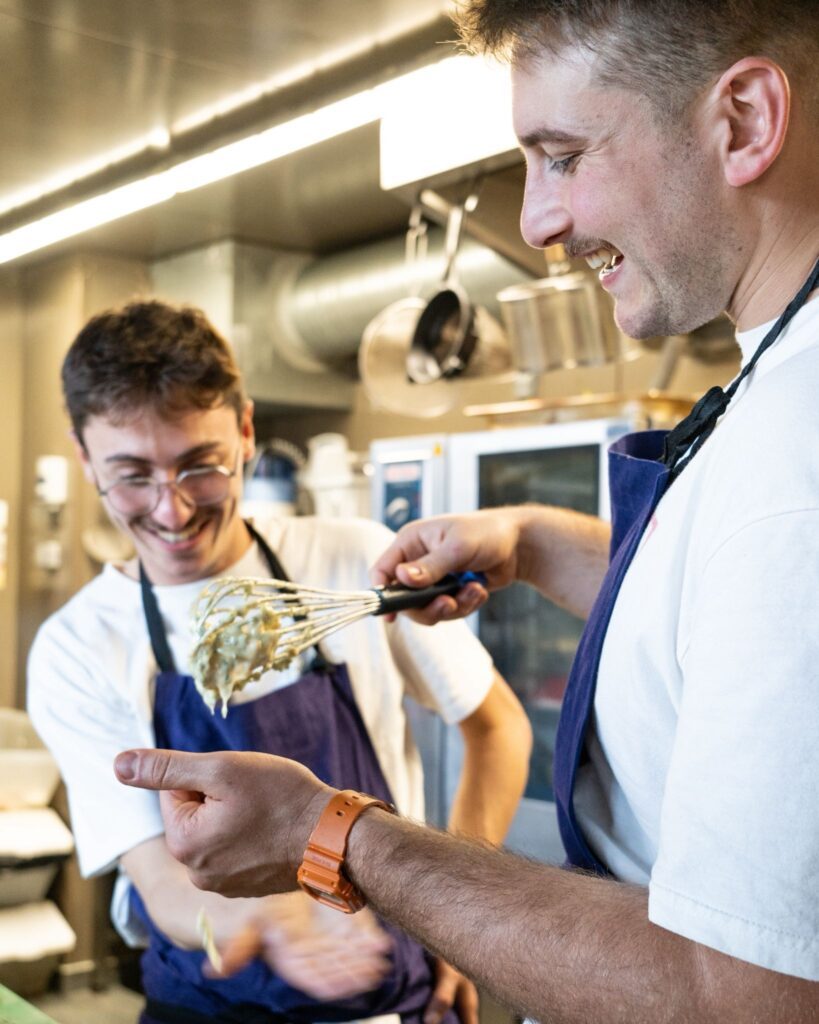
Exactly. We do traditional sandwiches, but we make everything ourselves apart from the bread. For the jambon-beurre, we make the ham, the butter, the pickles. For the chicken mayo, we take in whole chickens, bone them, skin them, and turn the skin into crisps that go into the mayonnaise. They’re chef’s sandwiches, because Alfred, my business partner, is a chef. He trained in a fine-dining restaurant in Montreal and then in some very fine Paris kitchens. He brings his gastronomic knowledge to sandwiches. We’ll also offer more unusual options like bánh mì, hot dogs, focaccia… In the evening, we didn’t want to do takeaway only. We wanted seating, a meeting place where friends can drop in for a coffee, play cards, find that clubhouse atmosphere again. We’ll open in the evening too, with tapas, beer, wine and sharing plates. So we’ll be a hybrid sandwich shop, open at lunchtime and in the evening.
Would the idea of picking things up again at a small club, in Fédérale or Régionale, appeal to you?
Not really, because I’ve always associated rugby with high standards and commitment. I have neither the body nor the time to commit 100% to a rugby project. It wouldn’t be respectful to the other players to turn up once a week, to miss training sessions and matches. My body wouldn’t allow it anyway. I still get crazy pain in my knees. When I do one sprint too many or fall on the knee, it swells up. It’s out of the question.
I do hold certain things against rugby. I think a lot of players are led to believe that being a professional is an ideal way of life. It is one when you start earning money, when you have visibility, when you're a starter and your coach wants you.
Do you hold anything against rugby?
I do hold certain things against rugby. I think a lot of players are led to believe that being a professional is an ideal way of life. It is one when you start earning money, when you have visibility, when you’re a starter and your coach wants you. You go through exceptional moments then, I think, even if I never fully got access to that. But we don’t talk enough about the impact a coach can have on a career. In a squad of forty players, there are around twelve who play every weekend and twenty-eight who stew. I hold that against rugby a little. I’d also like clubs to oblige their players to train for something else and take an interest in something else. Professional clubs push a player to complete a BTS or a qualification so that their academy earns points. They don’t care whether their players fulfil themselves in any way other than through rugby. You can’t ask an 18-year-old, far from his family, to take that step on his own. You have to make players curious. Most of the time you find yourself on a bus where, if you don’t talk about PlayStation or sports betting, you’ve got nothing to say. There are seriously intelligent lads who use none of their intellectual capacity beyond knowing who’s playing on Thursday night in Pro D2, the odds on Biarritz against Nevers, or whether you played online on the PlayStation this week. I find that sad.
Do you think it makes sense for outside speakers to come and talk to young players at clubs?
I was lucky in that my father is an actor and my mother a primary school teacher. I grew up in the town where I was born. So I had a good circle outside rugby. I’d go and work in my father’s theatre after university, when there was no training. And my mother always pushed me to keep studying or to read books. But a 16-year-old who arrives from a small town and discovers Lyon, who has a status thanks to rugby, who signs a contract at 18 and earns 300 euros a month feeling like he’s hit the big time, you can’t ask him to take that step on his own. So yes, it would be really worthwhile for people to go into academies and open players’ eyes to that. Provale tries to do a bit of it. But I think we talk too much about studying and about life after rugby. We need to talk about hobbies, about a passion other than rugby. You can find something that fires you up outside rugby, like cooking, gardening or cycling. I can point to Baptiste Couilloud, who I know well. He has three businesses alongside rugby. He has the means to, yes, but above all he has that instinct to be curious rather than just be the perfect rugby player.
And what really drives you?
There’s food. I have an almost unhealthy thing going with food. To give you an example: at ten months old, the first day I walked, I escaped, opened the fridge and tried to eat out of it (laughs). Right now I’m loving working in catering, selling dishes. I’m currently doing a sommelier qualification so I can buy and sell wine better in the restaurant. What also interests me is learning and improving as a person. And that’s what’s brilliant about rugby too, because you have clear targets. The strength and conditioning coach tells you: “in two months you’re going to post a better bronco time”. You don’t believe it, the target is so high, but you get there through sheer repetition. Setting up a restaurant really isn’t simple. You spend your time working through one problem after another.
How would you like to end this interview?
At one point in my life I didn’t know how I’d ever be happy without rugby. And now I wonder how I ever managed to be happy with rugby. That’s the most striking part. Since I stopped, I spend my weekends with my girlfriend and my dog, I can go and see my mother. The situation may look sad, but it takes you towards something happier. It’s a bit philosophical, but it’s genuinely what I’m living.
Comments