
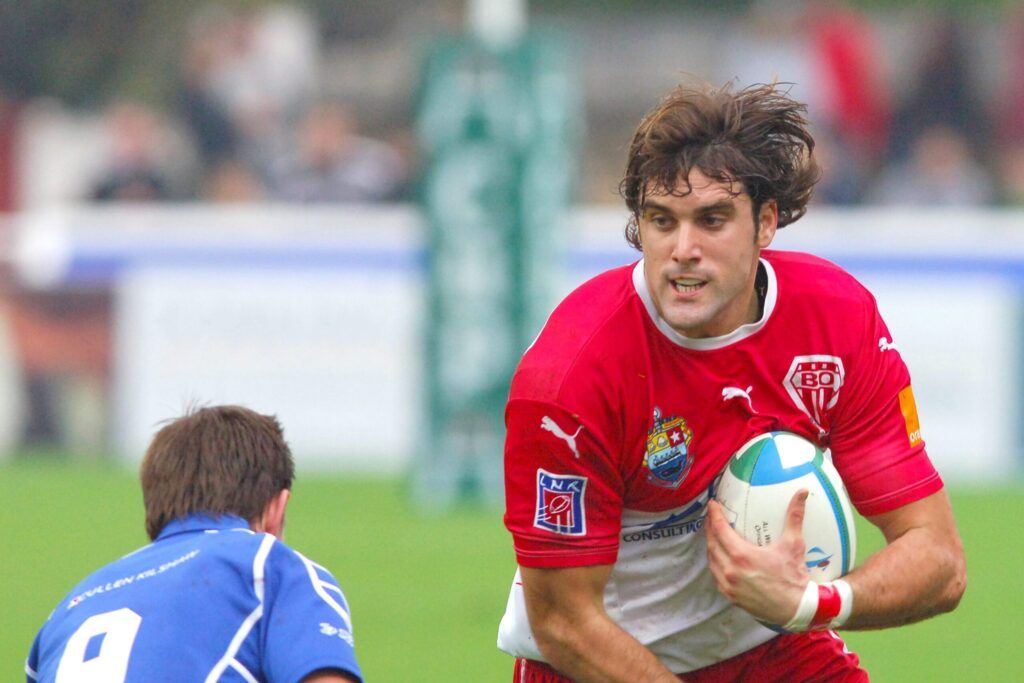
What are your first European Cup memories, even before you played in it?
My first memories are of 1996. The first European Cup, the images from Cardiff, the trophy being lifted… it marked a whole generation. I was young, in the South West, and seeing those images was something very powerful. Then there were the great sides like Stade Toulousain who dominated, so of course it made you want to be part of it. It was a bit like the summit of club rugby at the time, something quite mythical. You had this feeling that everything was decided there, in those matches, with an intensity you did not find anywhere else.
And when you discovered it with Biarritz Olympique?
When I arrived at Biarritz in 2002, I really discovered the European Cup from the inside, and everything was different. The away trips, for a start. You go to Wales, England, Scotland, Italy… it is not the Top 14. There is an opening up, a form of excitement. And even the silliest little details. The ball, for instance. It was different, a bit rounder, almost like a football. I remember that Dimitri Yachvili, Damien Traille and I often talked about it, because it floated a little in the air after a kick, you had to adapt. It might sound like a trivial detail, but it sums up the spirit rather well. In the European Cup, everything changed. The atmosphere, the preparation, the travelling, the sometimes awkward kick-off times, the long journeys… it was another dimension, another way of approaching rugby.
What made that competition so special in your eyes?
The irrational side of it. You could prepare everything, analyse everything, but there was always something that escaped you. I remember completely mad matches. Improbable scripts. A semi-final lost in the last second at the Parc des Princes against Stade Français and a Dominici try, a match won by a huge margin against Cardiff, where we scored 15 tries… There was always that moment when everything swung. And above all, the level. When you got to the European Cup, everything went faster. The tempo, the impact, the accuracy. The Irish, Welsh and Scottish teams put everything into that competition. It was their priority. When we came back to the Top 14 afterwards, we had the feeling that everything was simpler, because we had raised the bar. We had taken on that rhythm, that intensity, and it made the difference.
You played in two finals, in 2006 and 2010. Which one left the biggest mark on you?
2006, without hesitation. The final at Cardiff against Munster Rugby. We played in a closed stadium, with 71,000 Irish supporters. When we arrived, there was a sea of people. It was hostile, clearly. There were giant screens all over the city, especially in Limerick, showing the match. You could feel that a whole people was living for it. For them, winning was vital. For us, it was our first final. We lost by four points, but the atmosphere… it is indescribable. The closed roof, the noise, the pressure… it is probably the most powerful thing I have experienced in terms of emotion on a pitch. You find yourself inside something that is completely beyond you. That day, at Cardiff, it was 15 of us against 71,000.
There were also those matches moved to Spain, to Anoeta…
Yes, that was incredible too. We were among the first to play there. For us, it was a party. We could bring our families, our loved ones. There was a completely different atmosphere, almost festive, spread over several days. It was also a way of opening the competition up, of trying new things. And you could already sense that the European Cup was looking to evolve, to step outside its traditional boundaries. But at the time, it was still very much rooted in European history, in the rivalries between clubs.
You often mention the opponents. Did some of them stand out more than others?
Yes, inevitably. I think of teams like Sale, with Sébastien Chabal, or players like Jason Robinson. He was a nightmare to defend against. An electric player, very fast, a bit like Kolbe today. Every match was a challenge. And I was often the one who had to take him. So you prepared differently, mentally and physically. But that is also what was stimulating about it. You were playing against the best players in Europe, sometimes the best in the world. And that pushed you to raise your level.
You also get the feeling that collective experience counted enormously…
Yes, completely. In 2010 for example, we reached a final even though we were not necessarily doing well in the Top 14. But we had the experience. We knew the competition. We knew how to handle those moments. That year I was coming back from injury, eight months out, and I only played three matches… quarter-final, semi-final, final. That is not ideal, clearly. You feel the rhythm is different, that you have to adapt very quickly. But that is the European Cup too. It puts you face to face with your limits, and you have to find solutions fast.
With hindsight, has the European Cup lost its magic?
Yes, clearly. We have moved into a business sport. Before, there was a genuine sporting quest. Today there is an economic logic behind it, with TV rights and markets to capture. The arrival of the South African teams, for example, is linked to that. But for me, it distorts the competition. It is no longer really a European Cup, even if we still call it that.
Why do you think it works less well today?
Because not everyone plays the game. The South Africans, for instance, have no European rugby culture. I went to see a match in Cape Town, there were 5,000 people in the stadium. No interest for them at all. Their rivalry is with New Zealand. Even in the rugby schools over there, the kids do not know the French clubs. It is quite striking. So of course it does not take. And behind that, French clubs are starting to make choices too, because the calendar is too crowded, because there is the pressure of survival or of the Top 14, and because the financial risk is too great.
Can we say the European Cup is dead?
No, it is not dead. The history is still there. You still have big clubs, big fixtures. But it has lost value. Before, winning the European Cup was a major objective. For us, at Biarritz, it was clear, we wanted to win it. Today, it is not necessarily the priority any more. The Brennus has taken on even greater importance. And then the format, the calendar, all of that has changed. Too many matches, not enough clarity, a competition that has lost a little of its identity.
In spite of everything, what do you take from that period?
That it was unique. Truly. A competition apart. An exceptional human and sporting adventure. The European Cup, in that era, was something you could not reproduce anywhere else. An intensity, an atmosphere, memories… that stay with you for life. And above all, that sensation of playing for something bigger than the championship. Something that pushes you to go beyond yourself, to find resources you do not find anywhere else. That, for me, is the real European Cup.
Comments