
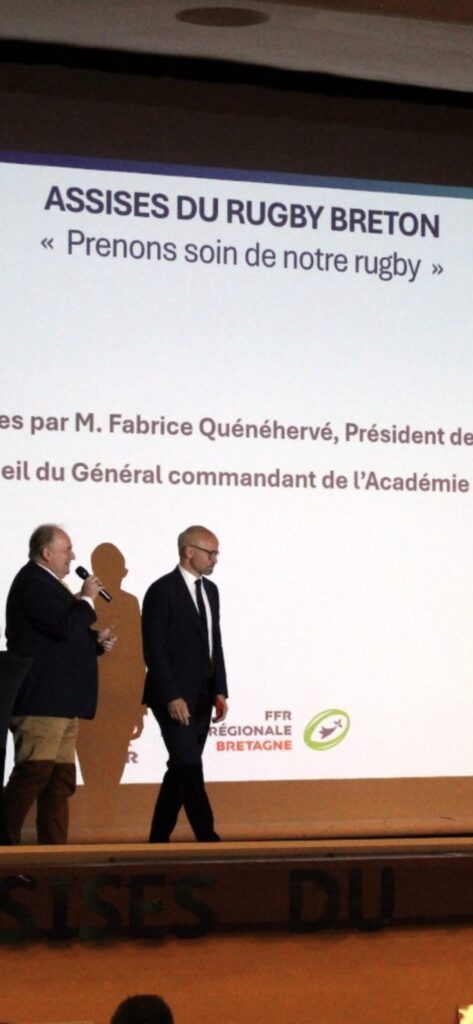
A busy but smiling president, Fabrice Quénéhervé has every reason to be. The Breton flagships are delivering, the grassroots are growing, the number of registered members is climbing for the sixth year running and the tip of Brittany is about to welcome the whole French rugby family on 3 and 4 July. An interview with an administrator who is holding his course.
President, Vannes are Pro D2 champions of France and back in Top 14, very good news for your league…
What a joy! And a double, since Vannes also took the title and promotion in Espoirs! It feels good, even if I usually say that there is not necessarily an absolutely direct link between the performance of the flagship playing in professional rugby and the trends in amateur rugby, which reaches a wider public: schools, educational rugby, recreational play, amateur competitions… But one thing is certain, performance helps visibility, particularly in the media. That visibility, and we suffered from a real shortfall in Brittany, allows us to fuel development and gives more echo to the work on the ground, which is absolutely incredible. Our clubs always show a great deal of ingenuity and initiative in promoting rugby and getting people to discover it, but it was fairly confidential. The more time passes, the less that is true. So, thanks to this increased visibility, we are more attractive. This is the sixth consecutive year in which our numbers have risen, that is unheard of over the last 30 years!
And what about the number of clubs?
The number of clubs, to be honest, is extremely stable: still at 65 give or take two for the last fifteen years or so. In fact, that mainly hides roots and a structure that keep getting stronger. Clubs that were based in the same place have merged into one. I am thinking of Brest, of Plouhinec… In the end, even if the picture looks extremely stable, we are gradually continuing to strengthen our network and the existing clubs are getting denser. The average number of officials in the running of clubs, and the average number of registered members, keep growing: those are very, very good indicators of good health.
Does that validate your areas of progress?
Yes. We had defined four main areas: development, improvement, structuring, outreach. We are carrying on for the new four-year cycle. The approach is bearing fruit and, in the field of development, there is a heavy emphasis on schools and education, that is where everything starts. Also in the field of the women’s game, because we have incredible development potential. In fact there is a huge untapped reserve of women members. The French population is almost an even split between men and women, whereas in rugby we are at 85% men and 15% women. So we have a reserve of players in the rugby schools, but also in recreational play and, more marginally, in competition. Recreational rugby without tackling, five-a-side rugby, is helping us attract more and more women players. A good number of them then get involved in the life of their club and become officials.
Vannes the flagship, but also Rennes staying up in Nationale… With a budget of one and a half million euros, it is proof that money is not everything, even if it helps enormously.
We have the good fortune to have three clubs in the national men’s Top 100 this year, with Vannes, Rennes and also Saint-Malo! For Rennes, who are having a superb season and are building a long-term project, we suffer from the infrastructure. Even if that creates frustration and impatience on the club’s part, “Rome was not built in a day”… There is a genuine prospect of improvement with the renovation of the Commandant-Bougouin stadium, a project that is moving forward. When the club has a facility like that, the REC but also Stade Rennais rugby will have new resources and more visibility. Clubs need to increase capacity, improve the quality of hospitality and add value for their partners. So it is extremely positive to see the REC establish itself in Nationale while having visibility on this future facility, the stadium, and an environment that is going to keep improving. Beyond the flagships, things really are pushing up behind them, and that observation applies very widely. I do not remember ever seeing 100% of the Breton clubs selected for the French championship get through the first round, which was the case this year. And last weekend we still had six teams in the running, and Le Rheu came within a point, in added time, of going up to Fédérale 1…
President, the FFR congress is coming up, in Brest…
Yes, it is a great satisfaction to host the federation’s congress in Brest in early July. It is also a fair bit of work, but we want to do things properly. It is no small thing for the federation to come and hold its congress and gather the rugby family at the tip of Brittany. We intend to make it a promotional event in the service of regional rugby. We have initiatives in preparation. We are going to lean on our very good indicators: a sixth consecutive year of growth; when you add together players and officials, we have passed the 14,000 registered members mark, an overall increase of 1.6%. The simple fact that we are still on a growth trend, without having suffered the usual drop-off in the years following a World Cup, is very good. And the very pleasant surprise is that the two departments really driving that growth are mainly the Côtes-d’Armor, where a huge amount of revitalisation work has been done, and the Ille-et-Vilaine. Across the region we have gained 7.4% more officials, 170 people spread across the clubs of the league’s four departments. Once again, the course is holding and we keep moving forward!


Comments