
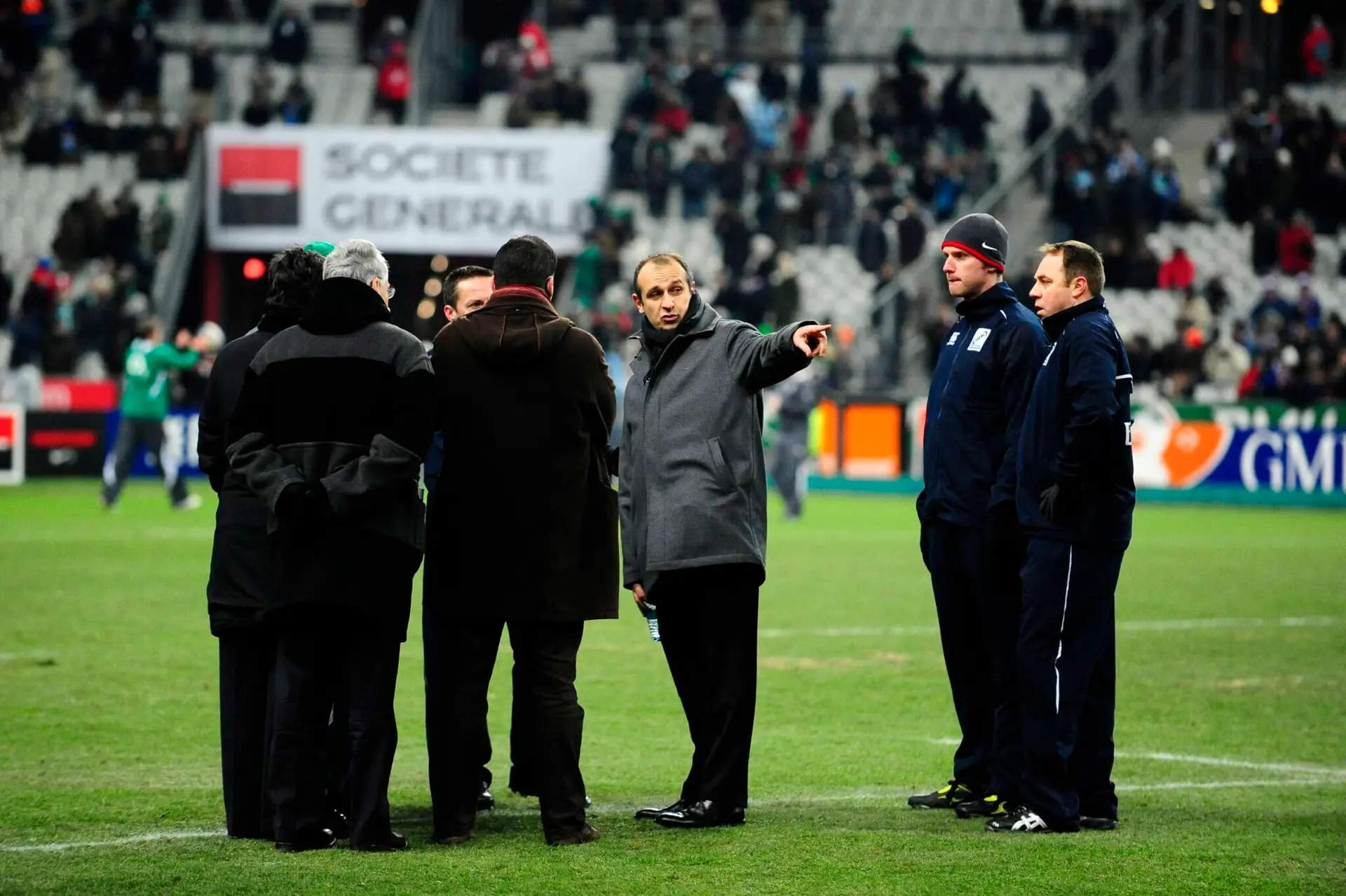
They were there in 2012, when France–Ireland froze on the spot because of the cold before it had even begun. They were there on Saturday, at Mayol, for Toulon–La Rochelle, stopped dead by the storm. Ten years on, the same feeling: the icy frustration of a promised match that supporters will in the end never see.
So it is that a (major) weather hazard sometimes throws the well-oiled machinery of modern rugby into disarray. Online ticket offices at bursting point, sponsors displayed everywhere, cameras trained on every scrum… But a biting cold, a frozen pitch, a storm, lightning, and everything comes to a halt. Those who lived through the Stade de France in February 2012 felt it all over again this weekend, at Toulon: sheer disbelief. On Sunday 21 September, just gone 9.30pm, referee Jérémy Rozier told the Toulon and La Rochelle players that the kick-off was off. The information was relayed by the stadium announcer. The anger and bewilderment predictably came pouring down from the stands, the prefecture having confirmed earlier in the evening that the match would go ahead.
Le match reporté RCT – Rugby Club Toulonnais – Stade Rochelais de la 3ᵉ journée de TOP 14 aura lieu le Samedi 8 Novembre à 16h30 et sera à suivre sur Canal+ pic.twitter.com/s8zYC7N7tX
— TOP 14 Rugby (@top14rugby) September 22, 2025
“Fiasco“, “amateurism“, call it what you like, but the decision looks largely justified given the weather conditions and the storm that came down on Mayol. And nobody seems to be disputing it. It is not that supporters are furious about the decision itself, but rather about the lack of anticipation. “The safety conditions and the state of the pitch did not allow the match to be played properly“, Jérémy Rozier, the referee, kept repeating to Canal + after the decision was taken in consultation with those involved in the match. And those conditions did not allow a game on Monday 22 September either – which both clubs would ultimately have preferred – with the pitch still flooded.
From frost to rain
French rugby fans Julien Laurent and Nathalie Hoarau, 46 and 44, were in the stands at Mayol when the referee blew the evening to a close. The two enthusiasts had just driven more than three hours from Lyon to see the match. The sky fell in on them once again. Because thirteen years earlier, in the middle of the Six Nations, the France-Ireland match they were attending, scheduled for Saturday 12 February at 9pm at the Stade de France, was called off just 10 minutes before kick-off, as the stands filled with 79,000 spectators were starting to rumble. It was the referee – once again – England’s Dave Pearson who took that decision because of the frozen pitch.
“At the time we lived on La Réunion, we had taken a flight especially to come to Saint-Denis, explain the couple, both physiotherapists. We were in the stand, the atmosphere was building. Then the rumour went round. The referee was talking to the captains. And all of a sudden, curtains.” At Mayol, as at Saint-Denis on 12 February 2012, the anticipation, the songs, the fervour evaporated in a matter of minutes, giving way to a heavy silence (with the sound of the rain all the same). “France–Ireland was even worse. Almost 80,000 people sent home without a single whistle. But on Saturday I had the same feeling of something unfinished. You feel cheated, even if you understand the decision, even if you know safety comes first, says Julien. But there is the question of respect for supporters. At this level you cannot announce that at the last minute, not when you are sitting in the stadium. The authorities had everything they needed to anticipate it. You cannot pretend to be discovering the weather forecast.“
“In Paris, we were told the frost was not that bad, that it would be fine. And then the referee turned up, tested it with the tip of his boot, and that was that. On Saturday, same again, but in a paddling pool.“
Nathalie Hoarau, RCT supporter
Somewhere between anger and resignation, many supporters also pointed to the lack of transparency on social media. Nathalie among them: “In Paris, we were told the frost was not that bad, that it would be fine. And then the referee turned up, tested it with the tip of his boot, and that was that. On Saturday, same again, but in a paddling pool.” The emotion, though, goes beyond the financial frustration. “It is not just a ticket you bought, it is a weekend you planned, friends you meet up with, a party ruined, the couple regret. We felt like we were living the same scene again: dazed supporters leaving the stadium in silence, as after a defeat, but with no match. Except this time under a downpour.“
"La rencontre était possible, sans mise en danger" : après l'annulation du match de rugby RCT/La Rochelle, le préfet du Var s'explique
— France 3 Côte d'Azur (@F3cotedazur) September 22, 2025
►https://t.co/JOrXkmK3ZT pic.twitter.com/xaCzluVoFJ
The rugby we love, a sport of traditions and of passion, may once again have come up against its most modern and most glaring paradox: ultra-professional on the pitch, but sometimes still amateurish in the way it handles the unexpected and the weather. A storm over Mayol, but a clear-eyed view: rugby does not exist outside time. And if nature is reminding us that it still has a say, it also highlights a form of fragility in a sport that is nonetheless seen as indestructible. Modern rugby likes to present itself as a well-oiled machine, driven by television contracts, financial partnerships and calendars planned down to the last detail. But a frozen or waterlogged pitch is still all it takes for the foundations of that architecture to crumble.
Grit in the machinery of the show
That gap between the power on display and the real vulnerability sends supporters back to an era they thought was over, one in which the weather still laid down the law, and which still makes itself heard now and again in the present. In an oval-ball world where every try is dissected in high-definition slow motion, where stadiums fit giant screens and premium hospitality, the inability to anticipate or manage a natural hazard looks anachronistic. “Can we really talk about rugby business when, out on the pitch, it is sometimes still a bodge job?“, the couple wonder. The frost, a tiny piece of grit in the machinery of the show, is a reminder that this sport, for all its modern clothing, remains at the mercy of elements that neither technology nor money can fully tame.
Ten years on, the witnesses of France–Ireland 2012 did not expect to live through that script again. They found it again, almost intact, on a very different scale, with that bitter mix of disillusionment and fatalism. A match that will eventually take place, on Saturday 8 November, like the France – Ireland game finally played on 4 March 2012 (17 – 17), one they will not see with their own eyes, but which they will keep in their memory all the same, with a wry smile.
Lény-Huayna Tible


Comments