
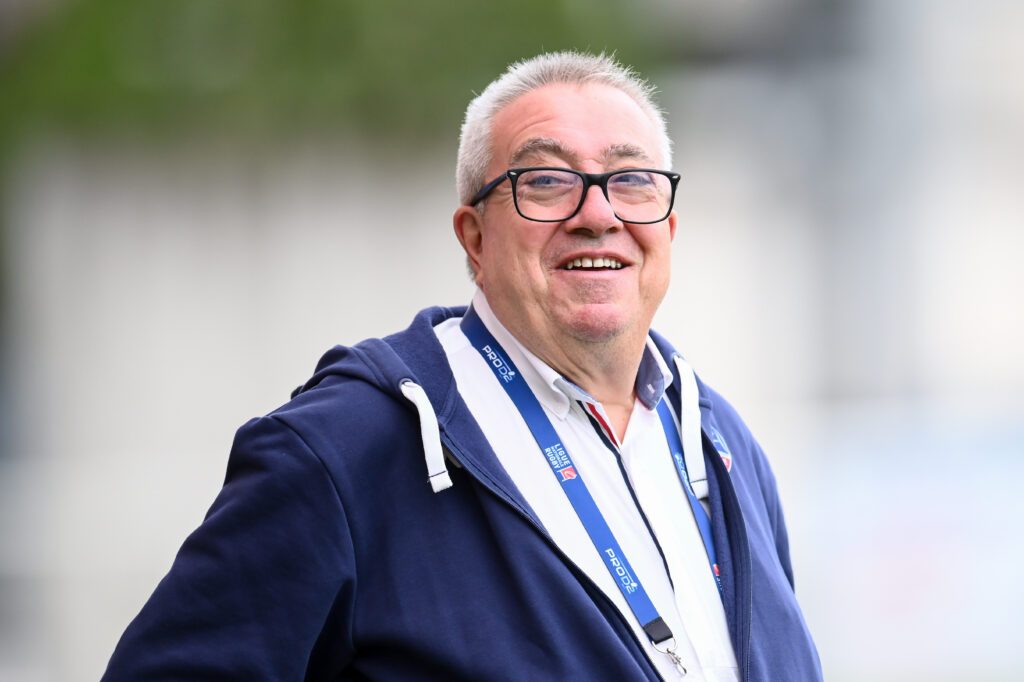
What is your state of mind as the new season begins?
I’m optimistic. I think we’ve brought in good signings, pre-season went well and the two warm-up matches were fairly satisfying (a defeat in Grenoble, a win in Montauban). We have to stay very cautious and measured, and not get carried away. Even in Grenoble, where the scoreline was a bit wider, I think we showed a really good side of ourselves for 60 minutes. I’ll say it again: we’re optimistic, even if we know that Pro D2 is an extremely difficult competition and it’s going to get tighter and tighter. But we’ll always have the same goals and the same ambitions.
What are those goals? Are you looking towards the top of the table?
Of course. First we need to secure the season, but above all do everything to go and get a play-off spot. If we manage it, great. If we don’t, it won’t be a disaster. What I really don’t want is a repeat of last season. We spent 23 rounds in the top six. Then we collapsed in that match in Carcassonne, which turned our whole season upside down. The competition is going to be extremely tough, for us as for everyone else. Today there’s no such thing as a small club in Pro D2 any more. Everyone has ambitions and wants to try to compete at the top of the table.
Stade Aurillacois have often struggled at the end of seasons. How do you explain that trend?
I don’t think there’s any particular explanation. Last season we were genuinely on schedule: we were on track with seven rounds to go. Then we lost that match which changed everything. At that point, maybe we had the feeling the season was over, that we had nothing left to play for. That was a misjudgement. There are also factors we can’t control. We had key injuries at the end of the season, tired players…
Did you work on that aspect during the off-season, particularly the physical and mental freshness of the squad?
On the physical and mental side, that’s the coaches’ job. For me, it’s more about keeping the group alive and making sure our leaders aren’t “dead” by the end of the season. After that, it will always depend on injuries and lots of other factors. But last year, it really was that last-minute defeat in Carcassonne that completely tipped us over. For me it had been a very positive season. I’ve said it before: from Round 23, it became a disastrous season, one of the worst we’ve had.
How far along is the new pitch, and what do you expect from it?
The project is being led by the local authority. I went to see the stadium recently and it’s magnificent. We’re now in the final phase. I’m no technical expert, but there’s still the sign-off to be done with the League bodies and the various parties involved, around 30 August. We’re going to have a great facility and a great pitch. Now, what I mostly expect is for us to shine on that pitch! I do have a few concerns, though. For our opponents, coming to Aurillac in January with a harsh climate and a muddy pitch was almost an advantage for us. It has to stay an advantage. We’ll still have the climate, but if we don’t have the mud any more, that might change a few things. We’ll see as the season goes on. Either way, I hope this pitch will let us play attractive rugby, keep developing our game and make sure the crowd enjoys it more and more.
So should we expect an even more expansive, attacking Stade Aurillacois this season?
We’ll see. Since last year, we’ve seen Stade Aurillacois play more expansive rugby, up until that match in Carcassonne. I hope the team will adapt. We’ve recruited quite a lot in the backs, and we’ve tried to improve certain areas while keeping what seemed relevant to us. I think we should see some good rugby. At least, I hope so.
How do you see your squad? Do you feel you have more depth than last season?
We hope so. We’re losing five very good players from last season, so those are real losses for the club. What I hope is that the players we’ve signed will be very good players too. Then there are hopes and there’s the reality on the pitch. But the feedback I’m getting is fairly positive. I think we can be pleased with our recruitment and I hope it will help us improve.
Aurillac has more limited resources than some of the big Pro D2 outfits. How do you stay ambitious in that context?
That hasn’t changed over time. Historically, ever since professionalism arrived in rugby, we’ve always been among the clubs with the smallest resources and the smallest budgets. It’s part of our history. Today we’re the oldest club in Pro D2. So we can keep holding on and existing despite a budget that lags behind the competition (around 10 million euros, editor’s note). But it’s true that it’s becoming more and more difficult and worrying. More and more big cities are entering the professional game and, when they do, their issues are nothing like Aurillac’s. When you see local authorities able to put in 3.5 million euros, shareholders putting in 4.5 million and so on, that’s not a problem in itself. But little by little it changes the structure of the clubs that have stayed at professional level.
In that context, what role should the surrounding area play for the club?
I hope the crowds will gradually come back. We have to convince people to come and support Stade Aurillacois more and more. It’s surely still one of the biggest draws of the Cantal department. We have the Tour de France, which is magnificent, the International Street Theatre Festival, which is something extraordinary, and we also have Stade Aurillacois, a club in professional rugby. I think the people of Aurillac and Cantal need to embrace the fact that it’s something quite extraordinary for the size of the town and the department. Last season we averaged a little over 3,000 spectators, with around 52,000 to 53,000 spectators over the season.
And at the end of this season, what will make you say it was a success?
If we match what we did in the first 23 matches last year, that will already be very good. If we finish sixth, even better. Fifth, better still… If we finish eighth, ninth or tenth but have had a good campaign, that won’t necessarily be a problem. The important thing is to have that goal of playing to try to reach the knockout stage. It’s now been more than ten years since we last got there. Yet we used to take part fairly often before that, which people sometimes tend to forget. We always hope to get back there, even though I know full well the competition will be fierce.
Comments