

A former athletics champion, Maryse Ewanjé-Épée went on to establish herself as a pundit and commentator, with a rare and finely tuned vision, fed by the demands of elite sport and by a teaching approach to performance. An attentive observer of rugby (her son plays for Massy), she has long argued that quality of movement is a major lever of performance… and of injury prevention.
As a former elite athlete, how do you see the link between athletics and rugby?
There is an obvious, almost natural link. Athletics is the basis of every sporting movement: running, jumping, throwing. Rugby calls on exactly those fundamentals, with one additional feature… the collision. Whereas athletics tends to try to avoid it! But all the qualities developed in athletics – speed, coordination, power, rhythm, endurance – are essential in rugby, simply in a collective context, one that is far more chaotic.
“At the top level, all sports end up resembling one another physically. Rugby today is fast, explosive, demanding in terms of coordination and the ability to repeat efforts.”
Maryse Ewanjé-Épée
Have athletic qualities become central to modern rugby?
Completely. At the top level, all sports end up resembling one another physically. Rugby today is fast, explosive, demanding in terms of coordination and the ability to repeat efforts. Even the forwards have become very athletic. You can no longer set contact rugby against a running sport: today, rugby is a sport of permanent movement.
Is running technique worked on enough in rugby clubs?
Not enough, in my view. There was a period, some twenty years ago, when everybody was made to run in the same way, sometimes absurdly so: 400 metres for props, for example. Today, strength and conditioning coaches have moved on, but pure running technique – posture, pelvic placement, coordination, quality of footwork – is still barely taught, especially to young players.
“Running fast, yes, but above all running properly”
Which types of running are the most decisive for a rugby player?
They are not pure straight lines. Rugby is about angled runs, changes of pace, footwork, breaking out of a breakdown. Being able to go from a pushing or isometric effort to a very quick acceleration without getting injured is essential. Running fast, yes, but above all running properly.
Elle fait ses propres cascades, jamais doublée;bon ça lui arrive de foirer certaines prises aussi…
— giggs (@SandmanIggy) September 3, 2024
Du terrain aux différents médias, elle nous abreuve de connaissances d'une manière claire et éclatante comme je la voyais à la TV.
Joyeux anniversaire @EwanjeEpee ! All the best.. pic.twitter.com/RrLpZziq3B
Can a link be drawn between poor running technique and injuries?
Clearly. A player who moves efficiently tires less and gets injured less. Abrupt transitions – coming out of a ruck and sprinting flat out – are very traumatic if the movement is not mastered. Running technique is a performance tool, but also a preventive one. It is a major issue, particularly in player development.
“You cannot simply add content. You have to accept taking out a little opposition work or field work to do technique. And culturally, that is not always straightforward”
Maryse Ewanjé-Épée
Why is this athletic work difficult to build in, especially with young players?
Because rugby sessions are already very heavy. You cannot simply add content. You have to accept taking out a little opposition work or field work to do technique. And culturally, that is not always straightforward. Yet learning to run well before putting on 15 or 20 kilos of muscle mass would be far more logical.
Is rugby making progress on these aspects nonetheless?
Yes, that has to be acknowledged too. Rugby has become very athletic, players run fast and for a long time. But the difference is made in the efficiency of the movement, not in top-end speed. The best player is not the one who runs the most or the fastest, but the one who runs intelligently, who knows how to position himself, angle his run, read the spaces.
Mais qu'il est beau cet enfant ! À part qu'il est le "produit" de Noisy-le-Grand (RCN) et pas de Noisy-le-Sec ? https://t.co/aitYxivxtq
— Maryse Éwanjé-Épée (@EwanjeEpee) September 10, 2024
Sevens seems more naturally geared towards running. Is it a model for the fifteen-a-side game?
Yes, clearly. Sevens is almost self-evident when you talk about movement. Everything in it is based on speed, changes of pace, the ability to read space. You cannot hide an athletic weakness. In the fifteen-a-side game, historically, the sport was built more around confrontation, but you can clearly see the lines shifting. Some nations, notably the Pacific islands, develop players very early who know how to run and to move, before contact is even mentioned.
And yet the statistics in the fifteen-a-side game are increasingly impressive…
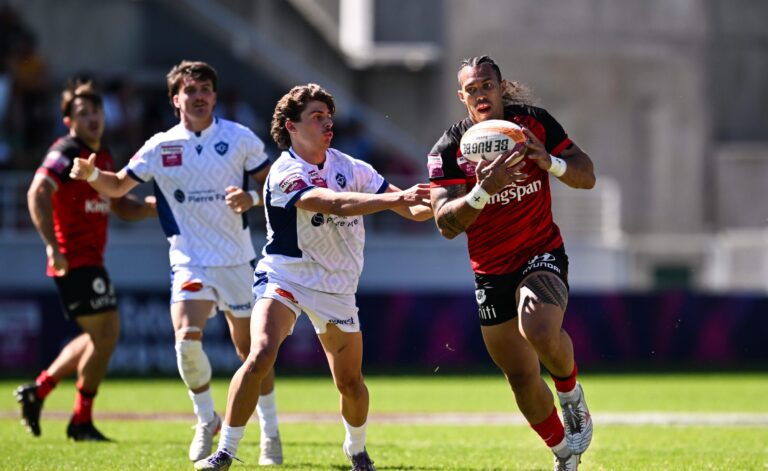
They are impressive, yes, but they do not tell the whole story. Running fast in a straight line is not the heart of rugby. What makes the difference is the ability to accelerate at the right moment, to angle your run, to change pace without falling apart. A player can cover a huge number of kilometres and be barely effective if he runs without intent. The aim is not to run more, it is to run better.
Can a rugby wing be compared to a sprinter?
Not really. It is a bit like comparing footballers to Usain Bolt. In a straight line, nobody can live with a sprinter. But rugby is not played in a straight line. A wing has to manage his footwork, the ball, the opponent, the space. On an angled run, a pure sprinter would sometimes struggle. Performance in rugby is contextualised speed.
“Rugby remains a sport of decision-making and of reading the game. To convince people, you have to start from the needs of the pitch, not impose an outside logic. Athletics is a wonderful tool, but it has to serve the game, not the other way round.”
Maryse Ewanjé-Épée
Have some coaches from an athletics background struggled to adapt to rugby?
Yes, because they have sometimes wanted to transpose models too directly. Rugby remains a sport of decision-making and of reading the game. To convince people, you have to start from the needs of the pitch, not impose an outside logic. Athletics is a wonderful tool, but it has to serve the game, not the other way round.
How do you view physical preparation in women’s rugby?
Women’s rugby often offers more continuity and more space, which brings out movement qualities more. You see longer, more varied running there. The qualities that come from athletics – coordination, active endurance, economy of movement – transfer very well. It is also an arena where technique can sometimes count for more than raw power.
Quel témoignage de @EwanjeEpee ?? pic.twitter.com/A5gm4Xjxnc
— ⭐France⭐ Pierron (@francepierron) September 26, 2025
“Running well, moving well, is already being a better player”
As a pioneer of women’s sport, how do you see athletic qualities being recognised in team sports?
It is improving, but it remains incomplete. For a long time performance was reduced to strength or pure speed. Yet real performance is control of the body, the ability to be efficient without putting yourself in danger. That intelligence of movement deserves to be given more value, for women as for men.
What message would you like to pass on to young rugby players, male and female?
Before wanting to be stronger or faster, learn to move better. Technique is not an optional extra. It is what allows you to last, to progress and to enjoy yourself. Running well, moving well, is already being a better player.
What athletics can really bring to rugby
For Marie Ewange Épée, what athletics brings to rugby does not come down to “running more”. It is above all about optimising the quality of the movement. On posture: running tall, with the pelvis well placed, allows better transmission of force and limits the load on the joints. On coordination: the arm-leg link is essential to maintaining speed while staying stable through changes of direction. On stride frequency and length: finding the right balance between cadence and stride length avoids burning excess energy. Finally, on managing transitions: being able to go from a static or pushing effort to a sharp acceleration is fundamental in rugby, notably coming out of rucks. In her view, these elements should be built in very early in player development, before muscle mass is added, in order to produce players who are powerful, efficient and durable all at once.



Comments