
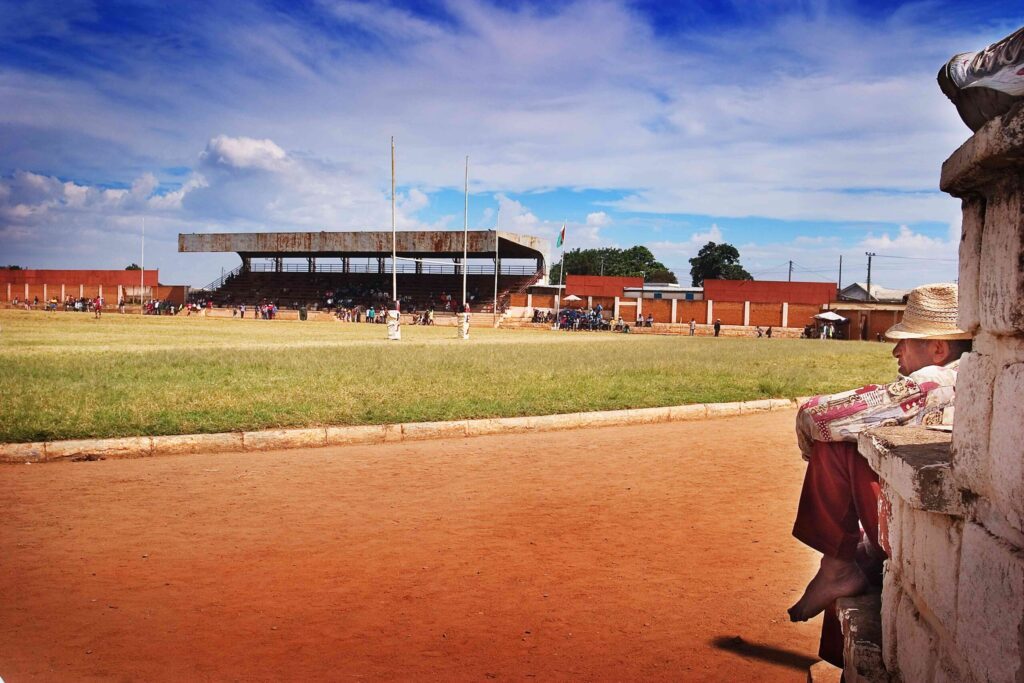
It is something like their very own European Cup…
Born in a region where the oval ball is still trying to establish itself against other sports, this sevens tournament aims to bring people together. La Réunion, Mauritius, Madagascar, Seychelles. An archipelago of talent, often under-exposed, gathered around the same promise. To provide a stage. To create momentum. To exist.
“In the Indian Ocean, rugby is a sport under construction. Less structured than in Europe, less covered by the media, sometimes less well supervised“, says one coach from La Réunion. Above all, less well funded. But deeply rooted in certain cultures, notably in Madagascar, where it goes far beyond sport to become a genuine popular phenomenon.
Rugby in the Indian Ocean: a sport under construction
The Indian Ocean Rugby Aroi is part of that reality. “It isn’t just about playing. It’s about creating a shared space. A fixture in the diary. A regional identity“, explained Bernard Sevaï, vice-president of the La Réunion rugby league in charge of rugby matters, before his teams left for the Big Island.
On paper, the idea is appealing. Provide game time. Encourage exchanges. Build a structured competition where there were sometimes only isolated initiatives.
But very quickly, the pitch is a reminder of another reality. That of the balance of power.
At the last edition, Madagascar quite simply swept through the tournament. Three categories, three titles, not a single defeat. Clear-cut domination, almost total. At U18 level in particular, the “Makis” crushed their opponents, with wide margins such as that 36-7 in the final, or a 26-5 win over La Réunion in the women’s competition.
Madagascar, Malagasy hegemony over the Aroi tournament
This Malagasy hegemony is no accident. It might even hint at something deeper. At a structural gap.
In Madagascar, rugby is the number one sport, with tens of thousands of registered players and a deeply rooted culture. Utterly paradoxical, when you consider that the country is one of the poorest in the world. The stadiums fill up, the competitions exist, the players keep playing… Without resources, but they keep playing.
Conversely, on the other islands, rugby is still developing. Less dense. Less regular. Less exposed.
Beyond the scorelines and the trophies, the Indian Ocean Rugby Aroi reveals another dimension, a far more strategic one. In plain terms, in Madagascar the tournament is not only a shop window. It is a tool. A lever for building structure.
National technical director Antsoniandro Andrianorosoa, quoted in the local press, sums it up without any beating about the bush: “The tournament allows us to spot young talent and to prepare for the next national championships in the sevens game.”
That sentence says it all. Where others see a regional competition, Madagascar sees a link in its development chain. A space for identifying players. A filter. An accelerator. Whereas rugby on the other sister islands can perhaps be seen more as a “tester“.
Because Malagasy rugby is not built solely in its domestic championships. It also feeds on these regional meetings, where profiles emerge, where potential is confirmed, where careers take shape.
Malagasy rugby: persistent logistical constraints
But that momentum, however promising, remains hemmed in by very real constraints.
The Malagasy coach does not dodge them. Complex logistics. Limited access to equipment. Physical preparation that is still uneven. All of them brakes that, for now, prevent a step up to the very highest level.
Another member of the federation: “Our frequent meetings with teams like New Zealand or Argentina show how far we still have to go.”
The assessment is clear-eyed. Madagascar dominate their region. But on the world stage, the gap remains. And it is precisely in that in-between space that the Aroi takes on its full meaning.
This imbalance is nothing new to those involved in La Réunion. They live it. And they analyse it clear-headedly. In the columns of le Quotidien, Jérôme Agenor, sporting manager of the La Réunion teams, makes no attempt to sidestep reality: “Madagascar will be favourites. The Malagasy will be at home. So they’ll be able to field all their best players.“
And so it proved…
An almost structural inevitability. Because – and we come back to it – beyond the simple advantage of home soil, it is an entire ecosystem that works in the Makis’ favour. Volume of matches, density of registered players, rugby culture. Where La Réunion are still trying to build, Madagascar are already cashing in.
La Réunion up against the Malagasy level: how much potential?
But for the La Réunion selectors, the aim goes beyond the bare result. This trip was part of an assessment process. Of confrontation. Of finding out the truth. “It’s an event that will allow us to assess our best young players in the region, to spot the finest potential.“
The Aroi then becomes a tool. An almost clinical indicator of the real level of La Réunion’s young players against the most demanding opposition in the region.
And here again, the verdict is blunt. “For the moment, we can see that our selections are still struggling to measure up against the collective game plan we’ve given them“, said Jean-Michel Piron, president of the La Réunion rugby league.
Behind that sentence, an even deeper problem emerges. That of a lack of benchmarks. Of a shortage of matches against others. Of a rugby that works hard but still lacks the exposure to calibrate itself.
Because one of the major issues highlighted by administrators remains the frequency of matches. The rhythm. The habit of playing at a high level.
Jean-Michel Piron makes it plain: “Here, at youth level, it’s the clubs that take part in a competition which qualifies them for a final tournament.“
A system that limits regular opposition, and therefore progress. Where other nations play match after match, La Réunion make do with a more restricted calendar.
Even past experiences have not been entirely convincing. In le Quotidien again: “We’ve already taken part, but at a regional level, a notch below, and we could all see that on the one hand the standard wasn’t very high, and on the other that the fact these tournaments are held over a single day didn’t allow us to play enough matches.”
A lack of volume that slows down learning. And which mechanically widens the gap with more structured nations.
Opening up the Aroi to Kenya and South Africa
From there, one line of thinking becomes unavoidable. Look beyond the regional framework. Go and find elsewhere what the area cannot yet offer. “We are indeed thinking about opening up to countries in the area other than the AROI ones.“
Kenya. South Africa. Options being discussed. More demanding horizons. Because to improve, you have to take on stronger opposition. Faster. More often.
In that context, the Indian Ocean Rugby Aroi appears for what it really is.
Not an end in itself. Simply a starting point.

Comments