
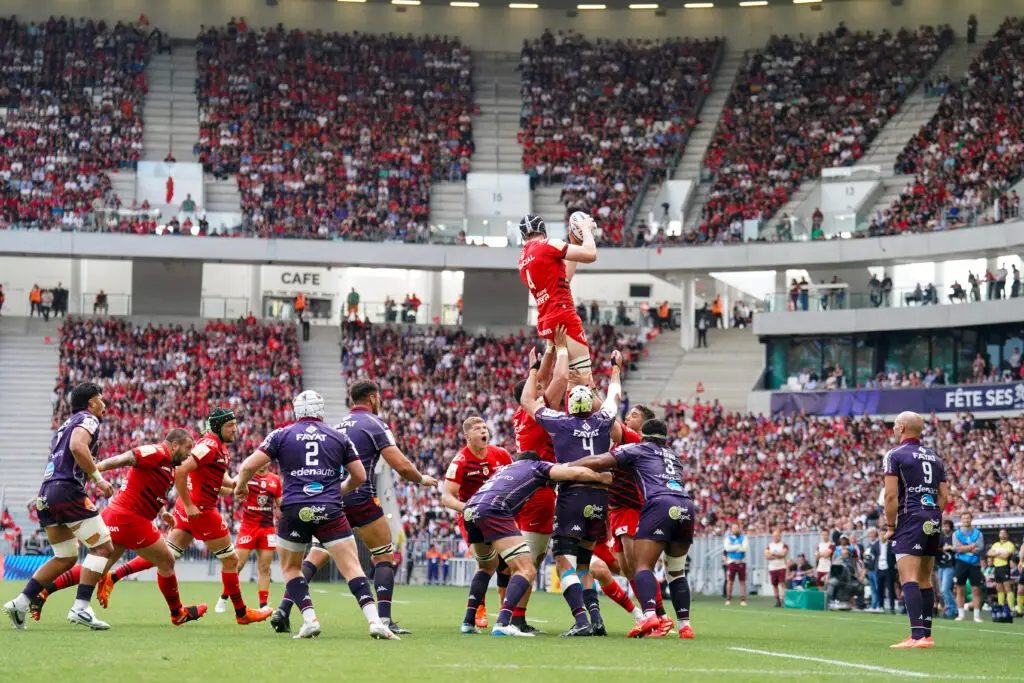
European rugby set out to be a summit; it sometimes looks more like a plateau lost in fog. As the second round of the Champions Cup comes around, ambitions are scattering, squads are fragmenting, and the competition still struggles to say what it really is.
While the leaves fall and winter stretches out its long nights, the Champions Cup, the great mass of continental rugby, is still losing itself in the mists of a late autumn. After a first burst of matches that did nothing but sharpen the questions, this weekend’s second round promises less to answer the doubts than to amplify them: who is really playing this tournament, and who is simply running aground in it?
A vast impressionist canvas
The observation is as blunt as it is clear-eyed. Thomas Ramos, one of the architects of Stade Toulousain, put it without any dressing up around ten days ago: within a field of twenty-four teams, how many are genuinely playing the Champions Cup? “If you amuse yourself by counting how many really play this competition, the fingers on your two hands are more than enough,” he said after the first round. A dig, but also a call to order. In its current format, the competition looks like a vast impressionist canvas in which the colours blur without clean outlines.
Some of the protagonists – South Africans in particular – have gone for wholesale rotation, sending out weakened sides even as teams cross two continents to face each other (shall we talk about the carbon footprint?), and the scheduling constraints tied to the international window help nobody. Fact one.
Buffer matches
And yet, at the heart of all this uncertainty, more tangible projects emerge. Aside from Antoine Dupont, back from injury and starting against the Glasgow Warriors like a lighthouse pointing towards calmer shores, the weekend offers a palette of contrasting duels. In Cape Town, the Stormers – unbeaten in the URC – host La Rochelle, double champions three years ago, who have chosen to rest several senior men. If not all of them.
La J2 s’approche… ⏳
— Investec Champions Cup France (@ChampionsCup_FR) December 10, 2025
Quelle affiche attends-tu le plus ? ?
? Toutes les infos de diffusion ➡️ https://t.co/EtwBDsKne1#InvestecChampionsCup pic.twitter.com/aB0tOr8JYy
ASM Clermont and the Sale Sharks meet at the Michelin in a head-to-head where the stakes look above all like a last chance to still believe in something. And then there are the “buffer matches”: fixtures where you scan the team sheets for who is missing rather than for who might go beyond themselves. The attacking bonus point system, different from the one we know in Top 14, has produced quantities of tries and wide margins, but hardly any suspense.
16 teams qualify
In a format where sixteen of the twenty-four entrants will reach the play-offs after four rounds, the feeling that the real stakes lie elsewhere persists, like a low note in a sonata still searching for its key.
Around the grounds, local passions are struggling to pull people together. But in truth, on a European scale, the Champions Cup sometimes gives the impression of one great collective question mark, a competition torn between the stated ambition of bringing together the best clubs of a continent (and of South Africa, which we still find hard to get used to…) and the reality of overloaded calendars, partial disengagement and teams with wildly different motivations.
This weekend again, we will wonder more about who is playing the Champions Cup than about who will win it. But perhaps, in the middle of a decisive tackle or a shining break, some clarity will emerge and finally set the course of that uncertain vessel that is European rugby: a course towards a competition capable of making passion rhyme with excellence, beyond the doubts and the calculations.



Comments