
They call it the scissor effect, and some see a cause-and-effect link in it. In other words, France in free fall, professional club rugby in rocket-launch mode. With the same players on both sides… 2016, the year of every contradiction.
France closed out 2015 with a memorable hiding at the hands of the All Blacks, in the World Cup quarter-final in Cardiff, 62-13. Non-existent. Quite the atmosphere…
(Photo: Juan Gasparini / Gaspafotos / Icon Sport)
At the start of 2016, Guy Novès and Philippe Saint-André were sharing the job until the end of the Six Nations. It began well, a narrow 23-21 win over Italy (Sergio Parisse missing the drop goal that would have won it for the Azzurri two minutes from time…), an even narrower margin against Ireland but a 10-9 win. What followed: three defeats, in Wales 19-10, in Scotland 29-18 and at home to England 21-31. France finished 5th.
Appointed at the head of France in December 2015 by president Pierre Camou, Guy Novès took up his duties for the tour of Argentina, matches deprived of the best players held back for the Top 14 semi-finals played at the Roazhon Park in Rennes. A successful start with a 30-19 defeat and a 27-0 win, France taking the series on points difference. The November tests would see France sit where they belonged, losing to the All Blacks and the Wallabies but putting 52-8 on Samoa.
December 2016, Guy Novès’s protector, Pierre Camou, was swept away in the federal elections. Guy Novès was exposed. Even though the new leadership “reiterated its confidence” in the Toulouse man, the writing was on the wall. The calamitous results of 2017 and his record (33% wins, 8th in the world) would prove fatal.
Meanwhile, the Top 14 was having a ball and playing the glamour card. The symbol of that era, the 2016 Dieux du Stade calendar had Italy captain Sergio Parisse on its cover, confirming the “starification” of the league’s players.
The league took precedence over France, stars everywhere you looked (Carter at Racing), Slade and Smith (Pau), Nonu (Toulon), Ashley-Cooper (UBB) and so on…
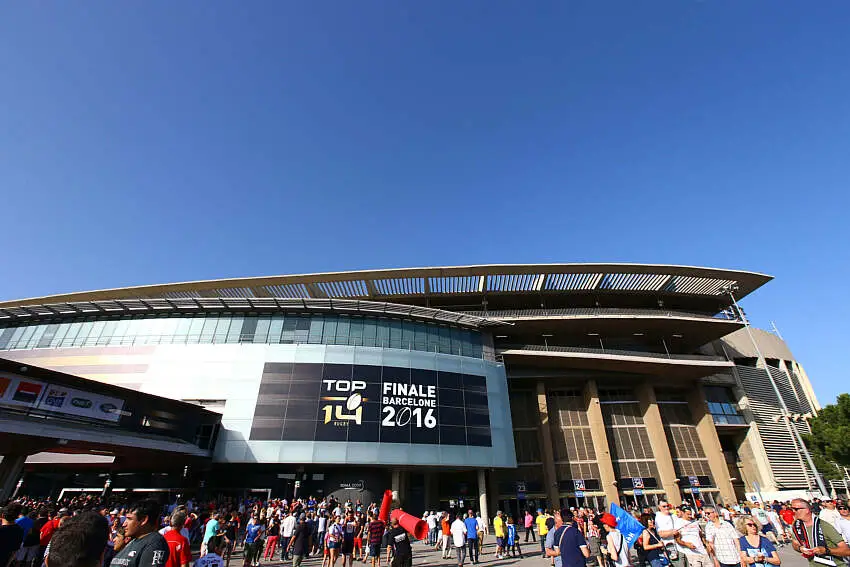
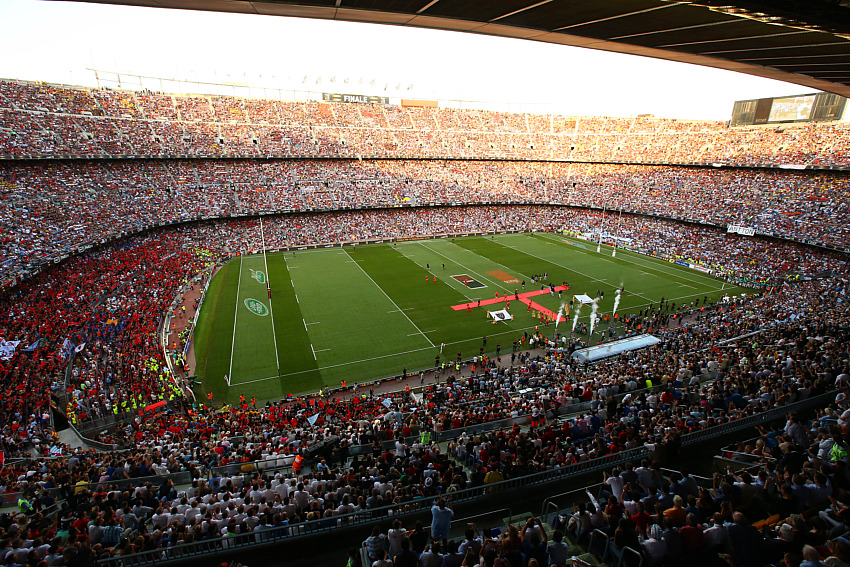
On the pitch, Racing 92 put together a full season. First beaten finalists in the Champions Cup in Lyon against Saracens (9-21), the Paris region side regrouped for the league.] Blazing semi-finals in Rennes and then, what can you say about the historic final staged at the Camp Nou in Barcelona… 99,124 spectators (a world record) watched Racing lift the Brennus for the first time since 1990. Full stadiums, stars, spectacle, everything was going the Ligue Nationale de Rugby’s way while the Federation was going through turbulence.
For all that, an LNR rule brought in for 2009/10 was starting to bear fruit: the introduction of a quota of home-developed players, the JIFF. Antoine Dupont, then at Castres, already had more than 20 first-team appearances and was on the France development list. Romain Ntamack would follow in his footsteps in 2017. The machine was up and running on the margins of the chaos, and France would have to reckon with the young ones.
If the “2026 is the new 2016” trend is currently flooding social media, French rugby finds a particular echo in that nostalgia. Going back ten years allows two realities to be set against each other: on one side, a France team in the middle of an identity and results crisis; on the other, a Top 14 at its economic and media peak, capable of drawing almost 100,000 people to the Camp Nou. Yet comparison is not proof. Do not read the non-selection of senior men such as Penaud, Fickou or Alldritt for this 2026 Six Nations as the start of a crisis like the Novès years… Or should you? Where 2016 was suffering a generational and political vacuum, 2026 is officially managing the “wear and tear” on its stars within a far more structured system. History is stuttering on TikTok, let us just hope it does not end up stuttering on the pitch as well.

Comments