
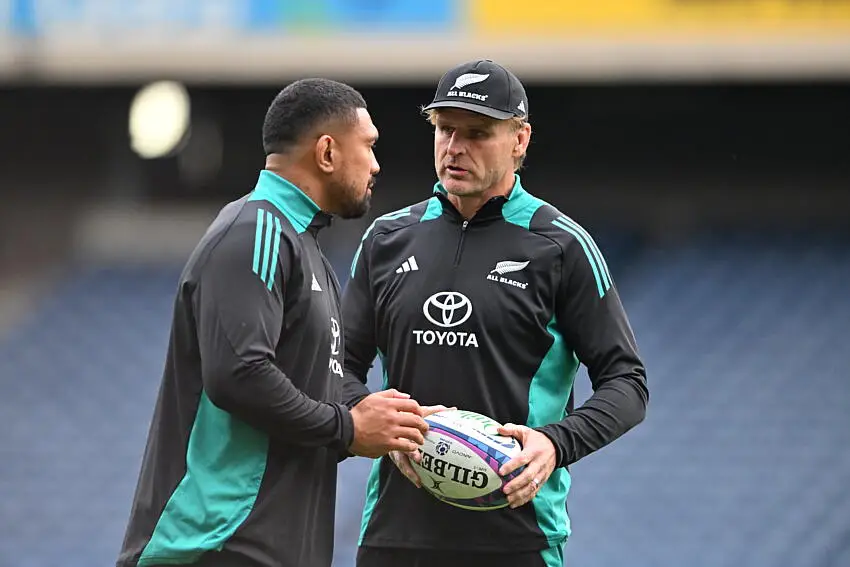
The subject grips you. Answers are still being sought. When New Zealand announced the end of the Scott Robertson era a fortnight ago, the country held its breath. More than a simple change of head coach, it was the fragile balance between the governing body, the dressing room and public opinion that found itself exposed. Yet, and despite the rumours of dissent, the All Blacks have so far avoided a collective explosion.
And yet New Zealand Rugby’s decision to part company with its head coach after a savage end-of-season review, which landed like a rarely heard clap of thunder, is not illogical. The head coach, in the job for only two years, has a mixed record – notable wins, but also historic defeats that weighed heavily in the equation.
Mutiny and uprising
The debate immediately crystallised around one word, repeated on a loop by the New Zealand Herald: “mutiny“. Some media outlets fanned the idea that senior players, Ardie Savea among them, had pushed the former Crusaders coach towards the exit. The federation had to respond. Fast. David Kirk, the NZR chairman, firmly denied the existence of any player “uprising“, describing the senior players’ answers as “measured and considered“.
The fact remains that this measure, taken less than two years out from a World Cup next door in Australia, may come a little late, and perhaps also very (too) brutally for a nation where everything has looked buttoned down for donkey’s years. All the more so as the All Blacks have been looking for a head coach ever since. And names are circulating, with nothing official. “The federation had never got us used to this, always ahead of its time, able to anticipate the slightest hitch, always able to see everything coming“, you can read in the local press. Decisions and a structure ahead of their time which, admittedly, could not prevent the odd swerve off the road (defeat by France in the 2007 quarter-final, by England in the 2019 semi-final), but which kept the All Blacks at the summit.
Scott Robertson has departed as Head Coach of the All Blacks. We wish Razor all the best with his next steps.
— All Blacks (@AllBlacks) January 15, 2026
A process will commence immediately to recruit a new Head Coach. pic.twitter.com/WWDtsox5ed
Scott Robertson himself spoke up, saying he was “gutted” by the turn of events, while making clear his respect for the honour of having coached the All Blacks. His statement cooled the atmosphere: the coach’s personal emotion prevented the controversy, publicly at least, from degenerating into a media civil war.
The Savea case
Then there is the figure of Ardie Savea, whose name has echoed through countless articles. The man who has captained the side several times is described as “seriously unhappy” by some local titles – descriptions relayed by the international press and by analysts who see in his public stances the symptoms of a wider malaise.
But the back-rower, voted world player of the year in 2023, could also be the illustration of those “new players capable of placing themselves above the jersey“, as it is written. In plain terms, an individual “above” the institution. And that, something of a novelty in itself, is hardly appreciated among the three-time world champions. For all its share of very great players, with influence around the world and sometimes even beyond the oval game, the New Zealand side has always functioned collectively, in an almost “corporate” way.
A level of demands
But far from any organised revolt, it seems above all that the tensions took the form of “demands“, adds the New Zealand Herald: clarify responsibilities, change tactical direction and give the group a clear sense of direction again.
So why has the country not tipped completely into the crisis that is nonetheless very much simmering? Because, paradoxically, New Zealand rugby culture and the caution of the authorities have acted as a moderating force. The official process – review, hearings, measured statement – absorbed the blast. The dissenting voices were given airtime but not institutionalised; the leaders preferred the threat of resignation to head-on confrontation. Commentators speak of a “necessary corrective” rather than a revolution.
An update on the All Blacks Head Coach process ?? pic.twitter.com/UDVcL6Qaiu
— All Blacks (@AllBlacks) January 25, 2026
With “peace” hanging by a thread, the job in hand remains vast: strengthening cohesion, renewing the coaching staff and, above all, rebuilding trust between players, coaches and supporters. A harmony that had never really looked as fragile as it has these past few months.
Two years out from the World Cup, New Zealand have chosen procedural calm rather than confrontation. The fact remains that a blast like this is hardly in the New Zealand habit. But calm does not mean resolution either. Because if the senior players’ demands are not turned into concrete action, today’s quiet could well be tomorrow’s storm. If it is not already…

Comments