
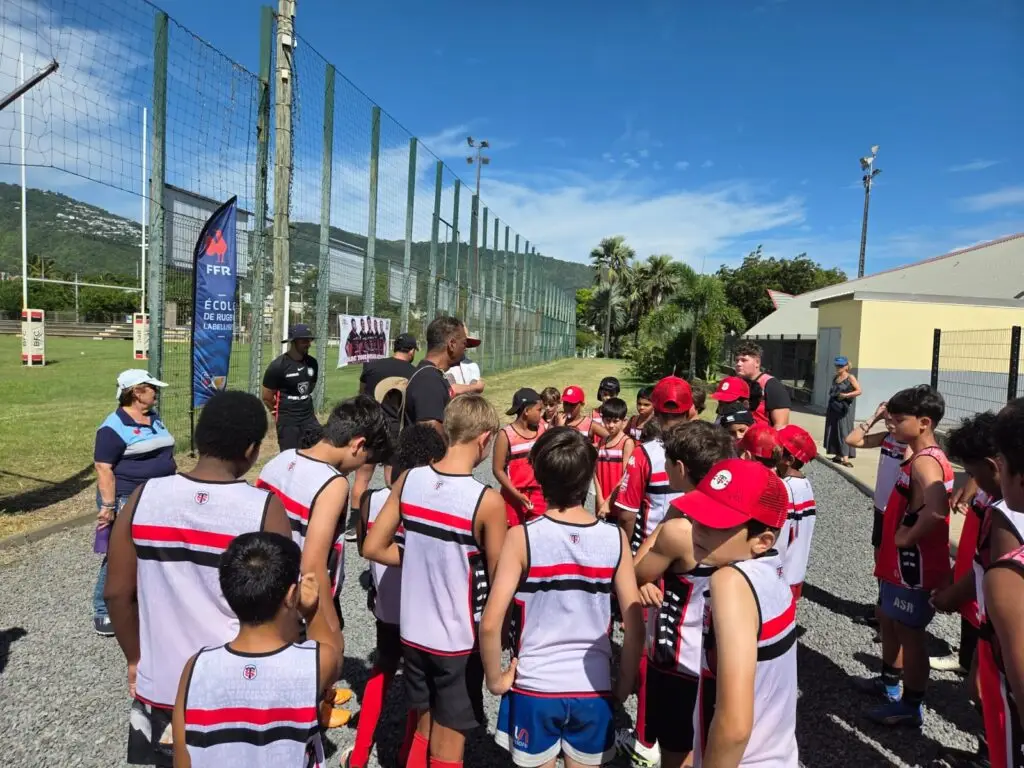
The wind comes down from the highlands and sets the white posts shivering. In Saint-Paul, the pitch at the ground still bears the marks of a morning session, a camp for the youngsters. A few balls are lying around, the smell of dry earth hangs in the air. On the touchline, Domitille laces up her boots. She smiles when you put the question to her.
“At the start, people look at us as if we’d turned up at the wrong sport.”
She is 13, only just, fairly solidly built and with a direct gaze. She came across rugby almost by chance, following a cousin to training. Since then, she cannot do without it. The tackles, the mud, the third halves. All of it.
But there are also the comments.
“At school I was often told it was a boys’ sport. We were told to go and do ballet. Some people thought we’d get injured or that we wouldn’t be strong enough“, she says.
20% of registered players in Réunion are women
A few metres away, Sasha and Maëlle burst out laughing. They know the tune.
On the pitch, though, nothing sets their carries apart from the boys’. Shoulders drop, the impacts crack, the gain line is won centimetre by centimetre.
Rugby remains a mostly male territory. In France, women still make up a minority of registered players. They were a little over 15% in 2021, around 26% today, even if the progress has been steady for twenty years.
Everything is being done to shift things”
In Réunion, the proportion is lower still. Barely more than a fifth of registered players. A figure that says a lot. “But everything is being done to shift things”, the president of the Réunion rugby league, Jean-Michel Piron, would say later.
Maëlle sits down on a ball, elbows resting on her knees. “When you arrive at a club, you sometimes feel you have to prove yourself twice over.” Prove you can tackle. Prove you understand the game. Prove you deserve to be there. Because here, the culture is still different. More “pronounced“.
The history of women’s rugby in France is a recent one. The first structured competitions only appeared in the 1970s. For a long time, players operated in the shadow of the men’s clubs, with few resources and almost no visibility.
Even today, professionalisation remains limited. Only a handful of internationals have a genuine contract. Most juggle studies, work and training.
On the island, the gap is even more visible.
A sport that nonetheless breaks plenty of clichés
Domitille talks about the car-sharing to away games, the shared pitches, the late training sessions. “But it isn’t a complaint. We know why we play.“
Rugby, they say, is a school. A school of solidarity. A school of character.
Sasha, the third member of the inseparable group at this camp, gets up and grabs a ball. She spins it in her hands like a familiar object. “This sport breaks a lot of clichés. When people see us play, they change their minds.”
A more sexist society?
Because the question goes beyond the pitch alone. In France, several recent reports have warned of a resurgence of masculinist rhetoric and gender stereotypes in society. Almost a quarter of the population is thought still to subscribe to forms of so-called paternalistic sexism, associating women with domestic or secondary roles.
Sport does not escape these representations. Rugby, perhaps more than others.
Because it carries an old culture of manliness. Because it prizes power, confrontation, team brotherhood. Values long reserved for men.
But on the pitch at Saint-Paul, those codes are gently changing.
“We just want to play”
Maëlle remembers her first try. “I felt I belonged. Not as a girl who plays rugby. As a rugby player.” Mature, isn’t it?
The nuance is essential.
The sun goes down over the Indian Ocean and the light softens. The girls get back to training, in a stream of boys. The passes flow, quick and precise.
Rugby is perhaps not sexist by nature. But it remains a world that is transforming slowly.
With every tackle, every scrum, every try. And on this pitch in Saint-Paul, Domitille sums it all up in one sentence. “We’re not trying to prove that girls can play rugby. We just want to play.“


Comments