
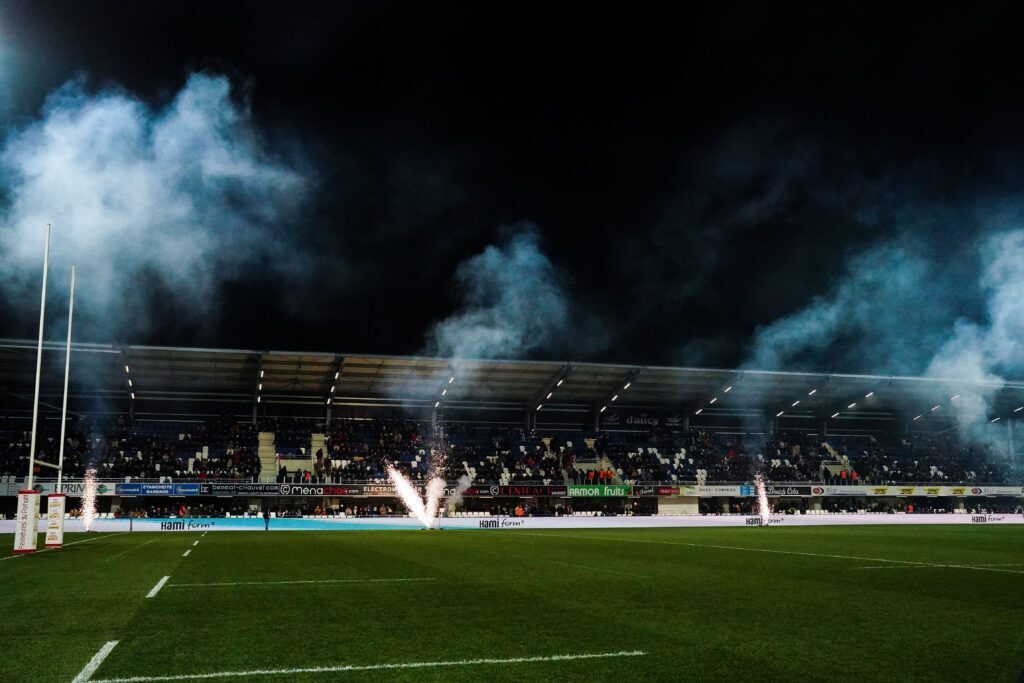
Walk into any rugby stadium in France or Europe and you get a curious sense of having heard it all before. The speakers blare out the same unifying anthems, the same choruses chanted in unison, the same musical build-ups calibrated for a try or for the players coming out.
That repetition is not down to chance, nor to a simple lack of imagination on the part of the people picking the tracks. It says something deeper about rugby and about the way the sport thinks about the collective.
Signals and moments
First of all, the stadium is a place of ritual. Rugby, more than other sports, cultivates a shared memory and a shared imagination. Music plays the role of symbolic marker there. “We Will Rock You” or “Freed From Desire” are no longer simply songs: they are signals. They announce a moment, call for a reaction, synchronise bodies and voices. In a stadium, effectiveness wins out over novelty. You do not experiment, you reassure. A crowd of 50,000 people does not come together around the unknown, but around the recognisable.
There is a timing constraint too. Rugby is a stop-start sport, punctuated by short and unpredictable breaks in play. The music has to be instantly identifiable, capable of producing an effect within seconds, sometimes to the detriment of the players and the coaching staff. A hook, a beat, a simple chorus. Take Ernest Wallon, for example, where the Toulouse sound system blasts out loud, very loud. Subtlety does not have time to blossom between two scrums. “Music becomes a functional tool, almost a piece of match equipment, in the same way as the scoreboard or the announcer,” someone tells us in the stands at Jean-Alric in Aurillac.
Economic and budgetary logic
To that you can add an economic and legal logic. The big international hits, played everywhere, are often simpler to use in rights terms, thanks to blanket agreements with collecting societies. They also offer a form of cultural neutrality: well enough known to bring people together, consensual enough not to offend anyone. In a sport attached to its values of unity and respect, the choice of music is rarely a place for boldness.
But that uniformity also says something about the crowd. Rugby is experienced as a collective celebration, where you come as much to share as to watch. The music is not there to surprise, but to accompany. It works like an automated supporters’ chant, a sonic extension of the terraces. Through sheer repetition, it becomes the stadium’s intangible heritage.
The din of a chorus
One question remains open: is this frozen soundtrack ever going to change? At a time when rugby is trying to win over new audiences, younger and more urban, some clubs are attempting to bring in other references, other styles. But change is slow. Because in rugby stadiums, music is not just scenery, it is above all a promise of continuity, a thread stretched between the generations. And sometimes, in the din of a chorus heard a thousand times, that is precisely what people come looking for.
Our top 10 stadium songs:
An unofficial and subjective playlist, passed on from stand to stand, and now the universal soundtrack of modern rugby.
1. “Seven Nation Army” – The White Stripes
There is no escaping it. Its minimalist riff has become a global crowd chant. In rugby, it accompanies tries as readily as big moments, turning every ground into a tribal echo chamber.
2. “We Will Rock You” – Queen
The clapping and stamping is tailor-made for the terraces. Simple, unifying, almost military, this track is a tool of collective mobilisation, used before scrums or to crank up the pressure.
3. “Freed From Desire” – Gala
Recycled as a supporters’ chant across Europe, this 1990s dance hit has become an automatic celebration anthem after a try or a win. Above all the anthem of France during its World Cup…
4. “Eye of the Tiger” – Survivor
A symbol of effort, of combat and of pushing your limits, this track often accompanies the players coming out or the moments when the stadium wants to make clear that “the match starts now”.
5. “Thunderstruck” – AC/DC
Its electric intro is ideal for putting a charge through the stands. Straight-up rock works as a sonic stimulant before the decisive phases. Still on AC/DC, let us go and ask the Toulon fans about their entrance track (Hell Belt!).
6. “Song 2” – Blur. Short, brutal, explosive. Its famous “Woo-hoo!” is perfect for punctuating a collision, a big carry or a spectacular passage of play.
7. “Jump Around” – House of Pain. Used to make the crowd literally jump, this track turns the stands into a collective dancefloor, often at half-time or during breaks in play.
8. “I Gotta Feeling” – The Black Eyed Peas
More consensual, more festive, it often serves as an intergenerational glue, particularly at the end of matches or during celebrations.
9. “Don’t Stop Me Now” – Queen
Another classic from the British band, used to accompany attacking spells or euphoric finishes.
10. “Zombie” – The Cranberries
Now a supporters’ chant in its own right, taken up a cappella by the stands, particularly in Ireland and France. Played less through the speakers than by the crowd itself, but unavoidable.
Not forgetting, of course, our great French classics (Les yeux d’Émilie, Les oies sauvages, la Pena Baiona, some Johnny and so many more…)
And you, what is your playlist for a match?



Comments