
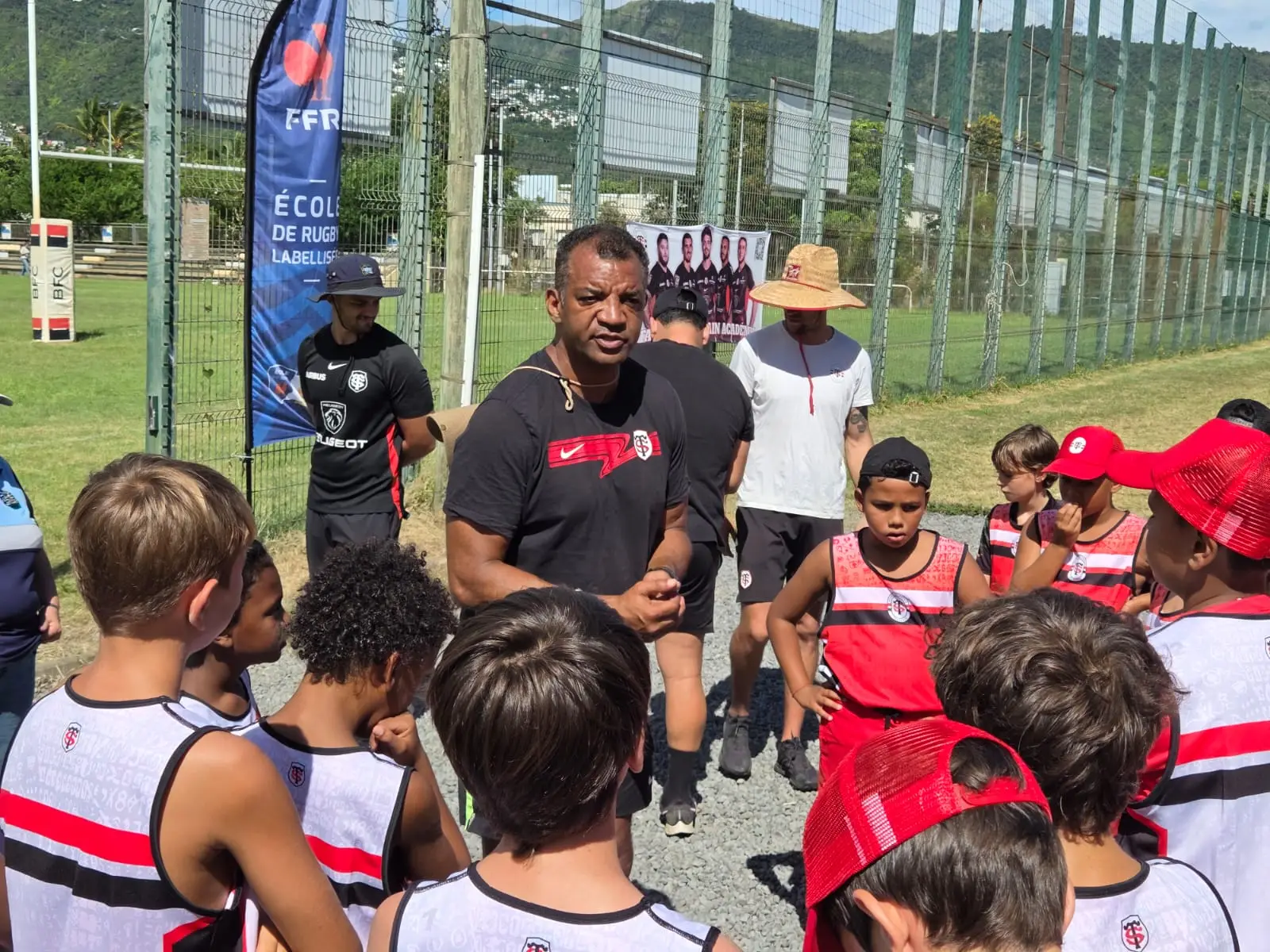
Some images tell the whole story without many words. A child lifting his head before making a pass. Another one talking, calling, repositioning himself. A ball that doesn’t hit the floor. “Just like Dupont“, shouts 12-year-old Maël. On the other side of the world, Toulouse rugby is taking root.
In Saint-Denis de La Réunion, the island’s administrative capital, these movements are not incidental. They carry a signature. That of Stade Toulousain, unmistakable among all others. A rugby of movement, of speed, of collective instinct. A rugby that is learned, repeated, handed down.
For three days, the academy of the multiple French champions turned the island’s pitches into an extension of its identity. After a first wave of more than a hundred children in Saint-Paul, around fifty took part in the Saint-Denis session. A particular vision of how you export an identity, a brand, an empire.
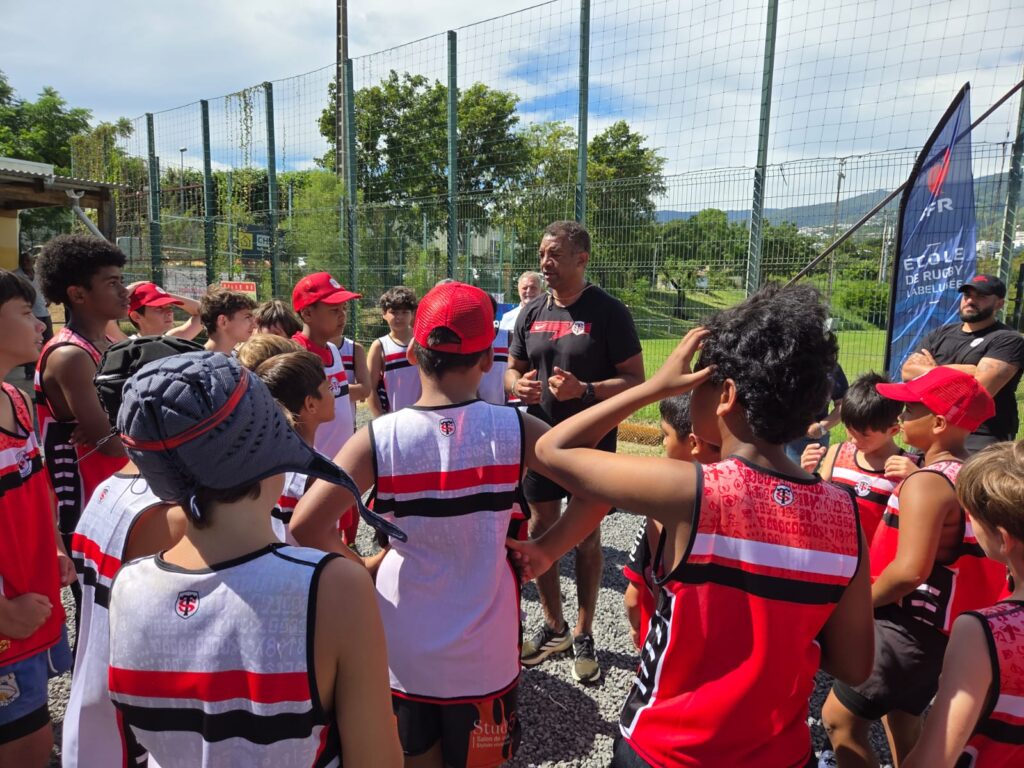
“It’s obvious that Toulouse, even for the less clued-up, is a selling point“, adds Jean-Michel Piron, president of the La Réunion rugby league.
Youngsters came from all over the island, some complete beginners, others already hooked. All drawn by a simple promise. To get close to, to touch, to understand this rugby they usually watch from a distance. From a very long way away…
Stade Toulousain aren’t here to recruit, they’re here to pass it on
At the side of the pitch, Émile Ntamack watches without raising his voice. He corrects a technique, encourages a movement, lets them play.
The former international embodies this philosophy. Here, as in French overseas territories all around the globe, this is not about early talent identification or projecting anyone towards a professional career.
“It’s a bit early to talk about talent identification, he explains. We wouldn’t know what to do with a ten or twelve-year-old in Toulouse, far from home.“
The message lies elsewhere. “The idea is for them to realise that what they see on television is within reach.” In a few words, Ntamack sums up the essence of the project. Demystify the top level. Bring the dream closer.
“We tell them you’re going to play like Stade Toulousain and above all you’re going to realise that it isn’t complicated.” Out on the grass, that translates into exercises that look simple but are demanding to execute. Stay on your feet. Keep the ball alive. Communicate constantly.
“We’re going to produce a rugby with plenty of movement, a ball that stays alive as long as possible“, he explains.
A method, a culture, a signature
What strikes you isn’t only the quality of the exercises. It’s their coherence.
Because every drill is part of an overall vision. That of a rugby where the collective comes first, where speed of execution makes the difference, where the game never really stops. Just like the senior side, currently top of the Top 14.
And yet, “this rugby isn’t something reserved for us, Ntamack insists. It’s the way we train and the way we develop it that means you find it out on the pitch.“
So Stade Toulousain aren’t selling a “secret“. They are sharing a method. A teaching approach and, more than that, a philosophy. All over the world.
And above all, they are sharing a culture. “Rugby provides an education based on the group, on difference, on respect and on enjoyment.”
And in the exchanges between children, in the encouragement, in the mistakes corrected without pressure, that culture becomes tangible.
A quiet strategy that goes beyond the pitch
But behind the sessions and the smiles, another reading suggests itself. Because Stade Toulousain are no longer content to shine on Top 14 pitches, they are part of a broader movement. That of a club extending its influence.
But not through slogans, through concrete actions. “We’re getting more and more requests“, Ntamack says. And if we can help out, we do it.”
La Réunion is one example, as the Caribbean was before it, and mainland Europe. The initiative came from parents whose children had taken part in a camp in Toulouse. A request, an opportunity, then a trip by the academy of the club from the Capitole.
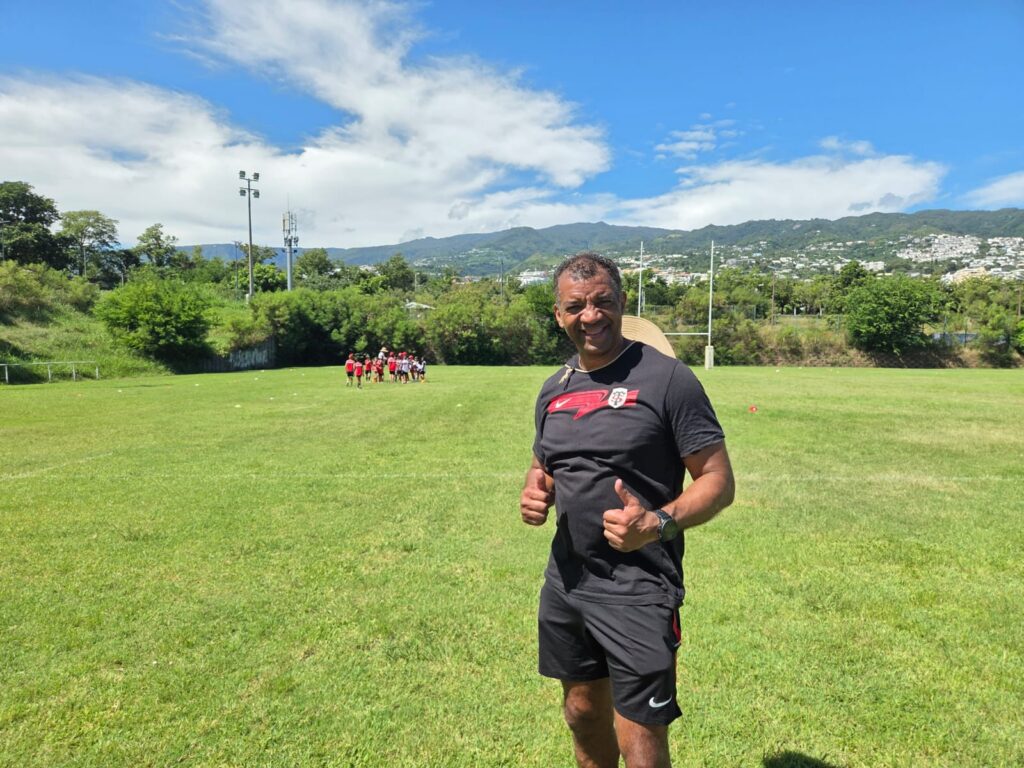
“It’s the people you meet that make things happen. We develop it bit by bit“, Ntamack goes on.
That step-by-step approach amounts to a genuine development policy. A controlled expansion, built on handing things down rather than on projecting players forward.
Stade Toulousain export themselves where rugby wants to grow
In La Réunion, though, rugby is not the dominant sport. Football and handball take centre stage. The Dimitri Payets and Jackson Richardsons carry far more weight than a Wenceslas Lauret or a Maël Turpin (except perhaps for La Réunion’s newest adopted son Louis Bielle-Biarrey). And yet the potential is there… “There are fantastic athletes here“, Ntamack says.
In that context, the Toulouse club’s visit acts as a revealer. A trigger in a place where rugby culture struggles to break through the local habits.
It gives the sport visibility. It gives coaches tools. It feeds children’s imaginations. “At that age, you draw on dreams, Ntamack says. Some of them can tell themselves why not me.“
Why not them? “One day I’d like to play in Toulouse, alongside the greatest French players“, says 13-year-old Adriaan proudly, in front of rather more sceptical parents.
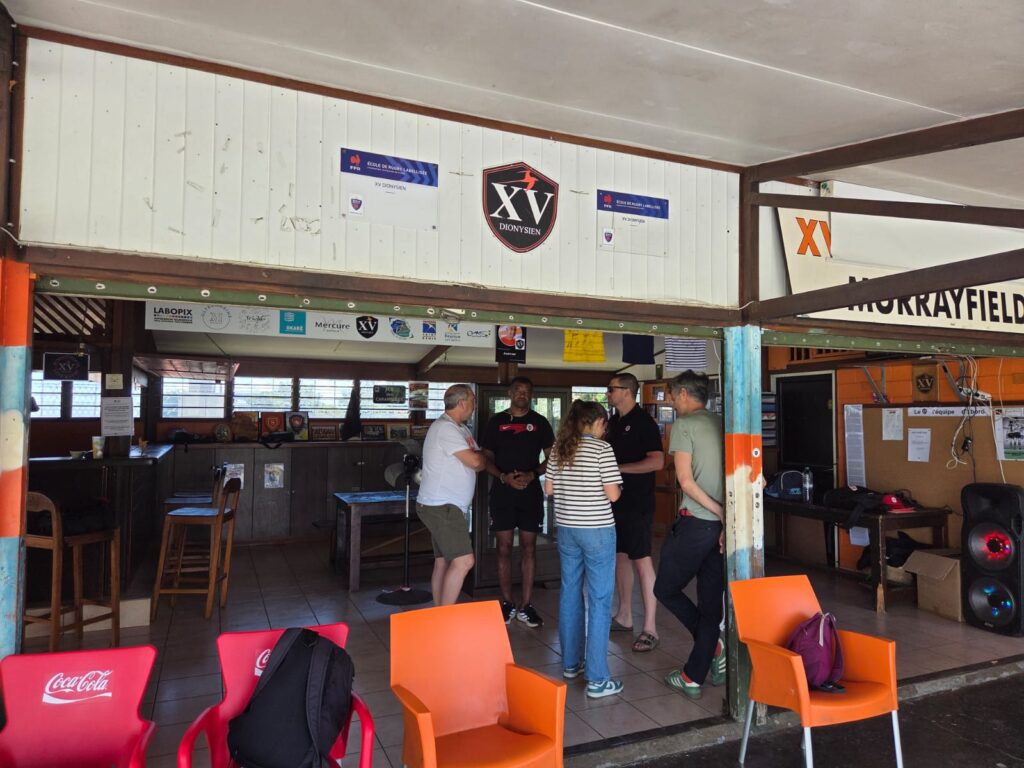
A destiny these young islanders will have to force open, even more than others. “You’d have to send them off at the age of 10 to somewhere 11,000 km from home…“, some parents point out at the side of the pitch.
“Stade Toulousain is a dreamcatcher, a target, a holy grail and almost, for the youngsters here, a life plan, Piron says, but a complicated dream.“
Above all, this visit sends a strong message. “Just because you’re in La Réunion doesn’t mean it’s out of reach“, Ntamack insists.
Coaching the children, supporting the coaches, leaving a mark
One of the most striking aspects of the camp sometimes plays out away from the spotlight.
Alongside the children’s sessions, local coaches talk with the Toulouse educators. They watch, ask questions, adapt. “We also work with the coaches to bring them new things“, explains the legend that is Ntamack, sparkling, true to himself.
The aim is clear. To make sure the impact of the camp doesn’t stop on the final day. “The younger you learn things, the easier it is“, he points out. The Toulouse recipe in its purest form.
And by passing on methods and principles, Stade Toulousain are playing the long game.
A club, a brand, a mark left behind
At the end of the sessions, the children stay out on the pitch. The caps and bibs they were given are carefully signed by the Toulouse legend. Another way of leaving the red and black mark on the island.
They carry on playing, reproducing the skills they’ve learned, telling each other about their moves. Something has changed. Imperceptibly, perhaps. But lastingly.
Because Stade Toulousain didn’t come simply to run a camp. They came to leave a mark. A lasting one.
“In a modern game where clubs are looking to exist beyond their own borders, Toulouse are moving forward with a strong identity“, stresses Jean-Michel Piron. The symbol of a unique model of expansion.
But an identity that isn’t limited to their titles. It is also being built here. On a pitch in Saint-Denis, in La Réunion, 11,000 km from Ernest Wallon.
In the passes of children who have never set foot in mainland France. And who, for a few days, played “like Toulouse“.

Comments