
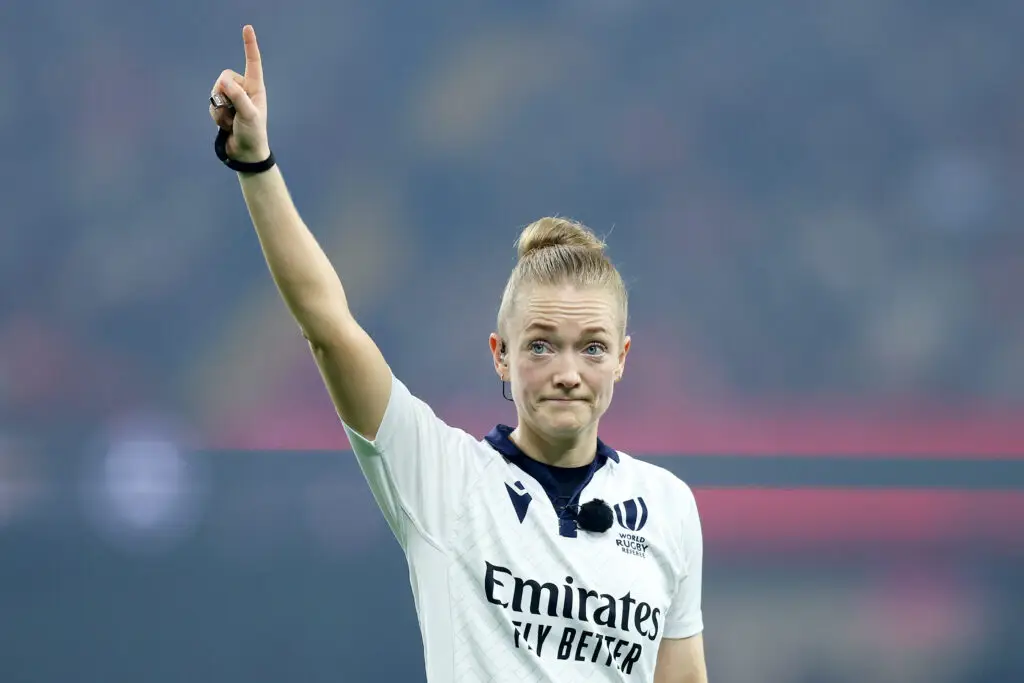
For the first time since the creation of the Six Nations, a woman will take charge of a match as the referee. The appointment of Scotland’s Hollie Davidson for the 2026 edition marks a symbolic and political step in a sport long locked down by male codes, and confirms the deep evolution of top-level refereeing.
The history of the Six Nations was written for more than a century without the whistle ever being handed to a woman. That lock has just been broken. As part of the preparations for the 2026 edition, World Rugby has confirmed an appointment that will go down in history: Scotland’s Hollie Davidson will become the first woman to referee a men’s match in the Championship. A decision that is both sporting and highly symbolic, and which goes far beyond a simple technical appointment.
From becoming the Scottish Rugby Union's first full-time professional women's referee back in 2017, to being named as the first woman to referee a men's Six Nations match ?
— Rugby on TNT Sports (@rugbyontnt) December 18, 2025
Hollie Davidson continues to shatter the glass ceiling ? pic.twitter.com/XAHxcNBTKV
At 32, Hollie Davidson is not a newcomer parachuted in to answer a communications need. A former player, she has gradually carved out her path in refereeing, climbing the ladder as far as the biggest international competitions.
Already used to leading fixtures, notably in the European cups, she has made her name through her rigour, her reading of the game and her calm authority, essential qualities in a game that is ever quicker and ever more exposed in the media. Her path, often summed up as a move “from ball to whistle”, above all reflects a wholehearted professionalisation in an environment still marked by a strong male tradition.
A performance-based logic
World Rugby owns the historic nature of this appointment, while rejecting the idea that it is an isolated gesture. The international body insists on a logic of competence and performance, stating that gender equality in refereeing cannot be limited to symbols but must be built to last.
The message is therefore clear: international level is no longer reserved for a single profile, and authority on a pitch depends neither on gender nor on past convention. The 2026 edition of the Championship, scheduled from 5 February to 14 March, will also bring together referees already well known to the public, such as England’s Karl Dickson or Australia’s Nic Berry, who will take charge of some of the major fixtures, notably France’s. In that context, Hollie Davidson’s presence fits into a coherent whole, and is not a tolerated exception.
?Hollie Davidson is set to make yet more history after she was appointed as referee for the Ireland v Italy match in the 2026 Guinness Men’s Six Nations?#AsOne pic.twitter.com/2zzP3qvDAC
— Scottish Rugby (@Scotlandteam) December 18, 2025
Beyond the Championship, this decision could have lasting effects on training structures and on vocations. For many young female referees, often confined to women’s or amateur competitions, this appointment opens up a horizon that was until now out of reach. The Six Nations, the shop window of European rugby, thus becomes the stage for a quiet but profound shift.
While the sporting stakes will of course remain central during the Championship, this edition will also carry the mark of a major cultural change. By handing the whistle to a woman, international rugby is acknowledging that authority, too, can change its face without losing its credibility.



Comments