
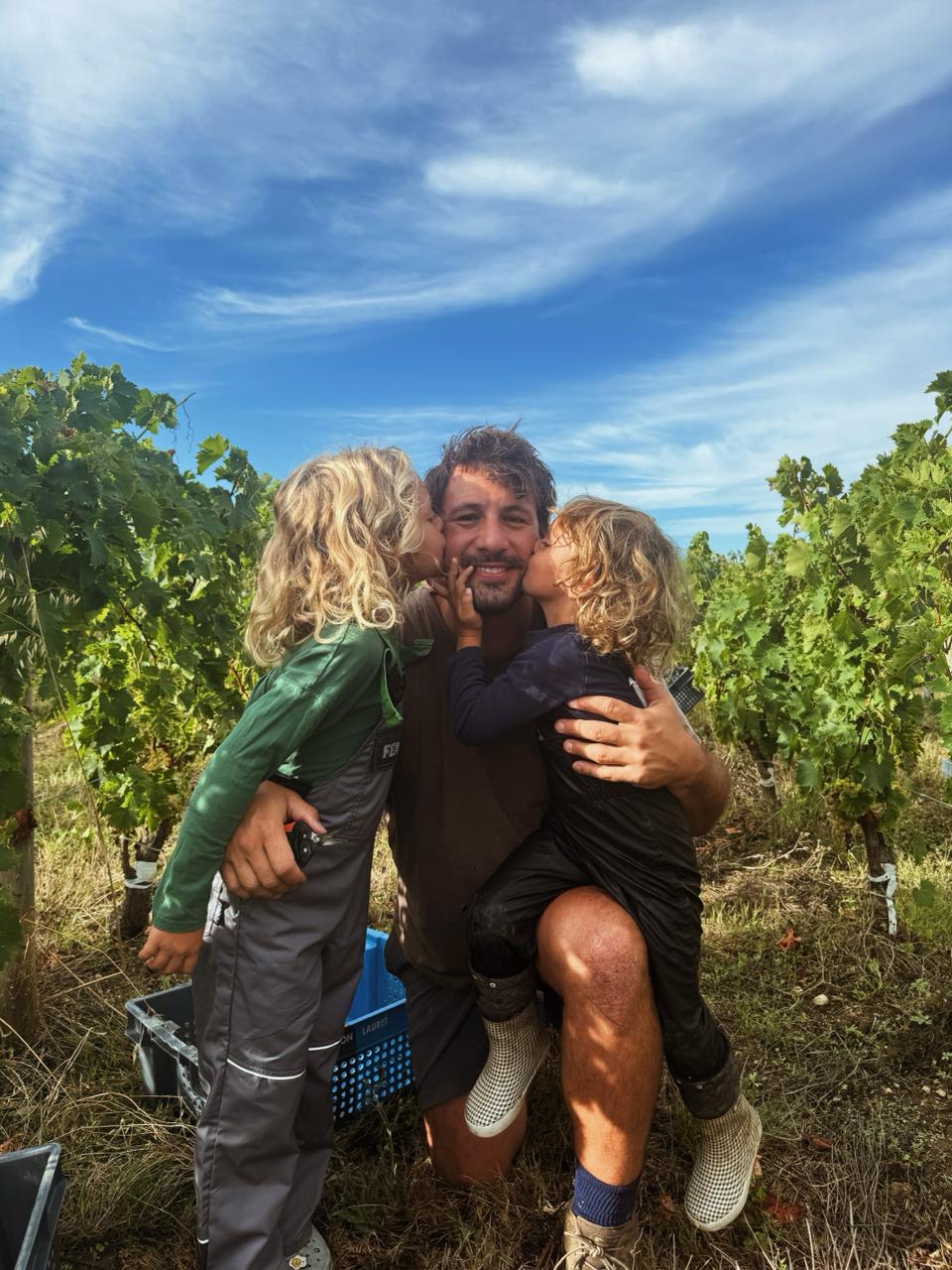
Whatever happened to Rémi Lamerat? A product of Stade Toulousain, the centre went on to play for Castres, Clermont and Union Bordeaux-Bègles, winning caps for France along the way. These days his boots are planted between the rows of vines at Domaine Grand Jour.
He talks about a career change he started preparing at 22 or 23, learning to be an entrepreneur on the job, the estate’s guinguette and the climate, which now worries him more than sales. Interview.
IT’S RUGBY. – Rémi, when did you realise you had to prepare for life after rugby?
Rémi Lamerat: When a career starts, you know when it begins, but you never know when it will end. That’s grumpy old man’s advice, but you have to keep it in mind. These days, choosing when your career ends has almost become a luxury. An injury can come sooner than expected and turn everything upside down. With my first physical setbacks and my first big bouts of self-doubt, I quickly understood that my career could stop at any moment. So at 22 or 23, I went back to studying viticulture and oenology to prepare for what came next. I was lucky to have a second passion that took up a lot of my time: wine.
Yet you didn’t end up in this world completely by chance.
I’m the fourth generation of my family to work in wine. My parents weren’t winemakers as such, but my father printed wine labels. We always grew up around that world, which is everywhere in the Bordeaux region. So I knew the environment without really mastering it. What I find stimulating today is that you are always learning. Today’s truth isn’t tomorrow’s, and even less yesterday’s.
What surprised you most about the career change?
Being an entrepreneur! Top-level sport gives you high standards, a taste for challenges and a constant urge to question yourself. But running a business is something else. I was very well trained on the technical side, but much less prepared for management. Looking back, I regret not surrounding myself with more people and getting more support on the business side.
Today, how much of your time goes on management compared with the vineyard?
The vines were there, but the neighbour was farming them. There was no winery, no customers, no stock, no range. So we started from a blank page on the whole commercial side. Today I have to be out on the ground, spread the word about the project, represent the estate and make people want to discover our wines. Over the past two years I’ve stepped back from production, even if I still keep an eye on it. Sales and representation now make up more than half of my work.
How do you build your credibility as a winemaker, beyond your past as a rugby player?
Rugby and wine have obvious things in common. Both are worlds tied to rural, local and human values. Of course, it’s easier to sell wine to a rugby club than to a chess club! But I don’t want to rely only on my sporting past to sell my bottles. That would be reductive, because my ambition is to be recognised as a winemaker. What makes me proud is seeing customers come back the following year because they liked my wine. At first, some come because they saw me play at Bordeaux or Clermont. Then they taste it, they like it and they come back with their friends and family. At that point, it’s the winemaker doing the talking.
Sharing also plays a big part in your project, notably with a guinguette, an open-air country bar.
Wine brings people together. It gathers them around a table, gets them talking and creates bonds. I really believe in those moments of sharing. Tourism has always been part of how I see the job: it helps sell wine, of course, but above all it gives people a good time. We stand for the rustic and the authentic, no fuss and no show. There are glowing embers, wine and people with smiles on their faces. I’m not sure I would have lasted in this business if I hadn’t been able to share my work this way.
This professional project is also a family one.
It’s even more of a life project than a professional one. We were looking for a quiet, rural setting, with the children at the village school and a real quality of life. I built my professional project around that vision, and the two fit almost perfectly. Today I’ve brought my family along on this adventure. The work keeps the life project going, but we must not lose sight of what made us settle here.
With climate change, a winemaker’s job also comes with constant uncertainty.
That’s what I find hardest today. What holds true one year can be swept away the next, which makes it hard to set a lasting technical strategy. This year, for example, we decided to work the soils more. After the difficulties we had in 2025, my colleague advised me to change our approach. We listened to him and we got what may be our best vintage since we arrived, despite a very dry and very hot year. But nothing guarantees this strategy will work as well next year. You have to keep adapting. Today I’m more worried about the climate than about sales.
Finally, what can we wish you for the future?
I get up in the morning and I love what I do. Even when I have to deal with invoices, technical problems or difficult days, it all serves one goal: making a nice wine, meeting what the market wants and bringing this estate back to life. So you can wish that Mother Nature is kind to us, because that’s something we don’t control. And above all, that people keep wanting to share good times. If it happens around a cuvée from Domaine Grand Jour, all the better for us!
Comments