
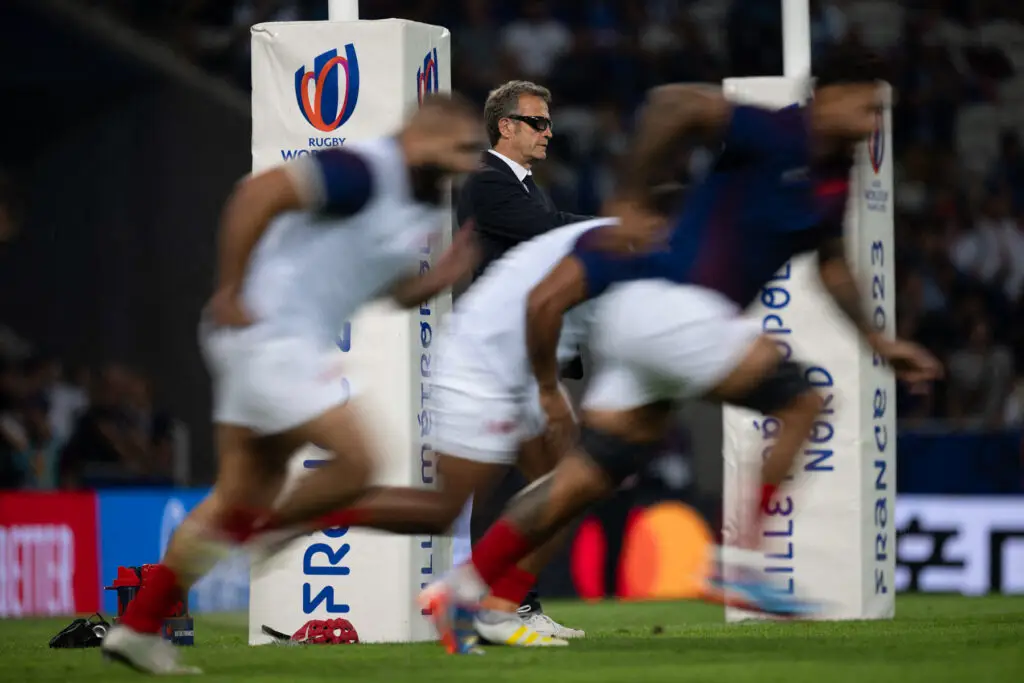
In the collective imagination, the pre-match team talk is a scene from a film. A coach on his feet, voice low, words cracking like whips, eyes catching fire. You think of Bernard Laporte haranguing his France side, of Fabien Galthié almost whispering, or of those New Zealand coaches’ speeches that went viral, spare and loaded with meaning. And yet, in the reality of the dressing room, the team talk is rarely a moment of pure eloquence. And that is precisely where it becomes interesting.
In rugby, there are scrums, up-and-unders, the heavy silences that follow a missed tackle. And then there is the pre-match team talk. Fifteen minutes behind closed doors, sometimes less, in which a coach, a captain or a senior player tries to tip a squad into a state of grace. The scene has become a sacred ritual, almost a literary genre in its own right, fed by documentaries, by the tales of former players and by a handful of lines that have passed into legend.
From Laporte to Novès, the art of the dressing-room blast
For a long time the team talk was seen as a moment of macho bravado: deep voice, hard stares, the promise of a battle. Aimé Jacquet left his mark in football, but rugby is not to be outdone. Bernard Laporte, in his France days, wielded invective like a weapon. Guy Novès, for his part, preferred restraint and tactical clarity, convinced that badly channelled emotion clouds the game more than it lights it up. Even then, he was known to let rip.
Because the team talk is not just an outlet. It is first and foremost a tool of “focus”, in any sport, according to the great principles of psychology. As kick-off approaches, players are saturated with information, expectations, noise. The job of the speech is then to simplify, to prioritise, sometimes to reduce rugby to three or four clear principles: win the gain line, secure the rucks, play together. Or else: “We walk all over their faces, we yank their b****cks”. Nothing spectacular (well, then again…), but the essentials.
The best team talks do not try to say everything. Fabien Galthié has often pointed it out: “The work has already been done“. At that stage it is no longer about learning, but about recalling the collective identity. Before the opening match of the 2023 World Cup between France and New Zealand (sorry for the memory), the staff insisted on the story of the group, on the road travelled, rather than on the opposition. A way of bringing the players back to themselves, to what they control.
But it is perhaps in amateur rugby that the team talk yields its most sincere gems. In a municipal dressing room with paint peeling off the walls, between a makeshift strapping job and the warm beer promised for afterwards, some barely comprehensible speeches hit home through their sheer simplicity. Or through their complexity, depending on the folklore of the region.
Social media and grand oratory
No management jargon, no data, no poems or poetry, just raw, simple words about the pleasure of playing together, about the injured mate stuck on the touchline, about the village next door that you “don’t beat that often”, or indeed about somebody’s family being insulted. Those team talks will never go round social media for the quality of their oratory, but they forge a culture, an attachment, sometimes a collective memory that lasts far longer than a scoreline.
Sometimes one word is enough. Jonny Wilkinson used to say that some of his greatest performances had been preceded by almost mundane team talks, punctuated by one right sentence, delivered at the right moment. Conversely, speeches that are too emotionally loaded can produce the opposite effect: tension, haste, needless penalties. To each coach his own method, to each coach his own reading of it.
The team talk is also a mirror of how modern rugby has changed. Gone, or almost gone, are the authoritarian monologues. Now it is about exchanges, about players speaking up, about natural leaders. In some Top 14 dressing rooms the coach talks less than the scrum-half or the back-rower, the men who carry the lived experience of the pitch. Then again, it is all relative…
So what is it really for? “To create a moment of collective truth”, those involved in the game often answer with one voice. An airlock between training and the chaos of the match. A moment when you remember why you play, with whom, and how. The rest – victory or defeat – is not decided there. But without that suspended moment, rugby would surely lose a part of its soul.


Comments