

Mattieu Bidau is today a contented lock. At 29, and after a career spent entirely as a professional at Dax, the player who came through Pessac Alouette (Gironde) is with Langon, in Nationale 2, with his ambitions intact. Calm and smiling, Bidau spoke at length to Ruck Zone about his season and about managing a schedule that is now very different from before.
Above all, the big lock agreed to look back, for the first time, on what he went through in January 2022… on the evening of his birthday. Out with friends at the time, Mattieu Bidau suffered a TIA (transient ischaemic attack, a mini stroke that leaves no damage to the brain), lasting around thirty seconds. It was the result of a heart malformation, present in many people but which does not always declare itself.
What followed was a long period of doubt, of convalescence and an obvious surgical operation. With hindsight, the Pessac native tells the story of that difficult ordeal but is delighted to be in fine form today. Interview.
RUCK ZONE. – How are your first steps at Langon going, having only ever known the professional world?
Mattieu Bidau: I won’t hide from you that this summer, after nine years at Dax, my daily life changed. It was a little bit hard, all the same. There was the travelling to take into account, too. Even though I had decided on it, since I chose to carry on living in Dax and the club accepted that. There was a real change in terms of training. Alongside that, I was made very welcome at Langon. It is a very family-oriented club. The lads are great. I found the same atmosphere I had been lucky enough to have at Dax. We were all very close there. So that’s it, I have settled in. I have found my rhythm and I am very happy to be at Langon.
Isn’t that rhythm too complicated with your dual project?
Before the end of my professional career, I had started preparing for life after rugby. My dad has a general building company. I had already worked there a bit but I knew I did not want to do that because rugby has already broken me physically to an extent (smiles). Over my last two years of rugby in Pro D2, things were pretty complicated for me with serious injuries, notably osteitis pubis and a ruptured shoulder tendon. That is why I got ahead of things. I retrained in wealth management advice. I started courses, I have validated one. Right now I am validating the second. I have already started holding meetings with clients. It is really cool because you can start that alongside another activity. Which means I have even more time because obviously, at Langon, we train in the evening since all the lads have a second job. I have time to work on my career change during the day. And on top of that, I can carry on doing my weights and keep a sort of professional set-up, like I had at Dax.
Being lucky enough to manage my own schedule, my lifestyle is a bit simpler, in the sense that the training sessions are still less demanding physically. The body takes less of a hit. That said, there is still the travelling, make no mistake. On Tuesdays for example I do the round trip between Dax and Langon. That is an hour and a half there, an hour and a half back. On Thursdays I stay over and come home on Friday or sometimes I even spend the weekend there. That way I spend the weekend at my family’s. It works out at between four and six trips in the week.
Langon are favourites to go back up. Do you approach it saying that openly?
It is a thought. Inevitably it is also a target, and not exactly a hidden one because the other teams know it. When a team goes down, it looks to come straight back up. But even in Nationale 2, there are clubs that are professional. The lads do nothing else all day. We don’t have only that. At Orléans we saw there was a small difference all the same over 80 minutes, in the mental and physical load. That said, we can certainly still allow ourselves to go and chase results. We have lads who don’t overthink it, and who play rugby for the pleasure of it.
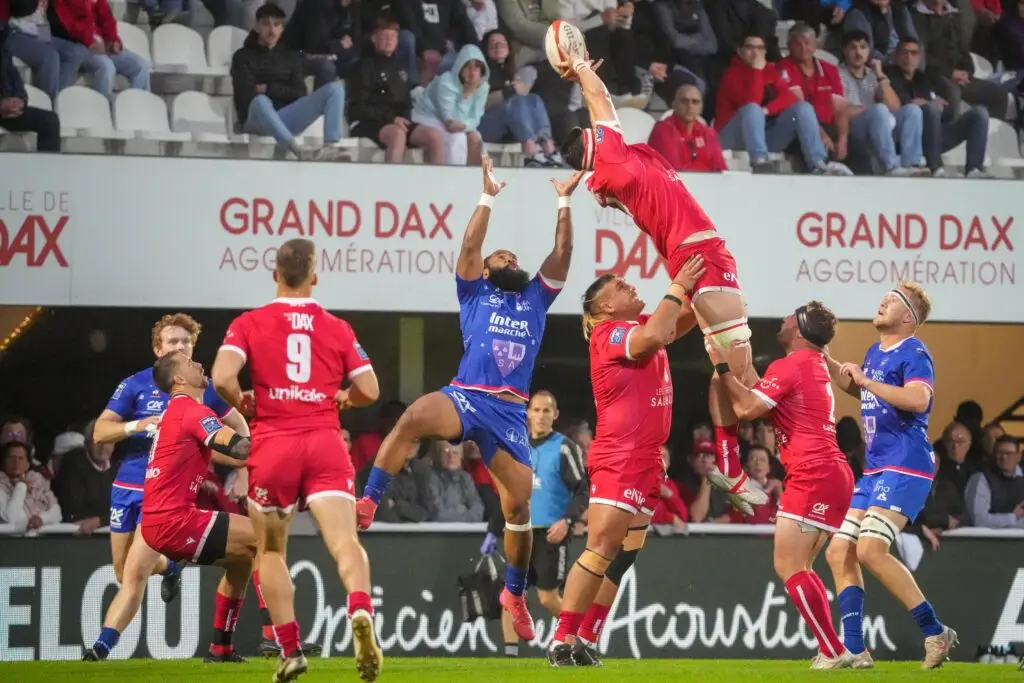
You have had a lot of injuries during your career… Hard physically but also mentally, no?
For a professional sportsperson, the mind is very important. But we are lucky enough to play a team sport. So when you are injured, you always manage to find support. That was the case for me at Dax. I had support from my mates. I really felt it, again last year, with my big shoulder injury. Mentally, it is hard to tell yourself that if I had not been injured, maybe I could have played more. Maybe last year, if I had not ruptured a shoulder tendon in the third match, I could have extended at Dax. I could have gone and chased new goals. So, well, all that comes into play. I also work on the idea of fate and I tell myself it is the law of sport. You have to be able to accept it, bounce back and see things differently. I did not only think about rugby and I almost took advantage of that injury by working on my career change. When I came back, the club told me I was not going to be kept on, when they could have talked to me about it earlier. All of that could have been different. Now I don’t hold it against anyone. That’s how it is.
You went through something very particular in 2022… You wanted to talk to us about it for the first time…
It is the chance to talk about it now that all that is behind me. It was in January 2022, when I was still playing in Nationale. After a match, we were quite simply out having a drink with friends after a win. It was actually the evening of my birthday. And there, I had a small TIA. A TIA is a stroke that leaves no damage to the brain. It was caused by a heart malformation. That heart malformation is not serious. It is present in a quarter of the population, but only the cases that are triggered are treated, either by a stroke or by the heart running out of breath. In my case it was a mini stroke, what is therefore called a TIA. There was a bit of a scare all the same, because I suffered paralysis down my right side. I was talking with a mate, and I had the feeling I could no longer manage to speak to him, that I could not manage to say what I wanted to say to him. He understood there was a problem. When I managed to speak, I told him I could not feel my right side any more, while my face was genuinely paralysed. Given that my grandmother had had one around that time, I did not take any risks. I went straight to hospital because it passed after about thirty seconds. I was looked after brilliantly at the hospital in Dax.
Well, with the resources they had, they had done every possible test but those did not confirm the heart malformation. We were a bit stuck. The neurologist could not really explain my case. In the end it was decided to send me to Bordeaux for tests. And that is where they confirmed that there was indeed a heart malformation. It was a relief. And then I had to be on Kardegic, a blood thinner. Except that at Federation level, it got stuck. They did not want me to carry on playing rugby because it could have got worse in the event of concussion. It was too risky in their eyes. It was delicate. I had managed to contact a Pro D2 player, Antonin Berruyer, who had suffered a major stroke. Except that in our case, since we were at amateur level, it was the Federation that decided, whereas for him it was the League (LNR). After that, I managed to take things in hand by contacting the department at the Haut-Lévêque hospital in Pessac and Professor Thambo in particular. He was great. I still thank him because I had been told there was a six-month wait for a video consultation and that the operation might only happen a year later. I had thought: ‘damn, how am I going to manage with my rugby?’ In the end the secretary called me back and told me I had an appointment the following week. He had reassured me by saying I could play and that we would do the surgery in the close season.
Except that the Federation blocked it again, and so did the club (Dax, editor’s note). I think they were a bit scared, which is understandable. The professor took me in again urgently a month later to carry out the surgery. After that I had six months of treatment. The procedure actually involved deploying a sort of small umbrella at the heart. As for the treatment, they can recommend five years but as I am an athlete I could do less. I am lucky that all that is behind me. The surgeon had explained to me that there were perhaps four or five lads out of the 40 in my team who have the same thing and for whom it will never be triggered. It really is striking.
Why did you choose not to talk about it publicly before?
At the beginning, we did not really know what it was going to lead to. It was also to protect myself because, well, seeing “heart problem” in the papers sets off alarms straight away. Nobody jokes about that these days, which is entirely logical. Now I know I can talk about it because I have no risk and no after-effects left. I had preferred to hide it temporarily until I knew what I had. That was the problem, above all. After four days in hospital, we still did not know what was wrong with me. That is why we mentioned back problems with the club, because I had a small hernia too.
Now I am not at all afraid of talking about it, because it is also something I want to do. It can happen to other athletes. At the time I thought, how come these people are not treated? But in fact it is because there would be too many cases. The next day, when I had to explain everything I had been through, it was indeed a form of stroke. Except that in general a TIA lasts between five minutes and an hour and when you get to hospital you have after-effects. In my case it had barely lasted thirty seconds. They even wondered whether it might have been an epileptic seizure.
With these repeated injuries, notably to your shoulders and knees, aren’t you afraid of growing old?
I think that once the shoulders have gone, they always will be that way. Then again, from Pro D2 to Nationale 2 there are two divisions between them and you feel it physically. In Pro D2 it is constant collisions. There is still plenty of commitment in Nationale 2, of course, I am not saying otherwise. But it is true that I am now in a format that is a bit adapted to my physical capacities. So my left shoulder, which was operated on, is fine. But I have my right shoulder which has been painful for three years, which has not been operated on and which, when I take certain bad knocks, hurts. But well, that is the law of rugby. Once again, I come back to the example of my father who has a general building company. He works 6 days out of 7. He is 57 and he is physically broken.
Me, at 29, when I go down the stairs and it hurts my knees or an ankle, sometimes with the shoulders pulling… You tell yourself it is worrying all the same because I don’t know how I am going to age. You can look after yourself as much as you like, but maybe at 50 or 60 I will have a destroyed left knee. When you play in Top 14, with the salaries that go with it, you know why you are wrecking yourself physically (laughs). Of course in Pro D2 and at the small club of the division, financially it is not the same. But it is still a pleasure to have lived off my passion. And then I am very tall. My agent had told me I could not really compare myself with the others. In tall players the joints are different. That’s how it is, that’s sport.
Comments