
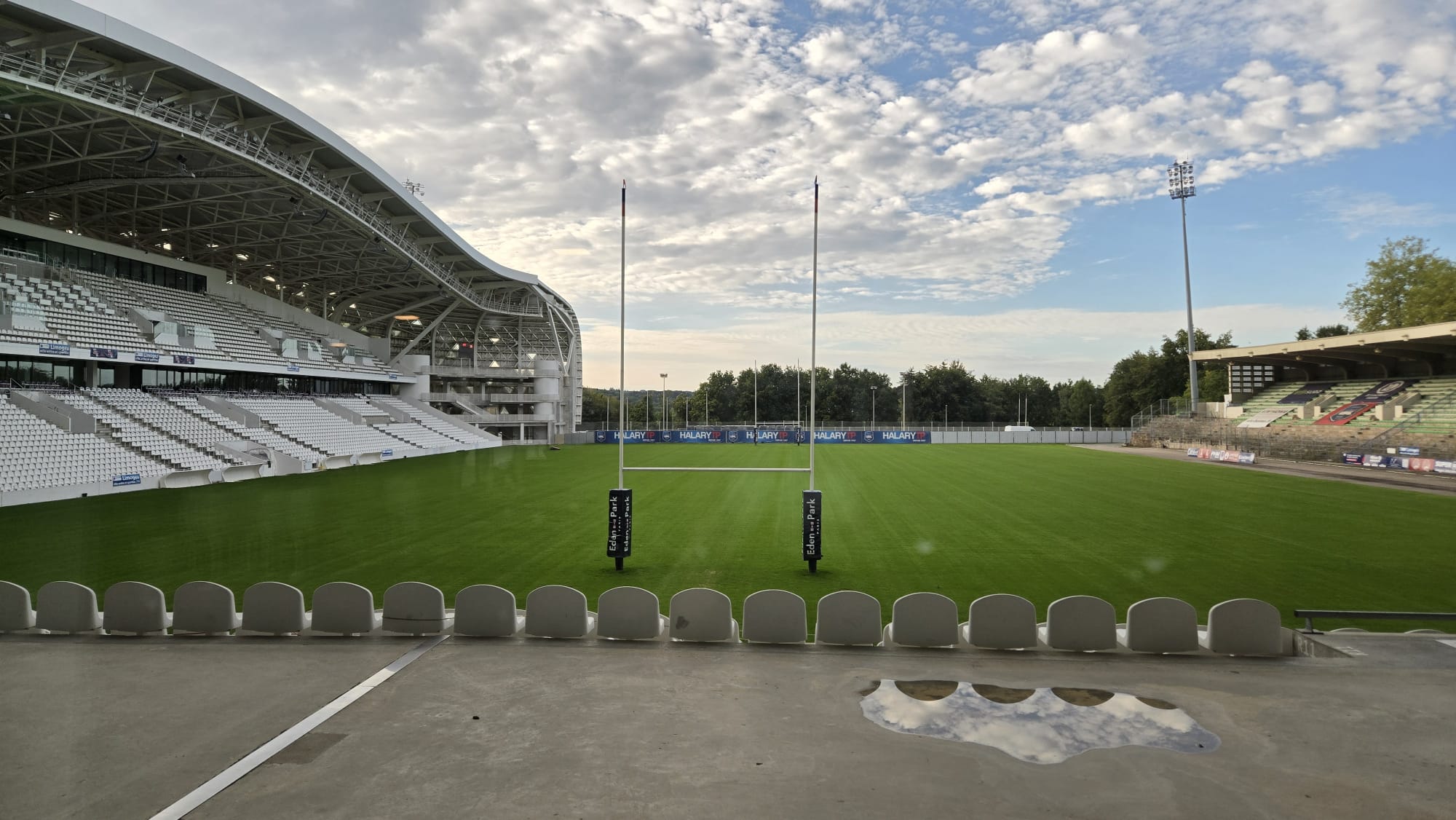
Silence is sometimes louder and heavier than a full stand.
At Isle, the last supporters are slowly drifting away from the René-Lamarsaude ground. A few children are still running behind the posts while the volunteers fold away the metal barriers. A few minutes earlier, defeat to Nontron had definitively shut the door on a return to Fédérale 2.
One more disappointment.
Ambitious projects
Some thirty kilometres away, at Saint-Junien, the picture is even crueller. Relegated on the pitch last season, the glove-making town’s club looks set for a second successive drop, this time for an administrative reason: their reserve team’s blanket withdrawal. A sanction that goes beyond the mere rulebook and says something, in its own way, about the fragility of an institution that was long one of the strongholds of Limousin rugby.
Further south, Saint-Yrieix-la-Perche is nothing more than the shadow of the ambitious project that once set an example. RCPSY now play in Régionale, within a partnership with Union Rugby Club Auvézère. The days when the club took on the best teams in Fédérale 2 already feel distant.
Barely a few years ago, the Haute-Vienne still had several representatives in the national championships. Today, apart from USAL Limoges (Fédérale 1), none of these clubs has a lasting place in the federal landscape.
Four clubs. Three different trajectories. The same destination. How could a department capable of producing so many top-level players watch its main clubs disappear, almost in silence?
“Everything else”
The question comes up everywhere. In the stands. Among former directors. Among the coaches. The business partners. The volunteers. Everyone has their own explanation. Yet all of them end up telling the same story. The same causes, the same consequences.
“For a long time we believed we could keep several ambitious projects alive at the same time, says a former director who has been through several Haute-Vienne clubs. We had the volunteers, the coaches, sometimes even the players. What we ended up lacking was everything else.“
That “everything else” has a name: money.
For years, each club nurtured its own ambitions. USAL dreamed of a lasting return to the professional world. Isle wanted to establish themselves in the national divisions. Saint-Junien were building their project. So were Saint-Yrieix.
But in a department of fewer than 400,000 inhabitants, they were all knocking on the same doors. The same companies. The same local authorities. Sometimes even the same volunteers.
“The problem is not that companies have stopped loving rugby, sums up a long-standing partner. It is that everyone is dipping into the same pockets.“
Basketball and handball
The same refrain keeps coming back. Because the Haute-Vienne is not the Tarn, nor the Corrèze, nor the Basque Country. Nor the south-west in general. Here, rugby shares its territory with other firmly established sporting institutions. Limoges CSP remains a monument of French basketball. Limoges Handball 87 has made a lasting mark on the local landscape. Cultural events also call on private partners. And there is money changing hands…
“The cake does not get any bigger“, sums up one Limoges business owner. The “football crowd” are in exactly the same position, incidentally…
There is nothing abnormal about that competition. It becomes a problem when a club wants to move up a level. Because amateur rugby is not all that amateur any more.
Today, playing in Nationale 2 or even in Fédérale 1 means funding strength and conditioning coaches, a video analyst, a medical staff, administrative employees, ever more expensive travel, suitable facilities and professional communications.
Federal rugby looks more and more like professional rugby. Without the income to match. Only recently, a source close to the League told us: “A lot of clubs have grown faster than their economic environment. And some have never managed to absorb that acceleration.“
Credibility
At Saint-Yrieix, though, they had tried something different. Driven by the directors of the time, among them Lionel Pelhuet – then the number two at Intermarché, today president of Limoges CSP – RCPSY had notably struck an unprecedented partnership with the Senegalese rugby federation. The idea went far beyond recruiting players. The project was built on sporting, educational and human exchanges between the two territories.
For a few seasons, the small Saint-Yrieix club drew attention well beyond the Limousin. Then the directors left. The partnership faded away. And the ambitions gradually evaporated.
As fragile as porcelain
“When a club rests on a few strong personalities, their departure inevitably leaves an enormous void, analyses one person close to the matter. You do not replace several years of contacts, experience and credibility overnight.“
That dependence on a handful of men comes up often in the stories of Haute-Vienne rugby. Builder presidents. Directors capable of going out and convincing partners, of carrying volunteers along, of uniting a whole territory.
When these locomotives stop, the carriages sometimes struggle to keep rolling. Deep down, the Stade de la Porcelaine tells almost the whole of this story on its own.
In the early 2000s, when USAL were playing in Pro D2, Limoges believed in its rugby destiny. A few years later, the city built a modern stadium and gave it a name that matched its worldwide identity: porcelain. The idea was simple. To make rugby a new showcase for the area.
Twenty years on, the stadium is still there (not entirely finished either). So are the supporters. But the arena, often hollow, has become, in spite of itself, the symbol of an unfinished ambition.
“Asking for trouble”
Promotions have often been followed by relapses. By doubts and by acrobatics that were frequently “asking for trouble“. Projects have come and gone. So have presidents. And every new season seems to carry the same promise: that of a comeback that never quite arrives. And yet it is here that the true Haute-Vienne paradox is born.
While the clubs have gradually slipped out of the national divisions, the department has nonetheless been producing players of the very highest order.
Pierre Villepreux, Alexis Palisson. Damien Chouly. Atila Septar, Pauline Bourdon-Sansus. Agathe Sochat. Lina Queyroi. Donovan Taofifenua. Jean-Baptiste Gobelet… Few French departments of that size can claim such a density of internationals. And of names.
“Our problem has never been the academy work, explains Jean-François, a long-standing coach at JA Isle (Fédérale 3). We know how to spot young players. We know how to support them. We know how to make them better. On the other hand, when they turn twenty, we no longer necessarily have the structures capable of offering them the next stage of their career.“
The Corrèze neighbour
And then there is the Corrèze… The proximity of Brive (also) explains part of the phenomenon.
An hour’s drive away, CA Brive offer what the Haute-Vienne is still struggling to build: an established club, national visibility, professional facilities and a genuine career prospect.
For a young player, the choice is often obvious. For a while, some had imagined a coming together of USAL and CAB. The idea of a merger did the rounds of conversations. Above all it raised smiles. Often strained ones, at that. On both sides of the Limousin border, many saw it as an impossible marriage.
The problem, in the end, has never been geographical. It is structural. The Haute-Vienne is not short of rugby. It is short of an economic model capable of sustaining its ambitions over time.
Local authorities continue to support the clubs, particularly on facilities. But everywhere the same message now prevails: public money can build a stadium. It can no longer fund, on its own, sporting ambitions that keep getting more expensive.
The rest depends on the business community. And that is precisely where the department is now reaching its limits. And yet… Despite the relegations. Despite the disappointments. Despite the unfinished projects. Something is holding out.
The right formula
You only have to attend a mini-rugby session in Limoges, Isle or Saint-Junien to understand that the passion has never left this land. The coaches still welcome dozens of children every Wednesday. The volunteers remain the first to arrive and the last to leave.
As though, amid the difficulties of the men’s first teams, the area were stubbornly carrying on preparing its future.
Perhaps that, in the end, is the real paradox of the Haute-Vienne. A department that has never stopped believing in rugby. That keeps producing future internationals. That has coaches recognised across France. That has facilities capable of hosting top-level competitions.
Being able to last
But which is still looking for the formula that would turn that wealth into collective success. Because in the end, Saint-Junien’s relegations, Isle’s difficulties, Saint-Yrieix’s decline and USAL’s thwarted ambitions all highlight the same paradox.
That of a territory that produces more talent than it manages to keep. A land where people still learn to play rugby as well as ever, but where it has become infinitely harder to build a club capable of lasting.
And the aim of no longer being merely a wonderful starting point for other people’s careers. But of becoming, at long last, a destination once again.


Comments