

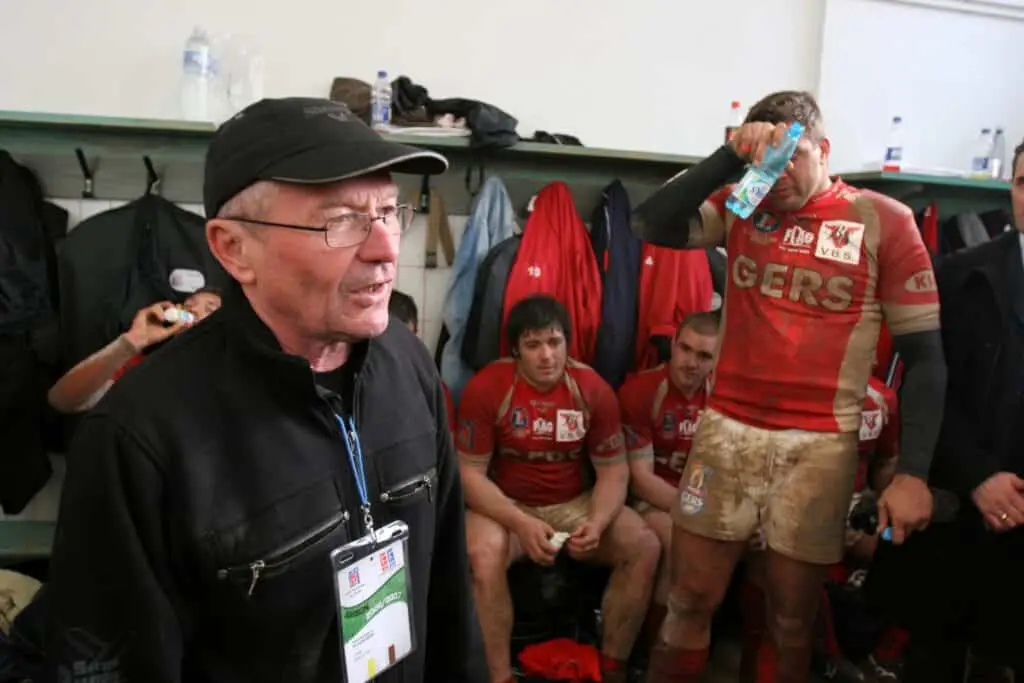
“Can we bring the meeting forward by fifteen minutes? I have to take my club’s Juniors to a match in Ariège afterwards”. And there was no question of him missing a moment like that! At the grand age of 81 summers, Henry Broncan still criss-crosses the roads of his Gers and beyond to pass on his unique knowledge of rugby and make the most of the thousand and one joys the oval-ball world still gives him.
It is a strong bond, one that the man who lived through Auch’s final hours in the elite as a coach (he coached the FCA from 1998 to 2007) is delighted to share with his Gers homeland, where rugby has worked its way into hearts more than anywhere else in the country. When he talked to us about it, sitting in the stand of the training pitch at the Jacques-Fouroux stadium, his eyes began to sparkle and we found ourselves listening the way a pupil would listen devoutly to his teacher.
You are bound forever to this stadium in Auch. What does it mean to you?
There is the main pitch of course, but I love the training pitch. That is where FC Auscitain prepared for its matches, where the players sweated and where places were won. Rugby is of course the hour and a half of match on the weekend, but not only that. And that pitch, for me, is legendary.
What would you have said if someone had told you 40 years ago that a former Auch player would one day walk up the steps at the Cannes film festival?
I am from another era and another world. What I do know is that Antoine Dupont is not putting a foot wrong for the moment, he is very strong. The pressure on him is going to grow and grow, though, and I hope he keeps on putting no foot wrong because we live in a world of jealous people and some of them are waiting for one thing only: for him to do something stupid. That is the unhealthy side of the people who gravitate around rugby and who use rugby more than they serve it.
How does it feel that the Gers is still, relative to its population, the département where rugby is played the most?
I am very happy about it. I put it down to the fact that the pitches are easy to get to. I live in Mirande and if a kid wants to go and kick a ball around at the ground, nobody is going to tell him to leave. There are not a huge number of other activities here either, rugby is the number one sport and children are very drawn to it because it is also a way of making a name for yourself. And then we have had so many examples of success, like Jacques Fouroux.
“We need a flagship club”
Isn’t this interest of the people of the Gers in rugby, despite the absence of a professional flagship, proof of a sincere passion for the sport?
Of course! I love going to see the small clubs and I always see plenty of enthusiasts on the touchline, along with wonderful volunteers. Today I am taking the Juniors of the Miélan-Mirande entente to Foix and there are two coachloads of supporters and 30 cars going there. We are talking about a simple Challenge Occitanie match, not the French championship. That too is the Gers.
You mentioned Jacques Fouroux, a name that resonates in French rugby. What does he represent for you?
I was a Junior at Auch when he was a Cadet. He is three years younger than me, he was always under our feet and he wanted to pass for the senior figure so we would push him back into his place a bit (laughs). I was very fond of him. He was an extraordinary character, a rugby nut who always defended the small clubs. He was my president, he is the one who brought me to Auch in 1998. Nobody else could have made me leave Lombez-Samatan. He was very good at leading men. We were very close friends right to the end (Fouroux died in 2005).
What legacy did he leave in the Gers?
Jacques Fouroux was 1.62m and 68 kg. That proves that with character and hard work you can become a very good rugby player, and he was one with France. It is the finest record of honours in French rugby. We have other examples too, like our current internationals. But you must not rest on your laurels either. It is difficult, we no longer have a dominant club. Auch, Fleurance and L’Isle Jourdain are in Nationale 2 and I would have liked one of them, Auch for example, to be at least in Nationale because we need a flagship. If you divide the forces by three, you end up with three average sides.
“FC Auch’s descent into hell: “The people of the Gers took it very badly, it was a trauma”
Are you calling for a merger of those 3 clubs to form a Gers super-entity?
Bringing clubs together in the Gers is not easy because there are local peculiarities, parish loyalties, old stories… But I would be in favour of going even beyond the Gers, perhaps with the clubs of the Hautes-Pyrénées where you can see that Tarbes is also struggling. If we could join forces… But it is not easy. The old stories, people being jealous of each other… that is also part of our strength. The small clubs want to keep their identity and that is a good thing too.
How did the people of the Gers experience FC Auch’s descent into hell in the 2010s?
They took it very badly, it was a trauma. I think that at a certain point the club got it wrong. Our strength was being small and we should not have taken the path of the big clubs. That is what the club tried to do and it paid the price. It is a shame because right behind the generation that went down to the third division, inside the club there were the Duponts, the Jelonchs, the Alldritts, the Bourgarits. They were there and they would all have played in the first team a year later. The club cracked and those kids left, but I think they still have a Gers and Auch heart.
“A good young player no longer stays with us, he leaves as soon as he is a Cadet”
Is the lack of top-level rugby in the Gers made up for by the presence of the headline names you mentioned in the France team?
You cannot live off the past. From the moment there is no flagship club, a good young player from here quickly ends up at Mont-de-Marsan, Pau, Toulouse, Colomiers and so on. He no longer stays, he leaves as soon as he is a Cadet. As long as the Gers is not capable of rebuilding a club at least in Nationale, we will keep seeing this. It is a shame because by staying here, given how well the clubs work, the youngsters who stayed until Juniors would not be wasting their time.
On a personal level, how do you explain still hanging around every pitch in the Gers and elsewhere at 81?
I cannot do without it. I do what I like, the rest doesn’t interest me. And rugby interests me all the time, because it remains a mystery. I am still incapable of saying that rugby is played this way or that way. Every weekend you learn something. It is a fantastic, rich sport and anyone who thinks he can explain it in a notebook or a video is mistaken. When you are sure you are going to win, that is when you lose.
How do you view the countless law changes since you started out?
The lawmaker does its utmost to make rugby possible. It is true that we are flooded with laws and that it is tiring, but thankfully there are laws and they do move. It also gives more and more importance to the referee, who is a decisive element in a rugby match.
You were one of the first to own up to saying that knowing exactly how a referee officiates gives you an extra chance of winning…
In rugby it is always the better side that wins, but you also sometimes hear that such and such a referee tipped the scales one way. So it is up to the coach to know his referee well, what he blows for, what he is like and how he handles the pressure of a match. Getting to grips with how referees referee is very rewarding.
“Let’s not say the French are divided, since they are still capable of agreeing on rugby”
You have seen rugby change a great deal on the pitch in 60 years. Has it been the same around and off the pitch?
Yes! You see a lot of young people and also a lot of women. I actually believe women are the future of rugby. I am amazed to see them produce analysis that men might no longer be capable of. I am teasing when I say we might be world champions the day we have a woman in charge of the national team, and I am barely joking.
Rugby has also opened up to every background, and notably to working-class neighbourhoods…
Thirty years ago, when I took part in coaching courses, we sometimes found ourselves alongside football coaches. And they would say to us “We go and find players in the estates, you don’t have any!”. And it is true that there were very few. Since then, development officers have taken that path of preaching rugby in the estates and we have been able to bring in some kids. That is work I would have enjoyed. I taught for a while at the Mirail (a very deprived district of Toulouse, editor’s note), I had brought about ten boys into rugby and they had loved it. Today rugby has gone into the estates and you sometimes find those boys in the France team. It is wonderful what rugby can give those kids.
Wouldn’t putting more rugby into society be a way of easing its tensions?
Rugby is enormous. Last weekend I was at a match between Lembeye and Saint-Gaudens. There was a huge crowd: people from LFI, the French hard-left party, others from the far right, people who watch the National Assembly where nobody can stand anybody else… Let’s not say the French are divided, since they are still capable of agreeing on rugby, which is complicated all the same, and of sharing good times together. I believe rugby is an example even if we have a bit of drugs, some sexism and so on. It is not perfect, just like life, but it shows that you can hold completely different political opinions, still get along and form a team to share something good together.
Comments