
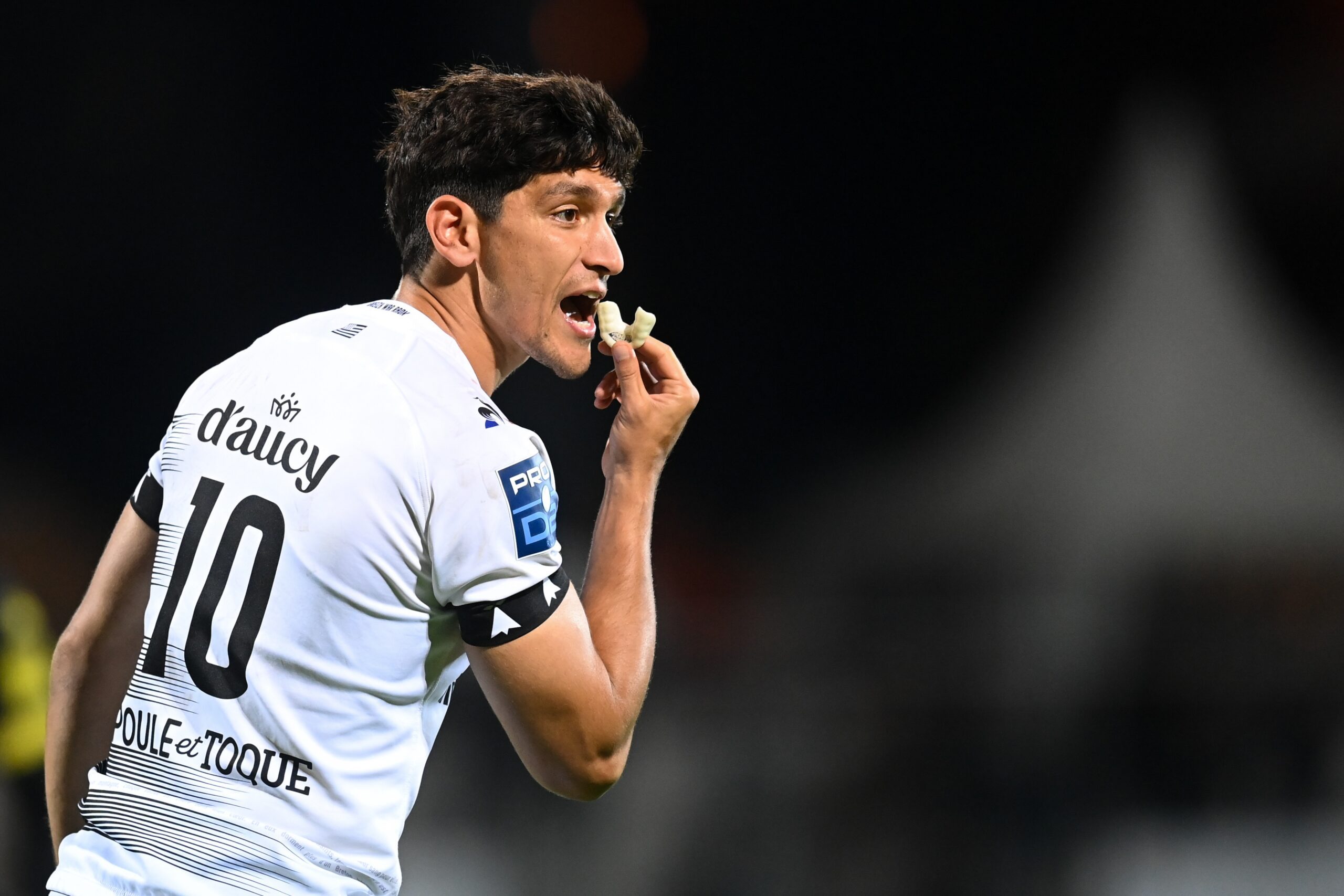
Christopher Hilsenbeck is edging ever closer to his dream. The 34-year-old fly-half, who has played for Colomiers, Vannes, Carcassonne, Biarritz and Saint-Jean-de-Luz, is stringing together good performances with the United States, who have qualified for the 2027 World Cup.
The fly-half’s story is an unusual one. Born in the United States, he was first capped by Germany, from 2012 to 2019. Hilsenbeck now plays in Chicago
IT’S RUGBY: With the football World Cup on, what is life like in the United States?
Christopher Hilsenbeck: Honestly, I have been fairly disappointed. Every time, the cities I happened to be in — Chicago, Denver or Charlotte — were unfortunately not host cities. So we had to follow the matches on television and the buzz was not that strong. But otherwise, in airports when we travel, in the hotels we stay in, you see an enormous number of fans. My impression is that it has caught on, that the stadiums are full. Even though this is not a football country, or “soccer” as they say here, the visiting supporters have brought passion and enthusiasm.
You played two home matches. Did competing with the football hurt the crowds coming to support you?
No, I was pleasantly surprised. We played in Denver, in a football stadium, the MLS one. We played in front of almost 11,000 or 12,000 people. There is a rugby community there. The atmosphere was great. The American federation’s old head office was in Denver, so there were a huge number of supporters. There were slightly fewer against Zimbabwe in Charlotte. We were more in the region of 5,000 to 6,000.
How is this Nations Cup going for the United States?
Pretty well! We had that last-minute win against Portugal. We started very well against Zimbabwe but towards the end of the first half we picked up a yellow card and lacked discipline, which made things harder for us. Quite a few players are coming off an intense but ultimately fairly short MLR season of 10 to 12 matches. So they are at their physical peak without being too tired. This year the group is very even. A lot of players are making themselves available, particularly those playing in Europe who want to be at the 2027 World Cup. So we have a hugely competitive team in every position. And even then, we are still missing two or three players through injury or unavailability. We are quite excited about preparing for 2027, with the matches left this summer. There will be a short tour of Japan, where we will face the Argentina and Australia A sides, then three more matches on the autumn tour. We will be kept busy and, above all, it will let the MLR players extend their season a little and bank some game time.
(This interview was conducted before the United States’ latest win, against Spain)
Against Portugal, you were the hero of the match with a winning penalty… How did you experience that finish?
First of all, we started the match badly. We were 12-0 down after about ten minutes. Then up front we started to get on top at the set piece, at the scrum and the lineout. The big black mark was our finishing. Every time we got into Portugal’s half we put them under pressure but we could not make it count. I do not know if you saw the video, but there is a maul where we go over the line, we come out with the ball dead and our hooker touches down outside (laughs). So we left plenty of points out there. The match was ultimately decided by that last penalty. I am pleased I landed it, but I think if we had been more clinical we would have made the game easier for ourselves. Portugal had a red card and two or three yellows. For now, we are pleased with the collective performance. There is a fairly large and complete staff this year. I think our kicking game is our main weapon at the moment. We have a South African specialist, David Williams, who came from the Sharks, and he has brought an enormous amount of detail and precision to that part of the game. We are building our identity around it.
Does an individual performance like yours against Portugal make it easier to settle in quickly, given you are still “discovering” this team?
Yes, definitely. This is only my second year with the national side. Last year I only played five matches. So it is new to me. Having done another season with Chicago, particularly with team-mates like Ruben de Haas, Tavite Lopeti, Brandon Harvey and Nathan Den Hoedt, helps a lot. Especially with Ruben, my No. 9, in building connections. He has been there six or seven years. He is one of the most capped players. I have that dream in mind: the 2027 World Cup. So I am very pleased to be able to keep banking game time and experience with this team, because a No. 10 is the one holding the reins. It matters to have the other players’ trust. Perhaps you earn it through moments like the one I had against Portugal. My team-mates were counting on me to go and win the match.
I had always known there might be a possibility and after about ten years I thought this might be the chance to discover something else
Tell us about the choice to opt for the United States…
My path has not been a straight line. I first played for Germany. We lost the repechage tournament in 2018. After that, the federation ran into enormous problems. It still exists today, but in a different form. That is when I looked into the eligibility rule, because I was born in the United States. I had always known there might be a possibility and after about ten years I thought this might be the chance to discover something else. Through Stephen Brett (the former New Zealand fly-half who played for Bayonne and Narbonne among others, ed.), against whom I had played during my years in France, I made a first contact. After his playing career he became backs coach of the United States, a role he still holds today. That was the first connection. Then I had to make myself visible, because American coaches do not necessarily follow French rugby, and vice versa. So it took a little time. But coming to Chicago and playing for that club raised my profile. The rest was not really luck, more an opportunity taken. My first year in Chicago went very well even though I had arrived as understudy to our South African fly-half. Coming to the United States has always been driven by that desire to play in the 2027 World Cup. And happily, last year, we won that decisive match against Samoa to secure our qualification.
What do you make of the American league? A lot of teams have disappeared, after all…
It is quite hard to assess. Last year, four clubs did indeed go under, and San Diego and Los Angeles merged. Purely in rugby terms it is a bit tighter this year because there are fewer teams. Everyone fought over the best players from those four defunct clubs. So the standard is quite high. You can see it, in fact: plenty of players end up signing in Pro D2, or even the Top 14. There are a lot of unusual profiles, big ball carriers, big X-factor players. So the standard is quite interesting and the league quite entertaining, since it is a closed league with no promotion or relegation. There is that desire to win and to put on a show, which is a good thing for a sport that needs to make itself known here. If I compare it with Pro D2, where the tension around a match is sometimes greater because results affect promotion, relegation or even a club’s survival, I would say things here are a little freer of those stakes.
At national team level, World Cup qualification was the saving grace. It has secured the next five or six years, through to the 2031 World Cup, which will be held in the United States. With the structure currently in place, with the staff too and everything happening around the federation, that will help build a competitive team for 2031. What it means for the MLR from one year to the next? I could not say, because these are private investors who come and go as they please. From what I understand, only five teams are left this season, since the sixth, Charlotte, was funded by World Rugby for three years. They are reaching the end of that third year, so next year there will only be five teams at the start. The competition will be shorter, or slightly reorganised.
Vannes, an incredible club
Do you not miss France?
(smiles) I miss it a little, but as the seasons are short, four to five months, I have plenty of time to come back to France. We have our home in the south of France. Happily, my wife and children are with me in Chicago during the season, and during the summer tours they go back to France. Between tours we often have two to three weeks off. I spend six months in the United States and six months in France over the year, so it is fine, I cannot complain (smiles).
On your former clubs, Biarritz and Carcassonne did not exactly shine this season, unlike Vannes and Colomiers. Did you follow those teams’ seasons?
Yes, of course! I followed both. I was a little disappointed for Colomiers. They fully deserved to play that semi-final at home. It was the first time, so it is always difficult, with more stress and more expectation around it. They are building something durable, which they will be able to repeat. I know Florian Nicot and Aurélien Béco well, and above all their human qualities. I have no doubt they are well placed to put together another good season, with a final position that will let them progress. And it is the same for Vannes. An incredible club, with very solid foundations and a constant desire to work and improve. Getting back to the top level is the logical next step for them. So I am pleased to see both of those teams doing well.

Comments