
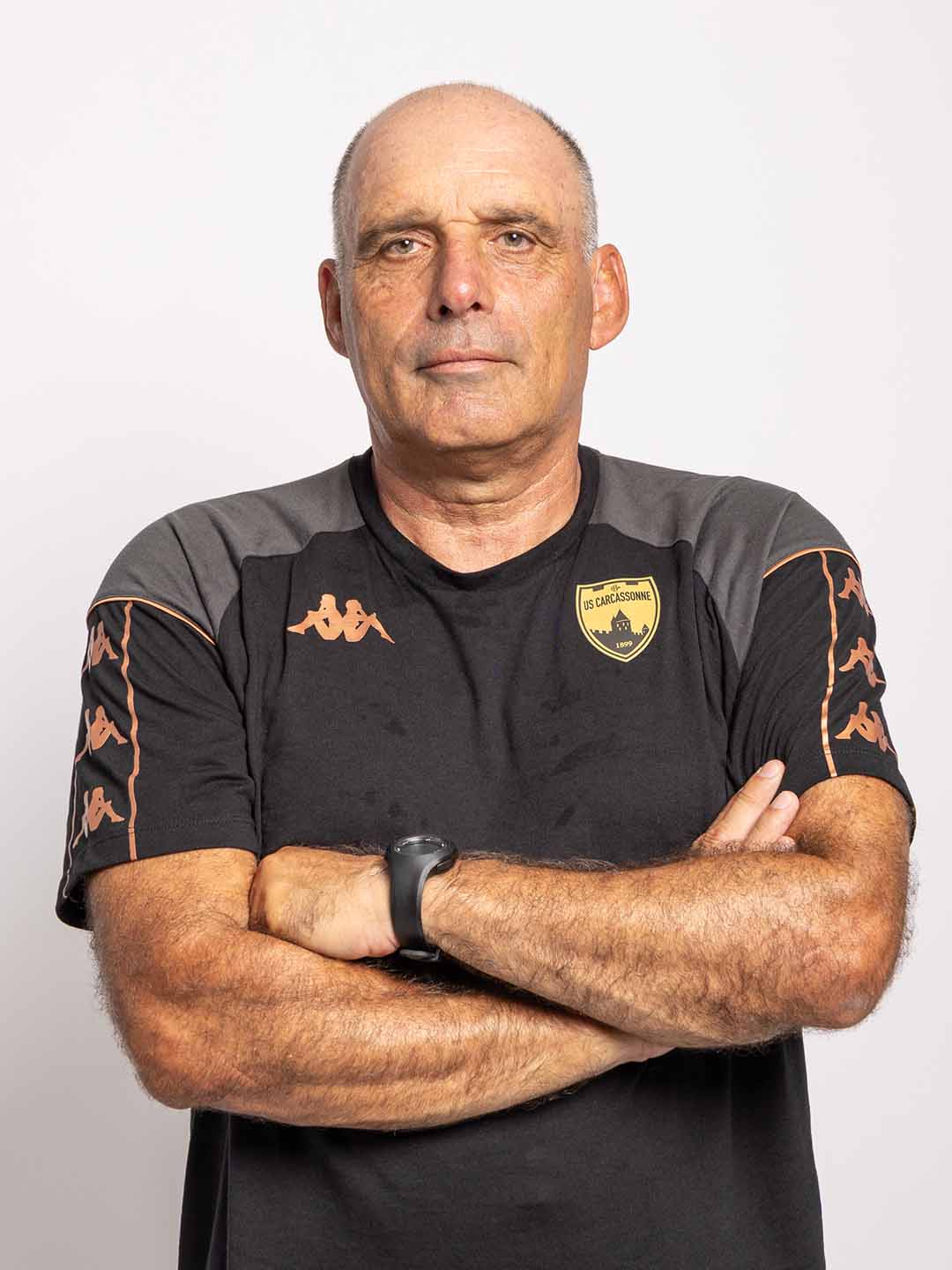
Third in Nationale on 44 points after twelve rounds, Carcassonne beat Mont-de-Marsan 34-31 on Friday 20 November and travel to Vienne on Saturday 5 December (7.30pm local time). Manager Joël Rey, formerly of Pau and Bayonne, answered our questions.
As a player, he wore the Section Paloise jersey. As a coach, he helped Pau and then Bayonne win promotion back. At Carcassonne, Joël Rey is back in a manager’s role, with a job he knows well: rebuilding a squad after relegation.
“A club is a bit like a cathedral”
Surname, first name, age, quality?
Rey, Joël. 61. And quality? I’ll admit I try to be patient. Nothing in my career ever came easily, so I’d say I’ve been patient. Here at Carcassonne, I know it won’t be simple. You have to be patient to reach the goal. Some people want it to happen very, very quickly, they want us at the top of the table. I say the aim is to be in the right place at the end of the season, and above all to be ready. That’s why I think I have patience.
I always try to smooth things over, and conflicts are rare. You have to try to understand everyone, be patient and tolerant, that’s it. A rugby club, a team, a group, is a bit like a cathedral. There’s the boss, the director, the president, the shareholders, the head coach, and all these people decide a cathedral must be built. But it takes “little hands” to build it, and maybe those who decided on the cathedral won’t be there any more when it stands.
So you need the monks of the chapter?
You need stubborn people, who keep their heads down and graft every day. That’s exactly it.
“It’s a bit like coming full circle”
How do you go from Section Paloise, the club of a lifetime, almost a tattoo, to coaching Carcassonne?
I started coaching straight away, while I was still at Pau: first the youngsters, then the professionals. At Pau I was already a manager. After playing alongside the likes of Harinordoquy and Traille, I coached the likes of Dumora and Fumat. But when you manage, you’re further from the pitch. I missed that, so I became forwards coach, because I really love being on the pitch. I did that for two years at Pau, then went to Bayonne, where I coached for ten years.
Then I wanted to get back into management. I got an offer from Carcassonne, and there you go! It’s a bit like coming full circle, as they say. I wanted it, and Carcassonne gave me the chance. It’s a club with a history, that interested me. I like working at historic clubs.
Coaching Christian Labit’s son, for instance?
Of course, of course. I won’t hide that when I arrived, I spoke with Christian. He told me about his boy, I looked into it, and I saw he does have some qualities! He’s not bad, he’s not bad, I like him. He still needs a bit of time, but he’s starting to earn his place with us. He’s around the senior players, he’s well supported. There’s Thomas Hoarau, for example, also a number 8. I think that’s a bit like the club itself. I played against the father, and now I’ve got the son (smiles).
“I only care about the future”
Was going to Carcassonne a bit of a leap of faith? Joining a relegated club that has taken a knock can’t be easy…
When I finished playing, I coached the youngsters for four years before moving up to the professionals. That club had also just gone down from the Top 16, so I helped with Pau’s promotion and rebuilding. At Bayonne, the same thing happened: the club were relegated from the Top 14, and I worked on getting them back up. They’re now well established. My dearest wish would be to win promotion with Carcassonne. Then I think I’d have come a fair way.
Joël, are there any volunteer firefighters in your family?
No! But it’s not easy working with players who carry some kind of trauma, who’ve taken a blow to the head. You have to move forward and wipe the slate clean of everything you heard or saw before. I only care about the future. But getting a group motivated again and going again isn’t easy. I’ll admit the start of the season wasn’t simple. Above all I wanted us to be conquerors, and in the end it wasn’t that hard after all.
In rugby, what is Carcassonne’s identity? Solid, strong, big set piece, big defence. Set piece and defence come up a lot: as soon as you’re a bit restrictive, that’s what people talk about. I’ll admit our start to the season was questioned on that point. But my colleagues on the staff and I have always liked to play, and I’d have found it a real shame to settle for just that. We still try not to neglect it and to be effective. There are periods of the season when we’re better than others at the set piece. Right now we’re a bit below par, but it will come back. What I want is for the club to have more than one string to its bow. If all you have is set piece or defence, in May you’ll be missing something to go all the way.
“That will be Carcassonne’s strength”
You didn’t say “team”, you said “club”…
Looking at Carcassonne’s potential today, let’s not kid ourselves: we can’t say we have a very big squad. We have to rely on the youngsters from the academy, and even on young players who aren’t in it yet, who play for the Espoirs and come and train with us. That will be Carcassonne’s strength. We’ll need the thirty-somethings with lots of experience, and also very young players with almost none, but with character and hunger. That can bring good things.
Who can you rely on?
Hugely on Yannick Osmond. Some people think we might tread on each other’s toes, but not at all. You need complementarity. He looks after an important area: I leave the attack to him, I trust him completely. Then Sylvain Charlet helps me with the forwards. Mehadji Tidjini looks after the defence and the academy. Those are the assistants I rely on.
A word too for the people who help me with strength and conditioning, which is essential to get the results we’re after. Well done to Mika Dallery, the head of it, with Julien and Yoann.
And above all, there’s one man, the kit manager Jean Serasse, who for me is the cornerstone of the club. There’s the sporting side, there’s the administration, but for everything to work, Jean Serasse really is the cornerstone of the “Carcassonne system”. I know everyone has leaned on him.
Joël ReyA rugby club, a team, a group, is a bit like a cathedral.
“Everyone was in unison”
Something you love? Something that makes you angry?
In times like these, I’d say: let’s be tolerant of one another, because I don’t get the feeling that’s the case. And let’s lean on sport. In rugby, to move forward, you have to be truly united, all on the same wavelength. That’s what matters. I believe a rugby team today reflects society. There are lots of people from lots of different places. On the pitch, we don’t play on the same qualities at all. We have different builds, different ideas. But when you come out on top, it’s because everyone was in unison. I think that’s what we need today.
Key figures
3rd Carcassonne's position in Nationale after twelve rounds, on 44 points (nine wins, three defeats)
217 Points conceded by Carcassonne, the lowest total in the league, ahead of Massy (218) and Chambéry (221)
5/6 Home wins for Carcassonne, the only defeat against Massy (12-23)

Comments