
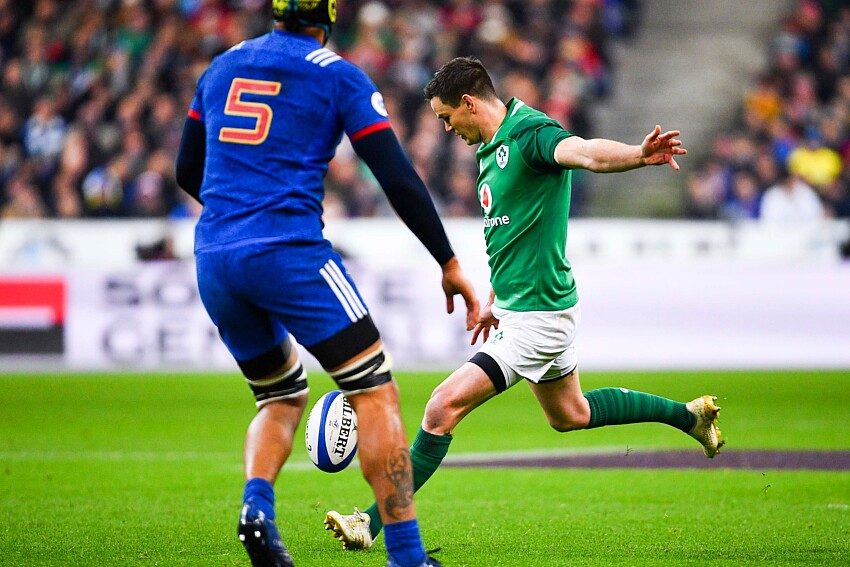
“What matters is the three points.” Except for the drop goal, which has become the poorest relation on scoresheets across every category, country and competition. An attempt to understand the phenomenon with Philippe Saint-André and Didier Retière.
Then there are the numbers: of the more than 9,800 points scored in the Top 14 this season, 7 drop goals were kicked, 21 points, just 0.21%.
In their day, Sexton punished France, De Beer crucified England in 1999 with five drop goals in a single World Cup match, and Wilkinson and Lamaison, Yachvili and Mazars need no introduction…
“Rugby’s poor relation”, according to Philippe Saint-André
Philippe Saint-André, currently coach of Provence Rugby and with a CV as long as a François Steyn drop goal, offers the following explanation: “The drop goal now only exists in two ways, off recovered restarts from the in-goal and in the closing minutes when you are three points or fewer behind, mainly in play-off matches. Even we, at Provence Rugby, have not worked on that part of the game this year except to prepare for the play-offs.”
Why the loss of affection, when every restart is a drop kick and pitches have become billiard tables? “Often, teams that get into the scoring zone prefer to keep the ball as long as possible so they can either score or win a penalty and then kick to the corner, and so on… It is true that it has become rugby’s poor relation, in every form of the game, we see fewer and fewer of them, or else it is decisive, as a last resort.”
Didier Retière: “Going for a drop goal almost works against the game”
Adding to the analysis, the former national technical director of French rugby (today technical director of the French tennis federation) Didier Retière puts forward several reasons: “So much energy is spent by the big men, by taking the middle of the field, that you tell yourself it is better to keep phasing, at best you will go forward, at worst you might win a penalty, and so on… Today I think there are two reasons amplifying the phenomenon. It is becoming harder and harder for the defence to win the ball back. In fact there is a sort of bias among referees in favour of attacking play, the attacking team is allowed to do almost anything, like the support players’ body position on the ball carrier, their attitudes, and so on… It is incredibly hard for the defence to get the ball. We are seeing very, very long sequences with advantages on penalties that go on almost indefinitely. In fact, kicking a drop goal is becoming a genuine admission of weakness… The second thing is the kick to the corner, which has become a very significant advantage today, very hard to defend. And refereeing today points the same way. Going for a drop goal now almost works against the game…”
1948-1992: how the scoring system devalued the drop goal
The law of the scoring system did the rest. It is worth remembering where the word “try” comes from: in the game’s earliest days, touching down in the in-goal was worth no points at all. It merely earned the right to “try” a kick at goal — only goals counted on the scoreboard. Rugby was a kickers’ game, and the drop kick its signature act: until 1948, a drop goal was worth 4 points when a try was worth only 3.
Then the lawmakers set about inverting the hierarchy:
- 1948: the drop goal is cut from 4 to 3 points — it is now worth no more than a try;
- 1972: the try goes from 3 to 4 points and overtakes the drop goal for the first time in history;
- 1977: the goal from a mark, the other historic way of scoring with the boot in open play, is struck from the laws;
- 1992: the try goes from 4 to 5 points — 7 with the conversion.
In 1948, a drop goal was worth a try. Today it takes more than two to match a converted try. The lawmakers’ message is unmistakable: rugby rewards those who touch down, not those who drop the ball onto their boot. One final paradox: the most retold world title in history, England’s in 2003, was nonetheless settled by a Jonny Wilkinson drop goal, off his wrong foot, in the closing seconds of extra time.
A closing aside: there is still one territory where the drop is alive and well. In sevens, every conversion is attempted as a drop kick…



Comments