
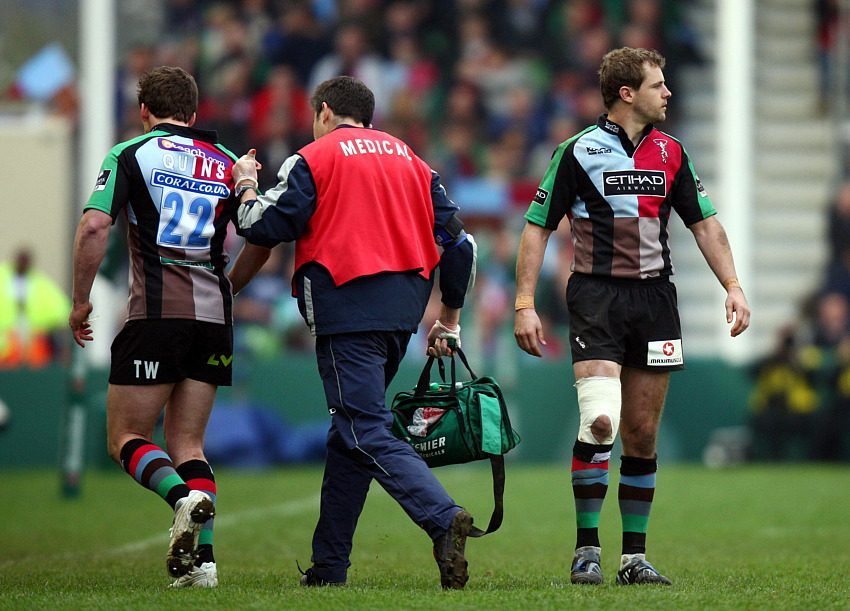
Do you remember the “Bloodgate” affair? 12 April 2009. Twickenham Stoop is holding its breath. With a few minutes left, Harlequins are trailing 6-5 to Leinster in the quarter-final.
A tight, locked-down match. Every point counts. So does every detail. But the London club are out of solutions. Nick Evans, their master craftsman, has gone off. His replacement Chris Malone has been injured too. No goal-kicker left, no plan B.
Then comes a strange scene. Wing Tom Williams, who has only just come on, leaves the pitch with his mouth covered in blood. The law allows a temporary replacement in the event of bleeding. Evans comes back on. The opportunity is unhoped for, almost too good.
But it is fake.
A deception stitched together in red thread
Very quickly, the pictures raise eyebrows. The blood looks thick, almost artificial. The investigation, run by European Rugby Cup, would lift the lid on an astonishing sequence of events a few months later.
Williams is not injured. He has bitten into a fake blood capsule hidden in his sock, during a driving maul. A premeditated act, orchestrated behind the scenes. The capsule was reportedly handed to him by a member of the medical staff, as part of a plan signed off at the top of the club.
2009 'The Bloodgate' rugby incident
— APSM Rugby Channel ? (@ApsmRugby) March 24, 2023
Harlequins vs Leinster
Heineken Cup Quarter-Final
12 April 2009 pic.twitter.com/f7QvPZyut1
The most disturbing part is still to come. To make the scene credible in the eyes of the officials, the club doctor, Wendy Chapman, actually cuts the player’s lip after he leaves the field. A manufactured injury to cover up a piece of cheating already carried out.
Rugby, a sport of commitment and truth, tips into a form of clandestine theatre.
A system, not an accident
The affair could have remained a one-off moment of madness. It became a systemic scandal. The authorities concluded that the practice was not isolated. Other similar fabrications had reportedly been used before.
Director of rugby Dean Richards was named as the architect of the scheme. Banned for several years, he came to embody the fall of a club that had crossed an invisible line, the one where cunning becomes fraud
Tom Williams, the player who faked the injury, was banned from all competition for four months. Club chairman Charles Jillings resigned after the affair came to light.
The revelation acted like a shockwave. Rugby discovered that it too could give in to the temptation of rigging a match.
The cruel irony of sport
And yet, despite the staging, despite the manipulation, despite the carefully constructed illusion, justice on the field had its say.
Ironically, Evans, brought back as a saviour, missed the winning drop goal, from 30 metres out and straight in front of the posts. Another twist of fate, more fatal still, was that Leinster won. Harlequins went out. And with them, their credibility.
10 years on from #Bloodgate…@ugomonye and @dannycare speak to former Harlequins team-mate @tomwiilliams about that fateful day.
— BBC 5 Live Sport (@5liveSport) April 11, 2019
An unmissable podcast on one of rugby's biggest ever scandals.
Listen on @bbcsounds ??️ https://t.co/8T4TB0ILio pic.twitter.com/7puUJ9c2X0
That defeat gives the scandal an almost tragic dimension. All that for nothing. An elaborate, deliberate, repeated piece of cheating that did not even bring a win.
A lasting scar
More than fifteen years on, the affair remains a dark reference point. It led to tougher medical protocols, to far stricter rules around blood replacements, and to a reminder that even the sports most rooted in tradition are not immune to going off the rails.
Rugby likes to tell itself it is a bastion of values. That evening in London, what it mainly revealed was its dark side. A capsule of fake blood. A furtive act. And a whole ethic left wobbling.


Comments