
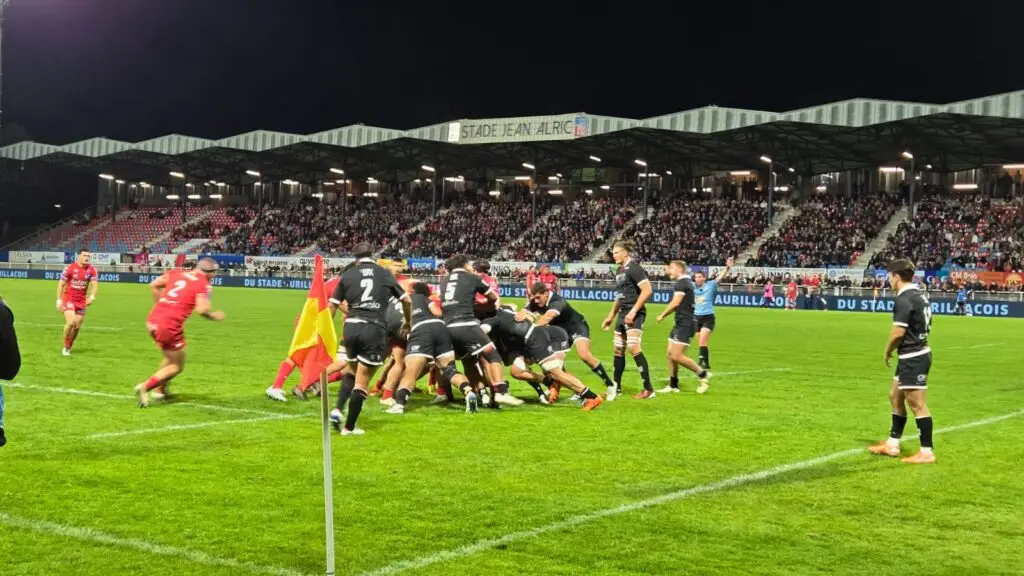
On Friday night, at the stade Jean Alric, the meeting between Stade Aurillacois and Dax (Pro D2) tipped into an uproar that went well beyond sport. Contested refereeing decisions, a crowd worked up to fever pitch, and in the middle of the pitch a referee – Ms Groizeleau – the target of jeering of rare violence. It was not only a match that was played out, but one more episode in the endless confrontation between passion and reason, between whistle and stand.
Friday 17 October, under the autumn gloom of the Cantal, the stade Jean Alric is already humming under the floodlights and the biting cold. Aurillac host Dax in a high-tension Pro D2 fixture, a game in which every scrum, every lineout, every gesture could tip into sporting drama. The supporters, wrapped tight in their parkas, are expecting a rugged battle. But more than the tackles or the tries, it is the refereeing – and more precisely the decisions of the referee, Ms Groizeleau – that becomes the heart of the controversy.
The whistles greeted her from the kick-off, and the booing would barely leave her afterwards. “She’s doing our heads in, f*****, she’s busting our b****, she can’t see a thing“, can be heard from the terraces. Virile, but fair. A penalty judged harsh against Aurillac, an offside blown late, a collapsed scrum “forgotten“, right up to the red card for Lucas Oudard, for an objectively high and dangerous tackle. The scoreboard runs away. Dax pull clear. The fury rises. In the stands, respect slides into something else: bitter chants, insults, and accusing eyes turned on the woman wearing the green shirt. The language goes off the rails (we will not repeat it). The whistles, scattered at first, swell into a wave. As the minutes go by, every warning shot is a spark. But another tension comes to swell the stands: the one that turns up when the referee becomes the leading character.
Imaginez-vous un instant dans la peau d’une arbitre de PRO D2… ?
— Ligue Nationale de Rugby (@LNRofficiel) April 3, 2025
Jérémy de @curieuxlive nous présente Aurélie Groizeleau, la seule arbitre féminine professionnelle de rugby en France. Entre performances sportives, diplomatie et langage corporel, elle nous donne les secrets de… pic.twitter.com/FqEFDMylvT
When respect leaves the stands
She, the referee of the evening, keeps her face closed, focused. Her signals are crisp, her decisions owned. But all around her, the terraces and the enclosure rumble. Insistent booing, insults on the edge (of the edge). The crowd is no longer only disputing offences: it is disputing an authority. And because that authority is female, the anger takes on a faintly bitter aftertaste. As if, that evening, the line between sporting criticism and personal attack had been rubbed out. Coarse, crude words from another age come down from the stands. You would have said the referee had become the receptacle for every grievance, every frustration. “It’s true that what’s being said goes beyond the bounds of the oval-ball game and of respect“, one supporter murmurs to us at pitchside. But that’s rugby, isn’t it?”
“The crowd demands football’s kind of justice, where sanctions fall at the slightest slip, the slightest lapse, but in rugby justice is complex, often nuanced, rarely perfect“, another supporter will say at the end of the game. Rugby, though, likes to see itself as different. It wraps itself in its values – respect, humility, brotherhood – as in a second skin. But in recent years the stadiums have rumbled louder. Referees, once almost sacred figures of the game, are becoming the targets of every grudge. Social media amplify, microphones pick up, cameras relay. The error, once forgiven, becomes professional misconduct. The referee, that solitary judge in the middle of the giants, finds himself handed over to the weekend mob. The paradox of a whistle that is nonetheless held sacred. The referee “is always right“, we are taught from rugby school onwards.
The night the whistle took the wind in its face
That evening, in Aurillac, the ritual was turned upside down: instead of respect, the din; instead of silence, the booing. Some will say it is the price of passion, that fervour is the ransom of living rugby. Others will see in it a more worrying symptom: the loss of that restraint, of that nobility of gesture and of word, which makes French rugby singular. Does it need saying that the referee, man or woman, is neither a heavenly judge nor an executioner? That he or she gets it wrong sometimes, yes, just as a kicker misses a conversion? That his or her word, even when contested, is what makes the game continuous? It is the referee who allows the game to exist at all. Without that whistle, chaos would reign. For better and for worse, those decisions make the game. Even if it means turning dreams (a home World Cup, in our case) into nightmares.
Félicitations à Aurélie Groizeleau pour son premier match arbitré en @rugbyprod2 ?
— CANAL+ Rugby (@CanalplusRugby) October 8, 2021
▶️ https://t.co/2CIbCLGkrZ pic.twitter.com/jJCzBcYCkI
The phenomenon is not new: every season, in every division, the criticism pours down. Coaches point out “inconsistencies”, supporters talk about “injustice”. The referee is judged “biased”, “too lax”, “too strict”. It comes with the furniture, as they say. “Those reproaches sometimes come from the simple desire to explain failure, to name a culprit when a win slips away“, concedes Yannick Labrousse, a doctoral student in psychology and sociology in Alsace and a fine connoisseur of the oval-ball game. But the repetition, the virulence of some of the remarks at Jean Alric that evening, shows that what was once a murmur has become a growl.
When the crowd spills over the game
“You can understand the frustration: rugby is a sport of emotion, of closeness, the future practitioner goes on. The stadium is a place of communion, of passion, and of protest too.” But there is a line that many cross: when you stop criticising a sporting decision and start attacking the person refereeing – their person, their gender, their voice, their gestures – you leave the debate and enter mockery, or even moral aggression. “She saw it, she saw it“, chanted Jean Alric that evening, when the international referee “finally” blew in favour of the home side. Good-natured stuff. There is no question here of blaming the laughter that greeted Ms Groizeleau’s backwards tumble, when the little remote-controlled car bringing the tee out to the home kicker tripped her up, but rather of taking issue with some of the words that accompanied her decisions. How far can you go? Where do you set the cursor in a case like this? Between the values of the oval-ball game and the traditions of the stadium?
The men and women in green remain aware of it, from the smallest division to the highest international level: “The referee plays a thankless role. He has to be judge, mediator, sometimes psychologist. He has to hold firm to his decisions despite the hostile chanting, maintain fairness despite the pressure, and start again with every decision from a base of shared laws.” And the crowd, for its part, might gain from remembering this truth: the referee gets it wrong sometimes – that is human – but insulting, threatening and humiliating repair nothing.
Rugby : Aurélie Groizeleau, seule française arbitre au #RWC2025 : « Osez, croyez en vous » ➡️ https://t.co/jpN6JAssyq#TousArbitres #LaMemePassion #JNA2025 @GroupeLaPoste @FranceRugby @LNRofficiel @top14rugby pic.twitter.com/DQzeEUdQTW
— ici Sport (@icisport_) October 9, 2025
The cry of the stands, the weight of the whistle
This Friday, the stade Jean Alric teaches a different lesson: that anger, when it becomes excessive, turns a moment of sport into a theatre of aggression. The players, out on the pitch, fight physically; the referee, exposed, fights to stay above the verbal scrum. “And the crowd, in its shouting, rises up against her, not only for what she decides, but often because she is the one who decides“, according to the socio-psychologist.
The Aurillac spectators leave the ground late, but happy, the win having finally made them forget the decisions they never stopped berating and sulking over. And the words that came out of it. “It’s human to criticise the refereeing. In every sport, we shout, we contest, we protest, and sometimes we applaud, explains Thierry Fabrègue, a devoted Stade Aurillacois supporter. It’s because we’re supporters. We’re with the players, we push with them. We protect them, we go with them. And when we think they’ve been wronged, we let it be known. Whether the referee is a man or a woman.” Out on the pitch, the players have already shaken hands. The referee heads back to the changing rooms without a word, flanked by two delegates, but with her head high. The silence of the tunnel contrasts with the clamour of the stadium. Ms Groizeleau ultimately did not respond to our requests.
What is left of rugby’s values?
Rugby, its values, its principles: respect, solidarity, humility. They are what is at stake. Refereeing is not an enemy, but a necessary function. “It is not a scapegoat, but sometimes the mirror in which the crowd sees its own demands, its own unchannelled anger“, the doctoral student argues. And when the whistle rings out into the night, it is the whole stadium you hear, in its joys, its disappointments and its limits. This Aurillac-Dax match will stay in the memory not for the tries, perhaps for its script, but above all for that bitter rustle when the referee, a woman with a whistle, was booed, jeered and judged. A moment when the crowd forgot the first rule: that of respect. If rugby is an art of the collective gesture, respect is its silent pillar.
Rugby likes to say it is a sport of Men and of values. But it might be time to admit that it is also a sport of words, and that those words, when they go off the rails, wound more surely than a mistimed tackle. This Friday, at Jean Alric, the whistle did not waver. It was the voices around it that failed.
Le mec est hors jeu de 5m prend la tête a pleine vitesse, mais ça sera une simple pénalité ahah
— BROKED (@Broked_Jms) October 17, 2025
Groizeleau je me demande vraiment comme elle a sa licence d'arbitre, a chaque match c'est un festival.
C'est même plus par rage, elle est juste dangereuse pour les joueurs. https://t.co/8rXgcvmxge pic.twitter.com/aOLJQ8gdXq


Comments