
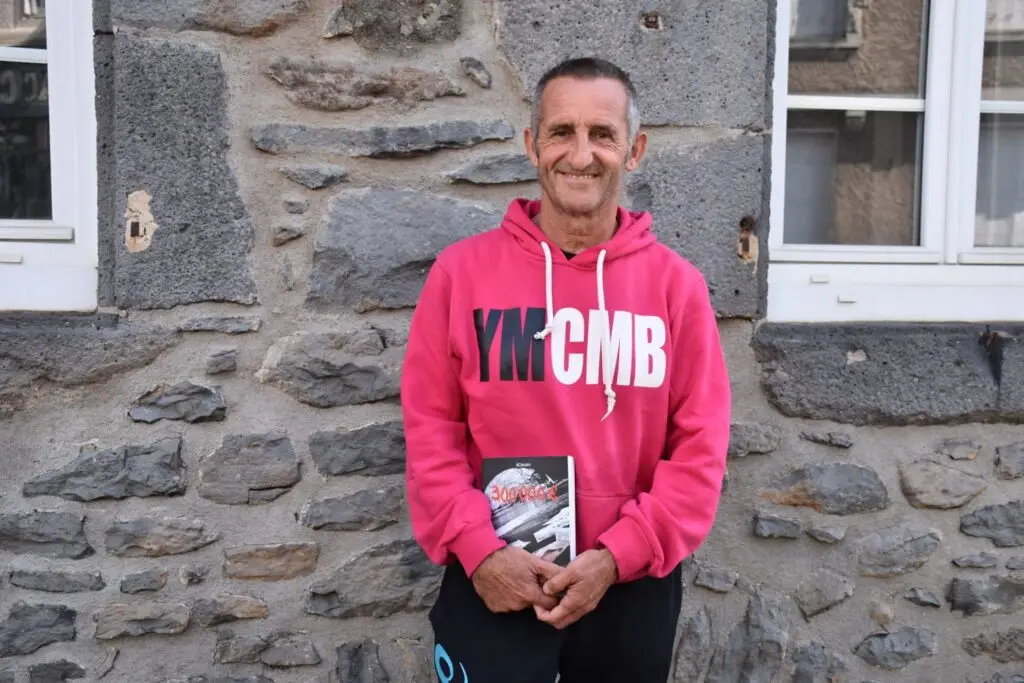
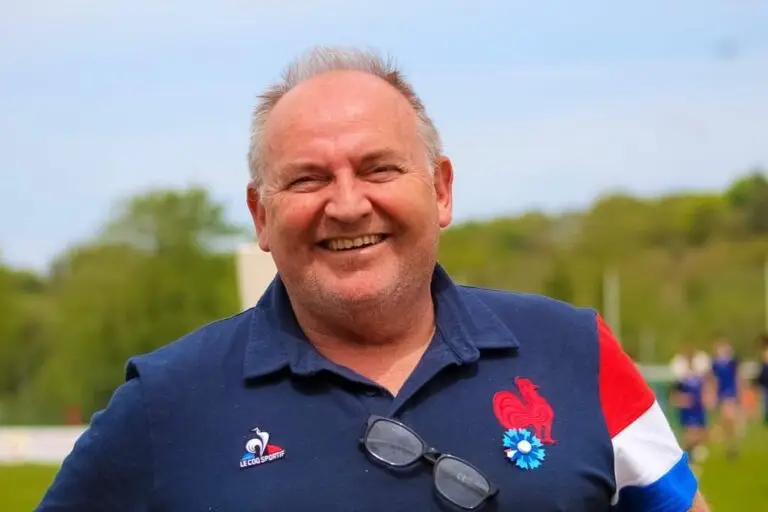
A former rugby player with a battered shoulder, turned tennis coach with surgical technique, Olivier Miranda spends his life juggling muscle and measure. On a court or on a pitch, he has found the same breath: that of the fair contest, the honest gesture, the beauty of the game. Portrait of a man who bridges two worlds that have nothing in common – except passion.
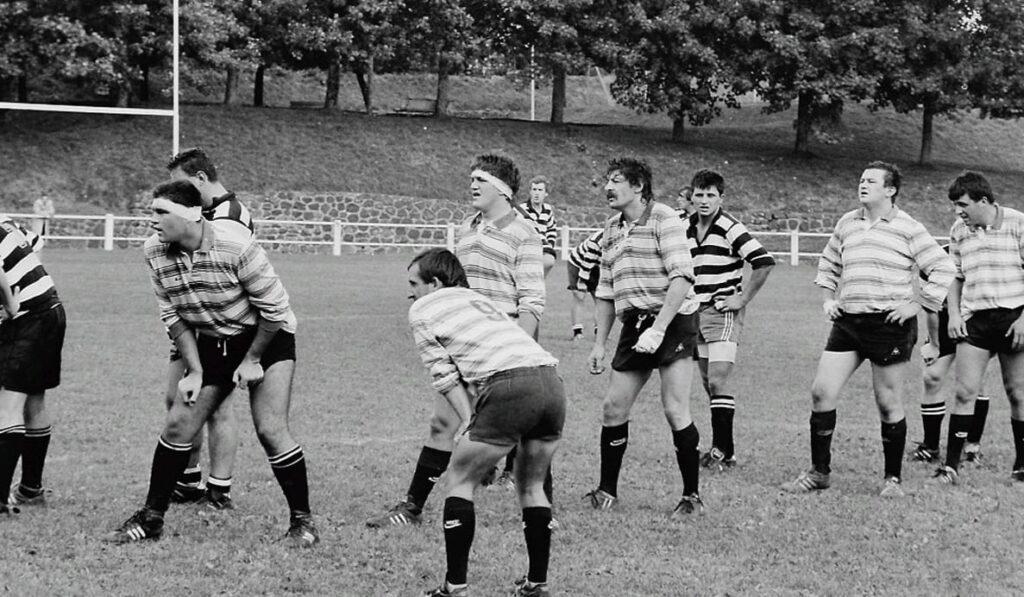
In Mauriac, in the north of the Cantal, everyone knows “Oliv”. His slightly bowed frame, his old boy’s smile, his measured teacher’s voice. A “character”, as they say around there. On the courts of the municipal club, the net stretched taut against the morning mist, he lines up the cones, sets down the balls, adjusts the stroke. Watchmaker’s precision, inherited from another life – that of Sunday’s tight scrums. Because before he was the respected player and coach of the tennis club, Olivier Miranda was a scrum-half at RC Mauriac, that tightrope-walker’s role among giants. “In that position, you have to think fast, speak clearly, and dare to mix it with the big lads“, he sums up with a soft laugh that barely hides the nostalgia.
You can still make out the sharpness of the little 9 who has never stopped tackling life. Olivier Miranda, “60-odd“, with a twinkle in his eye, has swapped the oval ball for the yellow one without really changing ground. “Deep down, it’s always a question of trajectory“, he says, with a half-smile, as if he were already serving up the perfect metaphor. Because for him, sport is not a simple pastime: it is a grammar of the body, a language he has been writing in ever since he learned to run.
Broken jaw
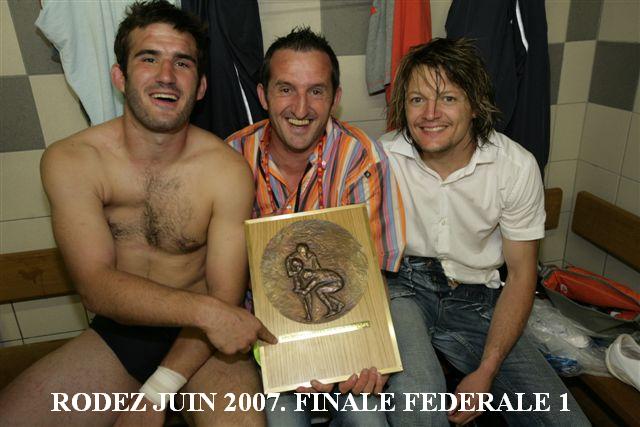
Born in Clermont, he could have dreamed of the Michelin and of ASM. But it was in Mauriac that he put down his roots. A club of mates, third halves in full bloom, mud that clings and leather that cracks. Rugby, for him, was not a sport: it was brotherhood in motion. “What I loved was feeling the others breathing next to me. You can’t cheat in a scrum.” Then the body called in its dues. A tired shoulder, a hip that protests, and all those old injuries that turn up without warning. Then came the punch too many, in ’91, taken behind the head, and a broken jaw. Never mind: that day, mighty Sarlat had fallen at Jean Lavigne, to the smallest side in the pool, which would go down to Honneur a few weeks later. “I couldn’t tackle any more. So I chose to keep passing things on, differently.“
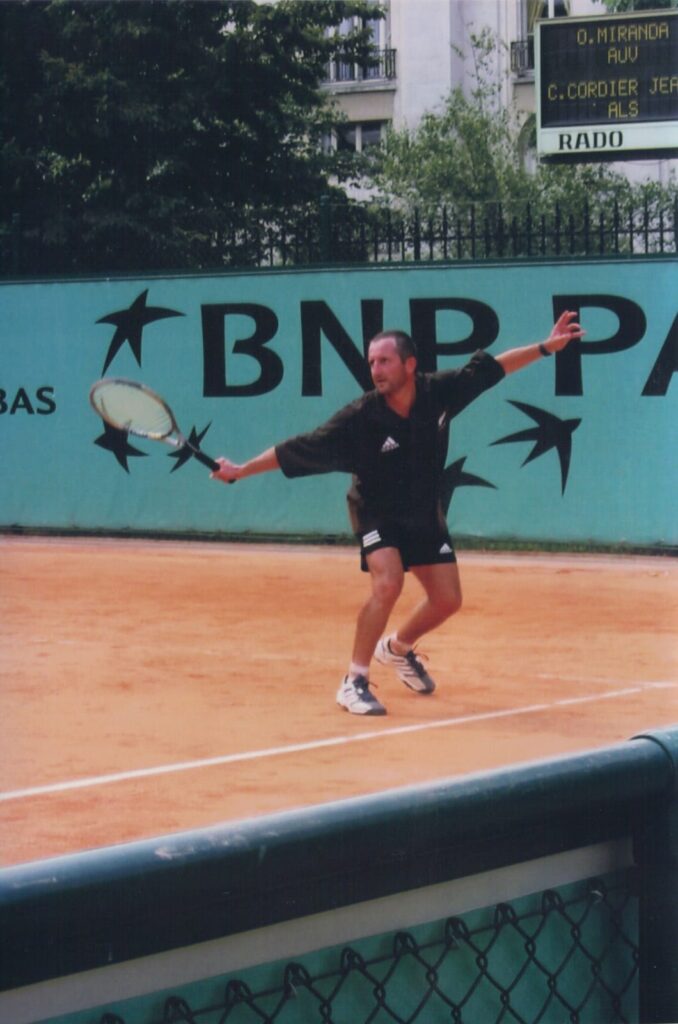
That “differently” is the little yellow ball, which he had in fact always kept in his pocket (ranked 2/6 in his prime, no less!). At first sight, a 180-degree turn. In reality, a sideways shift. Here too it is about reading, anticipation, rhythm. “On a court, you learn to listen to time“, he confides. The ball becomes the equivalent of the scrum: a point of impact, a moment when everything tips. The duel is no longer collective, but internal. “Rugby taught me solidarity, sharing, communion. Tennis taught me solitude, going beyond yourself on your own.“
“In rugby, you pass the ball backwards to go forwards. In tennis, you step back to strike better and go forwards. In both cases, it’s all a question of rhythm and reading.“
Olivier Miranda
Between the two, Miranda has built a philosophy of movement: advance without forcing, strike without destroying. Two complementary sports, made of footwork, of small adjusting steps, of tension. “But in tennis, you fight alone against your opponent, alone against yourself.” And where one comes to an end after 80 minutes, the other is never finished. “Maybe that’s why I prefer playing tennis and watching rugby“, he explains, beaming. Not the same mindset either. The values of the oval-ball game on one side, which no longer need proving, a more individualistic, self-centred side on the other.
Still in Mauriac, on those same lands where winter freezes the nets and summer smells of chalk and sweat, Miranda took up tennis the way you pick up the thread of a story: with humility and curiosity. Very quickly, he grasped the correspondences. “In rugby, you pass the ball backwards to go forwards. In tennis, you step back to strike better and go forwards. In both cases, it’s all a question of rhythm and reading.” His strategist’s eye, sharpened in the rucks, began to decode trajectories. The scrum became a rally, the pass a serve, the pressure that of a tie-break with the lungs burning.
An Auvergnat who supports the RCT
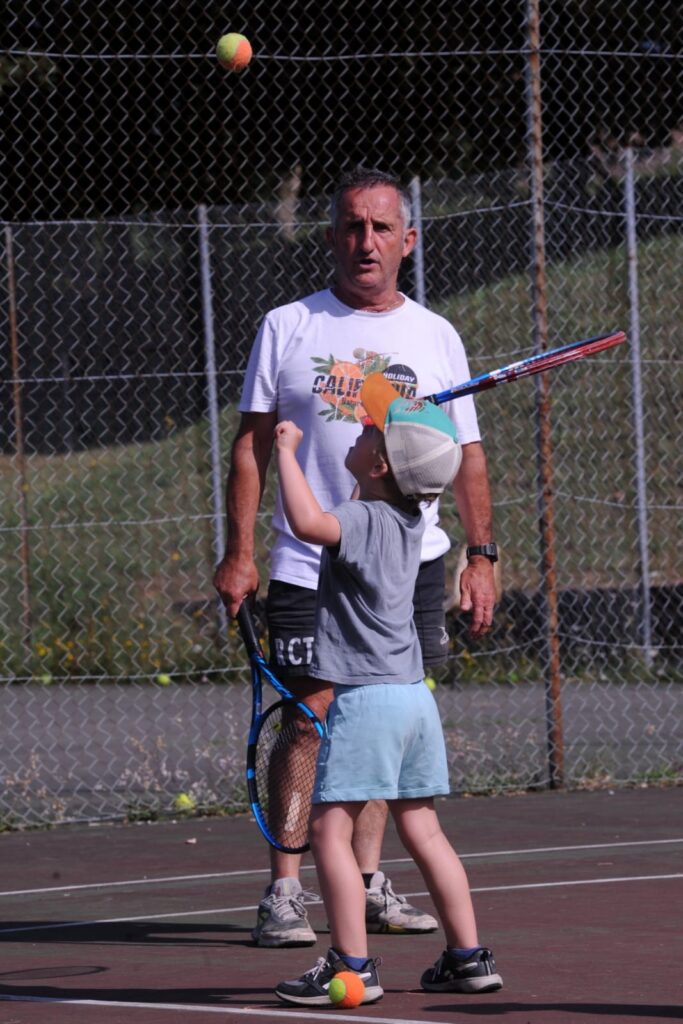
On court, Miranda says little, but says it well. “Bend your knees. Breathe. Feel the ball.” His pupils – kids, teenagers, adults from the area – listen to him with a kind of quiet respect. He imposes nothing, he accompanies. “He has that rare thing: he makes you love your own effort“, so they say. With him, teaching goes through the eyes, not through shouting. “Tennis is like a scrum: you have to listen to the silence.” He greets them with a firm handshake and a rare attentiveness. His sessions look like workshops in living: he talks as much about positioning as about patience, about taking the ball early as about confidence. On the bench, Miranda never shouts. He breathes, advises, adjusts. “Tennis is slow rugby“, he jokes. A discipline of breathing, an elegance of control. “What I love is when power finds its line.“
His path throws the purists and fascinates the curious. Some see him as a defector, an odd go-between linking two sports that ignore one another. He refuses to be boxed in. That link between the two worlds he cultivates in his words, in his teaching, in his relationship with the body. He often quotes gestures, a little less often scores. “What stays with you from a match is sometimes not the result. It’s the thrill.“
An RCT supporter for as long as he can remember – the paradox of an Auvergnat with his heart in the Var -, he lays claim to that taste for panache. “Toulon is grinta, excess, fervour. But respect too. And above all I wanted to do the opposite of my mates“, he breathes. Even if it meant finding himself at a motorway service station, the red and black shirt on his shoulders, surrounded by an “army of yellows“, a few hours before a Top 14 semi-final, in Saint-Etienne. Quite the “dummy“.
“Rugby is my youth. Tennis is my continuation.”
Olivier Miranda
On his own court, and behind 40 years of teaching (which he would celebrate in great style next August), still those short rugby shorts. RCT ones for preference, or RC Mauriac ones. In his voice you sense the same love of the pure game, the kind that transcends jerseys. At the weekend, he still watches matches, like those of Stade Aurillacois (his “other” club), a cup of coffee in hand, the way you catch up with old friends. “Rugby is my youth. Tennis is my continuation.”
The “Tenn-rug”, a future project?
Miranda has reconciled the two. Right up to the “Tenn-rug“, the perfect blend, which he has tried out with one of his two lads, the aim being to kick the oval ball over the net and force your opponent to catch it after a bounce. Not easy. But as with everything, what matters “is bringing people together“. By any means available. “Oliv” the writer this time – because he does that too – has therefore adapted a play drawn from one of his novels, wrapped up with a Pena Baiona which, in the memory of the old-timers, was heard right across the north of the Cantal. Life stories, once again, for this great reveller, with no “regrets“.
Olivier Miranda has never really left the field of play. He has simply changed lines: the try line for the baseline. In both he finds what he has always been looking for: the balance between power and precision, the taste for the collective right down to the solitary stroke. And when he serves the last ball of the day, in the warm silence of a Mauriac evening, you could swear he still hears, somewhere behind the fence, the distant rumble of a scrum.

1 comment