
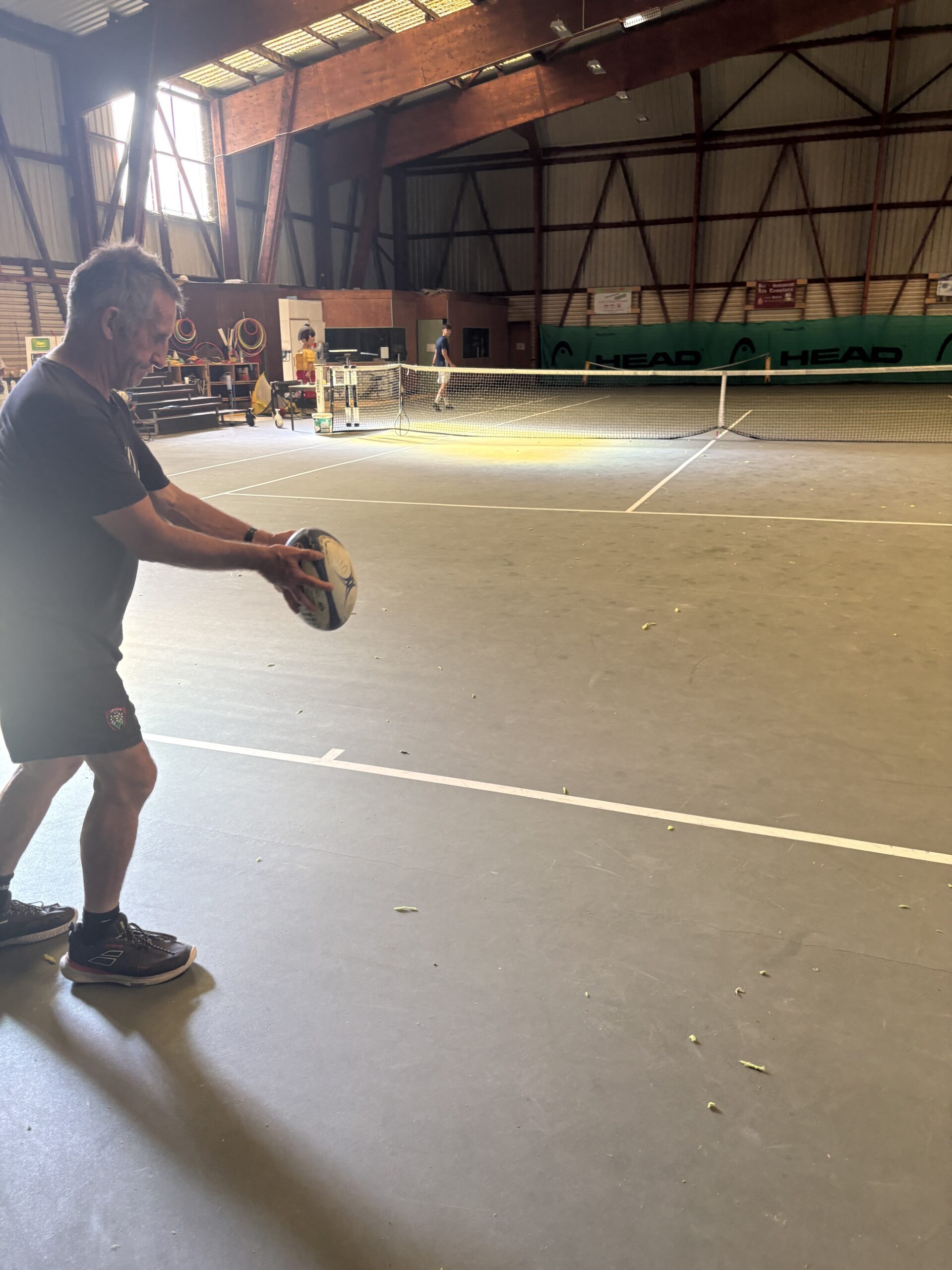
At first glance, it sounds like a bad joke made over post-match drinks. A rugby ball sitting on a tennis court. No racket. A net in the middle. And, on either side, players who have to catch by hand a ball their opponent has just sent over… with his foot.
Welcome to Mauriac, a small town in the Cantal where Olivier Miranda has decided to bring together two worlds that, until now, met mostly in changing-room conversations.
The setting suits him. Olivier is at home here. At 62, the man everyone calls “Oliv” has spent his life chasing trajectories. A former scrum-half at RC Mauriac, he then made tennis his profession. A state-qualified coach, he has been teaching in the same place for forty years and still passes it on in his own way, never really choosing between power and touch.
So the two were always going to meet one day.
A tennis ball, a rugby ball and Pete Sampras
The idea is not a recent one. It goes back decades, to a corner of the mind of a young coach watching Pete Sampras work on his reflexes.
“I had seen Pete Sampras putting tennis balls in a vice to open them up a little and make the bounce unpredictable“, Olivier Miranda says. Unpredictability. That is the word.
There was already something there he liked. A bounce that does not tell you exactly where it is going. A ball that forces you to stay available. Then the tennis coach started to transpose the idea with children, this time with foam rugby balls. “I would roll them towards the kids, you see, and it was the same, the bounce was unpredictable, so they had to be very alert, very available.“

TennRug’Be was born somewhere in that space. Between reflex, reading, accuracy and the pleasure of not knowing exactly what is about to happen.
And then there is the personal story. Miranda spent part of his youth in rugby before switching to tennis. In the portrait we devoted to Olivier Miranda, he summed up that path himself: “Rugby is my youth. Tennis is what came next.” TennRug’Be may well be the logical follow-up.
So how does it work?
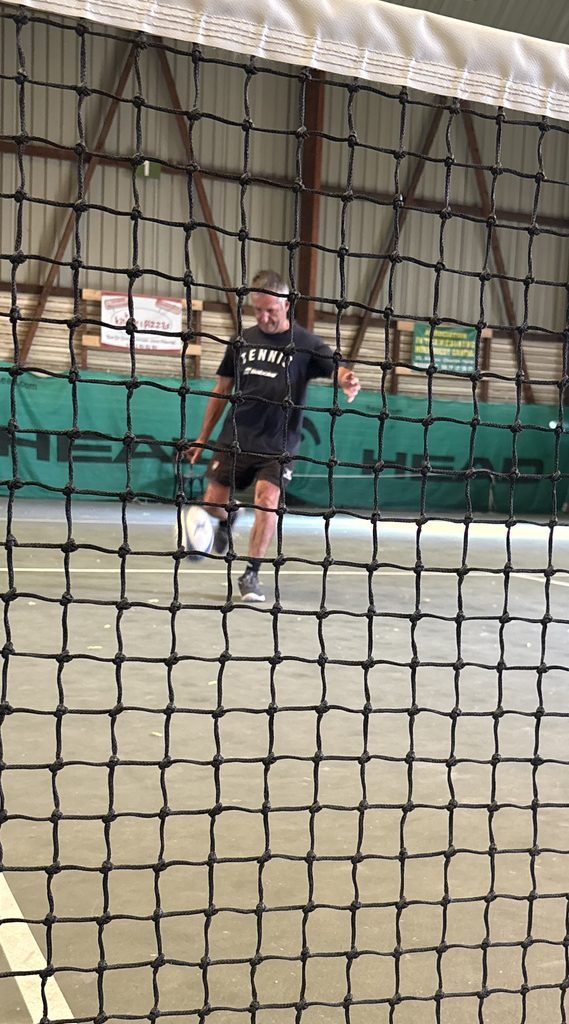
The simplest thing is to forget the racket. TennRug’Be is played on a tennis court, without the tramlines in singles and with them in doubles. The ball, of course, is oval. The aim is to send it beyond the opponent’s baseline, but it must bounce before crossing that line. It is struck with the foot, with no bounce first in open play.
And that is where the game gets strange.
The player opposite can catch the ball on the full. Or wait. One bounce, two, three, as many as he likes. He can also control it with his foot before picking it up. Then he has to strike the ball from where he caught it, or from behind that point.
In other words: you have to know how to wait, but not too long. Read the flight, but also anticipate the bounce. Move. Control. And send it back. “It is really all about being available, alert, mobile, accurate“, Miranda says.
The net is not only a divider, then, it becomes a “border” between two ways of reading the game. A bit of tennis in the space. A bit of rugby in the ball. A lot of accuracy in between.
Seven minutes to plant a doubt
The format is deliberately short: a game lasts seven minutes. If the two players are level, it goes to sudden death. Each one serves in turn and the winner is the player who gets the ball past the line with the fewest bounces. If they are still level, the bounce closest to the line settles it.
And doubles adds a little more rugby to the mix.
The tramlines come into play. Above all, the player receiving the serve must pass backwards to his partner. No striking it straight away. The forward pass is banned. “That may be the moment when TennRug’Be definitively stops being just tennis with a rugby ball“, Miranda says.
There is now a partner to find.
The rugby drill that did not yet have a name
Olivier Miranda is not imagining a worldwide revolution in racket sports just yet. He knows his invention is “young, experimental“, and that it first has to “live on the courts“.
He has registered it with INPI, France’s national industrial property institute. But for now TennRug’Be remains “in a box“, as he puts it. What he wants now is to get it played, to put it in front of children, rugby players and teachers.
He says: “I think I am going to do something with Stade Aurillacois, most likely. And I am starting to get it going with the RC Mauriac youth section, we are going to run a session.“
No question, then, of rushing things. His ambition, on the other hand, is far less modest: “My dream would be to organise championships.” For now, TennRug’Be could serve above all as a tool. A different warm-up. A movement drill. A way of working on catching, footwork, reading the flight of the ball and reflexes.
And that is exactly what caught Gilles Moretton’s attention.
Moretton watches, and promises nothing
The presence of the president of the French Tennis Federation in Mauriac inevitably gives the story another dimension. Gilles Moretton came to the Cantal for Olivier Miranda’s forty years of coaching, but also to discover this new practice, seen as an “activity mixing tennis and rugby“.
“Build the project“, the head of French tennis told him more than once. That does not mean TennRug’Be is about to become a federation discipline. According to Miranda, Moretton spoke rather of a “fun drill, interesting for warm-ups in particular“. Not yet a “sport in its own right“, in the way padel or pickleball are.
Which is hardly a snub. Quite the opposite. It is now up to the inventor to make his idea live. “He told me: it is up to you to develop it.” So the man from the Cantal is going to develop it. In Mauriac first. In rugby youth sections. Perhaps in Aurillac. Then elsewhere, if the ball rolls far enough.
Because deep down, his idea is simpler than it looks. Take two sports he knows intimately and look at “what they can still give each other“. “Coming from rugby and coming from tennis, I thought these were two sports that could be mixed.”



Comments