
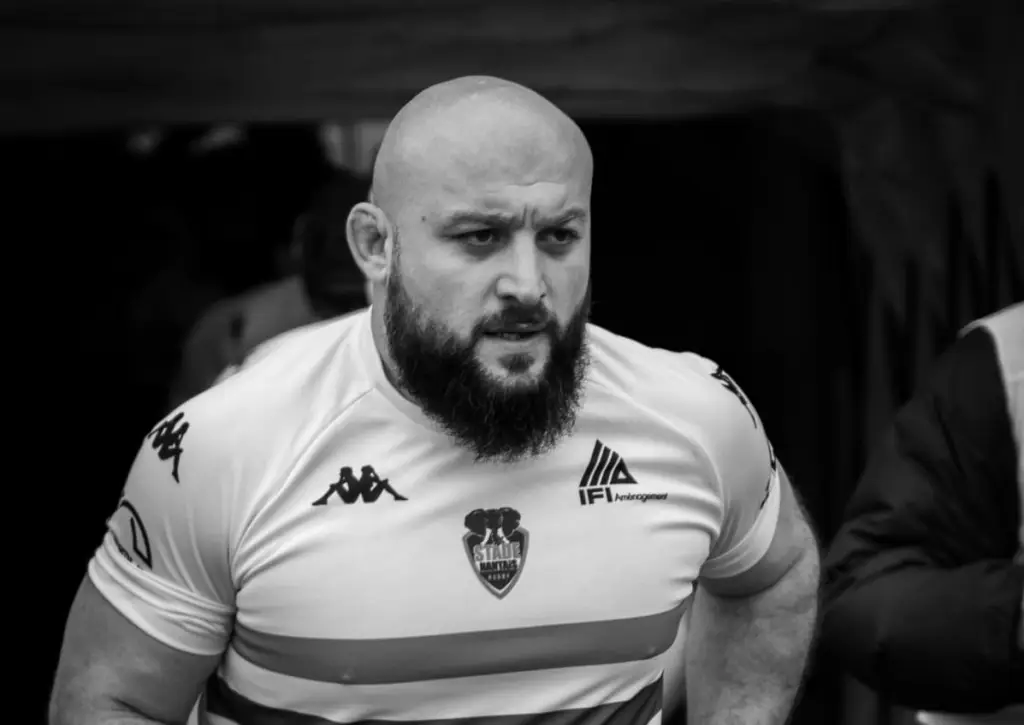
36 years old, Georgian, and therefore a prop, Saba Kartvelishvili has done plenty of roaming, from the mountains (Lannemezan, Chambéry) to the ocean (Stade Nantais), by way of the gentler charms of Angoulême. But his body has said stop. Not easy, but accepted.
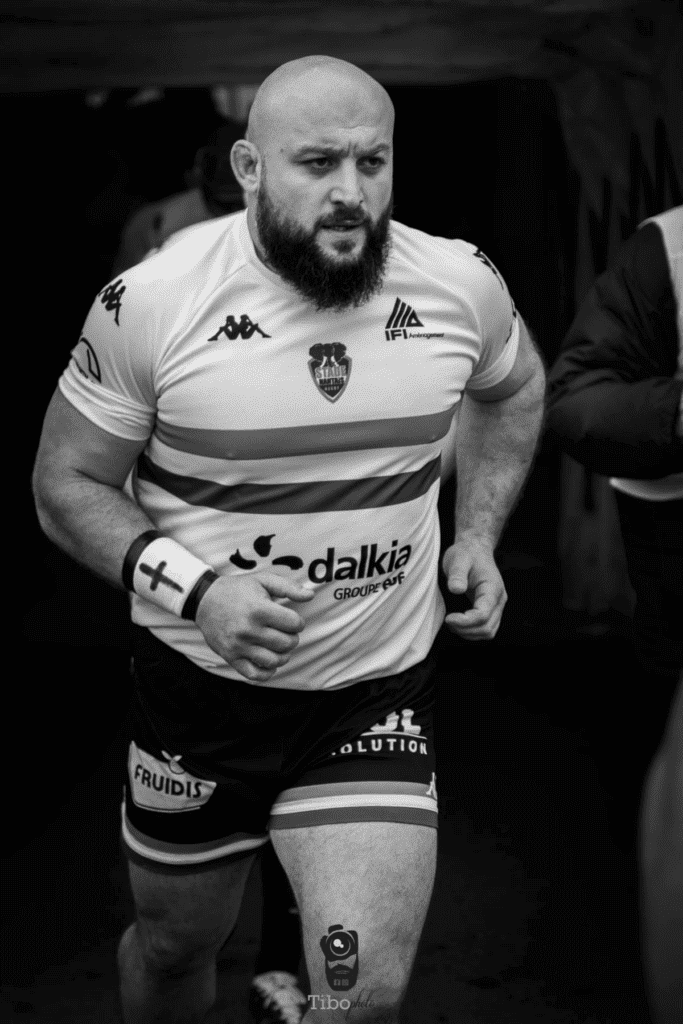
“I started at Lannemezan, then I was at Stade Nantais. Yeah. After my injury I did my rehab, I took rugby back up at Stade Nantais, and then I left for Chambéry, after Chambéry I went to Angoulême, and from Angoulême I came back to Nantes, and I stayed in Nantes for 10 years,” Saba explains in perfect French, as rugged as Georgian players can be.
He took up rugby at the age of 11, in 2001, in Tbilisi, looked after and guided by a friend of my father’s. The solid prop in the making had tried several sports, but it was rugby that drew him in.
It was a very particular time for Georgia, the end of a deadly conflict, 2001, 2002, 2003, but there was also great joy, there was that qualification for the World Cup in Australia, against Russia in Tbilisi in front of more than 60,000 fans, wild and proud, with the likes of Labadze and Zebghinidze, coached by Béziers man Claude Saurel. “A fine era,” the young Saba recalls, “even if things are going well today, back then it was better, I feel. There was a wind behind us, something had happened.”
25 years on, the time has already come to take stock of a strongman’s career cut short by his neck. “Rugby taught me a lot of things in my life. The values of friendship, the values of solidarity, of sticking together with your mates whatever happens. It helped me grow up. It made me discover plenty of things, different nationalities, it enriched me, and it helped me a lot to develop as a person. It’s also a sport that hurts, we know that very well, especially in the front row, that it’s complicated sometimes, often painful.”
Like that injury on 12 October: “There was a flash, head against head, it flashed, and it has left me with after-effects even today. Concussion. Meaning I get headaches, I can’t cope with noise, light bothers me, and above all, the most worrying thing for me is the memory loss.”
What followed was an MRI of the brain, then of the neck, and the neurologist’s verdict landing: the doctor said there was a high risk of ending up paraplegic or quadriplegic if Saba carried on… “I went through three very, very hard months, in the dark you might say, when I found out I had to stop, especially after a 25-year career. I didn’t want to stop like that, I wanted to stop differently. But there you go, I wasn’t the one who made that choice, it was my health. That’s how I’ve tried to reason it out.”
So what next, rugby on the coaching staff? Another project? “I’m going to stay in Nantes, because I like it here, but in rugby, no, I was a bit sickened by it at first, I didn’t even want to see a pitch, nothing at all. I wanted to turn the page completely.
As for life after rugby, I kept saying “we’ll see later”, and then came the injury. In the end, I hadn’t prepared anything. But there are the people around you, and your friends. And the solution: “I have a friend who works at a car dealership, he took me on, and since I’ve always loved cars, it clicked, it allowed me to learn something else.”
Thanks to tibophoto.com.fr for the photos
Comments