
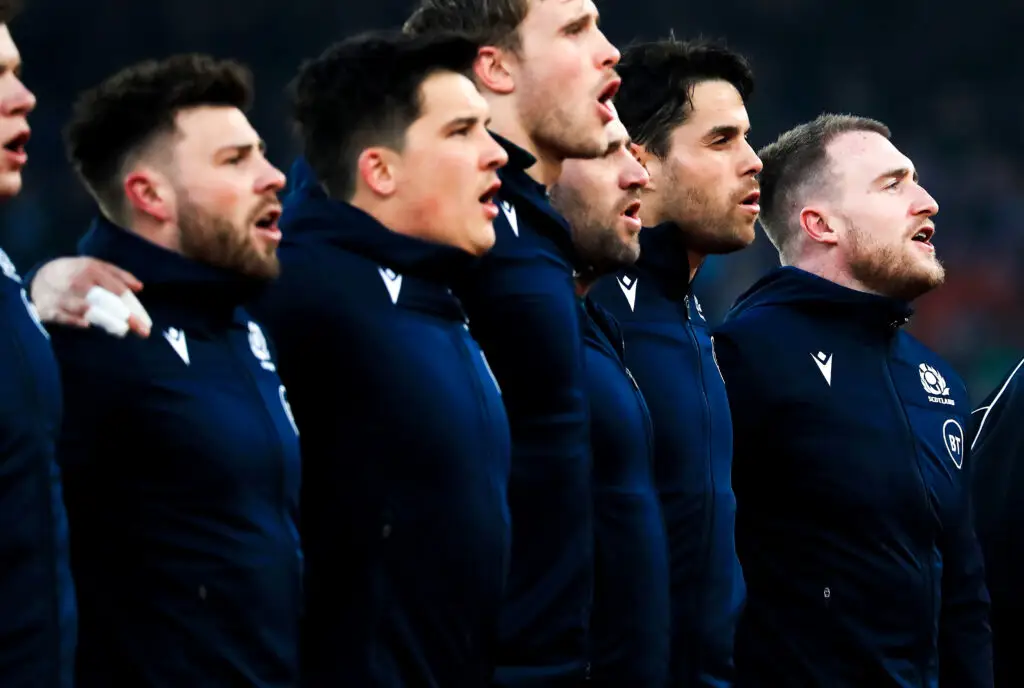
Five minutes before kick-off. The wind shakes the flags, a silence weaves itself together, and suddenly a “music” is born. The first chord of a national anthem rises into the air, carrying an emotion that goes far beyond the boundaries of the piece itself. Why that shiver, even when it is not “our” anthem ringing out? Why do these moments seem suspended, inhabited by a charge that goes well beyond the notes being played?
First of all because music has an intrinsic emotional power. As a column in Psychology Today points out, being moved by a piece of music – to the point of getting “goosebumps or damp eyes” – is a frequent and profound human reaction. In one study relayed by the magazine, 89.8% of participants said they had already felt intense emotion while listening to music.
A story of symbols
But a national anthem is not just any music. Anthems are powerful symbols of collective identity. In National Anthems, an overview from ScienceDirect Topics, we read that a country’s anthem, alongside its flag, offers “the most powerful performance of national identity“, forged by history and culture. Played in a sporting context, that music instantly carries those symbols into the arena of the match. In short, a belt that drives a people.
Social psychology also helps to understand the phenomenon. Several empirical studies on national “anthems” have shown that, when someone hears their own anthem, they react with “feelings of pride and patriotism” more than they do with other pieces of music, and associate the sound with specific national images and values. Even when the anthem belongs to the opposing team, those associations evoke collective belonging, shared effort, a sense of commitment.
Le plus bel hymne au monde ? ?
— Six Nations (FR) (@SixNations_FR) January 30, 2026
La magie du Flower of Scotland au Scottish Gas Murrayfield ?#GreatnessM6N pic.twitter.com/ZyUf1zKry0
That symbolic meaning is all the stronger in a context such as rugby, a sport in which national pride and team identification are central. Some work on sporting passions shows that the way a team sings its anthem conveys a cohesion and a group spirit that acts as a psychological driver for players and spectators alike.
Another often underestimated factor is the physiological response to music. American research in sports psychology indicates that music can “raise the heart rate“, “adrenaline and excitement before an event“, preparing body and mind for an “intense experience“. Seen that way, the build-up of tension we feel during the anthem is not only mental, it is an almost instinctive preparation for confrontation, a bodily signal of anticipation.
Patriotic attachment
When it is another country’s anthem that rises, we are not immune to that mechanism. Still less in front of a Land of my fathers in Cardiff, a Flower of Scotland at Murrayfield, an Ireland’s call in Dublin, or even a God save the King at Twickenham (that is saying something). The collective dimension of the anthem invites a form of social empathy, a projection of the self into the history and the passion of the opponent – not to idealise it, but to feel the symbolic dimension of the match with real intensity. It is less a patriotic attachment than an attachment to the idea of challenge and ritualised confrontation.
Finally, it is worth mentioning how emblematic these rituals have become of sport and of modern rugby. In many international competitions, anthems serve to place each team not only as a competitor, but as the bearer of a heritage, a culture, a people. The whole world has seen how much these moments matter, the political debate that sometimes surrounds them, or the importance attached to them, to the point where some athletes choose symbolic gestures during the anthem, as a way of asserting a position or a cause. So the anthem is sometimes a shop window for a team, but also an advert.
A column on Ireland's most divisive – and awful – composition.
— Roy Curtis (@RoyCurtis68) February 14, 2026
A hosanna to nothingness, the ghastly Ireland's Call.
Print version of earlier online post. pic.twitter.com/D4yBMtV3Zv
And yet the Marseillaise does not always produce that pure shiver stirred by certain foreign anthems. Perhaps because it is too familiar to us. Perhaps because it has been part of our soundscape since childhood. France’s official anthem since 1795, it was born as a “revolutionary war song” intended to mobilise people against foreign invasion. Its power is beyond dispute, but repetition has made it more intimate than mysterious. Where Land of My Fathers or Flower of Scotland retain, for many, a share of the exotic and of discovery, the Marseillaise already belongs to our memory. It moves us differently. Less as a revelation than as a recognition. Less as a shiver from somewhere else than as an inner vibration, deeper, steadier, almost silent. It does not surprise. It simply confirms.
So the shiver we feel is not a simple musical response, nor a question of pure nationalism. It is a confluence of elements. In other words, raw musical emotion, the symbolism of collective identity, psychological preparation for competition, and the shared dynamic between supporters and athletes. In those few notes rising before the shock of the match, an essential part of the sporting experience is played out, and of what makes us tingle, even when it is not “our” anthem.
LA MARSEILLAISE AU SIX INVITATIONAL 2026 ? pic.twitter.com/nz3i4bKI4Q
— ESIX | FR (@ESIX_FR) February 15, 2026


Comments