
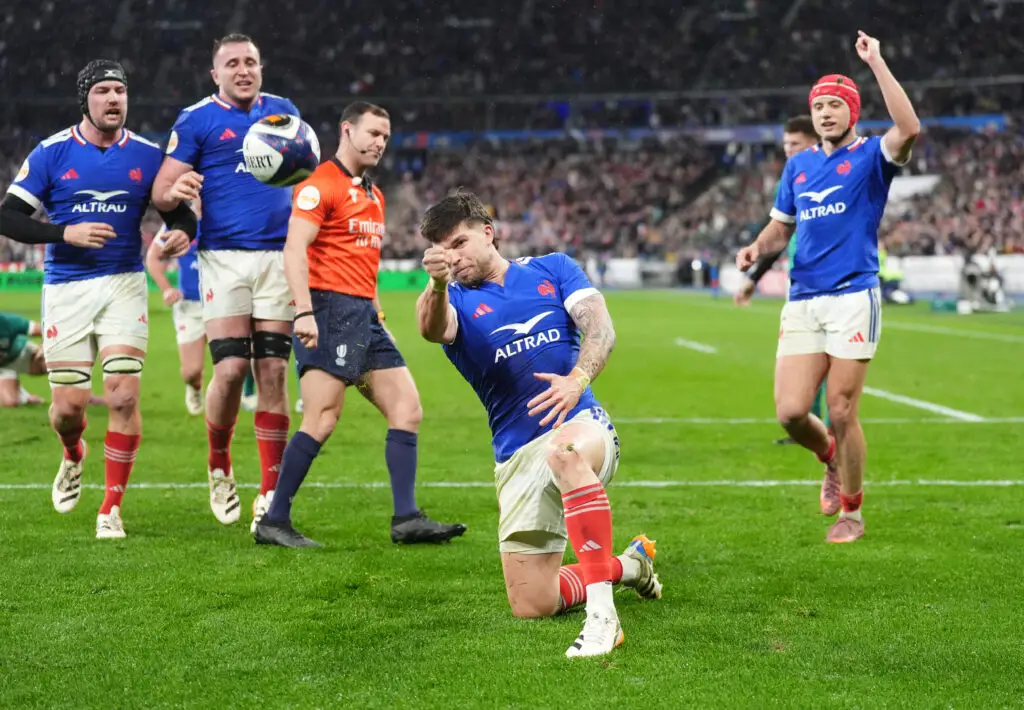
There was that particular scent of a decisive night at the Stade de France, a mix of anticipation, expectation and collective memory. France v Ireland, the opening game of the Championship, already looked like a full-scale test. And at the heart of the occasion, one question hung in the Saint-Denis air: which version of Jalibert was going to turn up?
The answer was crystal clear. From the opening minutes, the France fly-half set the tempo, playing the right way, playing fast, playing true. A Jalibert without needless frills, a Jalibert who put his shoulder in on defence and carried with intent in attack, and above all one with that creative touch that throws defences out of kilter. Against an Ireland side quickly overrun, he embodied the perfect balance between collective control and individual inspiration.
“Finishing with my head held high”
His try, scored after a razor-sharp line break and a run full of determination, summed up the night. More than a simple break, it was an act of self-assertion. Jalibert wasn’t playing to convince, he was playing to express himself. In his attacking shape, his kicking choices, his handling of the quiet periods, everything breathed a serenity rediscovered. Everything.
After the game, his words had the same clarity as his rugby: “Sometimes, in certain matches with France, when I come off I have a few regrets because I don’t feel I’ve been myself. Tonight, I wanted to give everything and finish with my head held high.” A simple sentence, almost modest, and yet one that sheds light on months of doubt and soul-searching.
?? « Il me fait penser à des mecs comme Michalak, qui attaquait la ligne. Au pied, il est très complet et il fallait qu’il s’améliore sur les plaquages. Ça va batailler pour la place de 10 jusqu’en 2027 », Vinvin nous parle de Jalibert, de retour avec le XV de France. pic.twitter.com/84ZSIBkT0Y
— Super Moscato Show (@Moscato_Show) February 3, 2026
For a long time, Jalibert carried the label of the inconsistent talent, capable of the sublime, often for his club, but also of fading away in the blue jersey. Against Ireland, he wiped away the hesitation and kept only the essentials: leading, creating, taking responsibility. Diligent in defence – rarely troubled in the one-on-ones – and inspired in attack, he dragged a coherent, precise and forceful France side along in his wake.
Building
The first half, dominated from start to finish by France, smothered any Irish ambition. Jalibert was everywhere, mixing kicks in behind the defence, long spells of possession and sudden bursts of pace. In the second half, despite a slight opposition revival, he kept control, slowing things down when required, launching attacks as soon as space opened up. Even after a heavy (and legal) hit from James Ryan, the Bordeaux man got back to his feet, grimacing, but without really flinching.
“We really enjoyed ourselves, but above all we stuck to what we wanted to put in place“, he said afterwards. Behind that understatement, one certainty: this match marks a turning point. Not an end in itself, but a solid base to build on.
Denis Charvet : "En ce moment Matthieu Jalibert marche sur l'eau. Il a un talent fou, il est en confiance, capable de tout. La concurrence va être rude mais s'il continue à réitérer ces prestations, il va s'installer en n°10."
— catourneovale (@catourneovale) February 8, 2026
Il va enchaîner et confirmer ?
RMC#XVdeFrance #UBB pic.twitter.com/IyFO5XL9WG
In this rediscovered score, Antoine Dupont played an essential part. Their understanding, visible from the very first sequences, was built on constant communication and a shared reading of the key moments. Dupont often committed defenders before releasing the ball, opening up space that Jalibert exploited with surgical accuracy. Conversely, the fly-half never forced his game, respecting the tempo set by his scrum-half.
And what about Ntamack?
That complementarity gave the French game a new breathing space, less rush, more control, and that rare feeling that every acceleration had been thought through by two men. Against Ireland, the pair didn’t try to shine individually; instead they imposed a quiet authority, the kind you get from partnerships that work because they understand each other.
Inevitably, this performance also reopens the debate about competition at fly-half. Because behind this recital against Ireland looms the shadow of a heavyweight absentee: Romain Ntamack. The Toulouse man, the established benchmark in the position in a France shirt, remains the natural first choice when his body leaves him alone. But Jalibert, by shining without trying to imitate anyone, was a reminder that the pecking order is not set in stone.
Jalibert pas plaqueur ??
— Toxikinho ?? (@Thomasinho24) February 5, 2026
Via le stream de @NogodiLeVrai #FRAIRL pic.twitter.com/4MyPnu4WOx
Where Ntamack embodies continuity, rigour and reliability on the big occasions, Jalibert offers something else: a more instinctive reading of the game, an unapologetic taste for risk, the ability to disorganise an opponent with a single touch of the ball. That clash of styles, long seen as a weakness, may now be an asset. Provided Jalibert backs it up, not with isolated flashes, but with a consistency finally in line with his talent.
This France v Ireland may go down as the night Jalibert stopped trying to prove anything and simply played. The night the debate fell silent, replaced by the obvious. And in a Championship that has only just begun, that version of France’s number ten could well change the tune of the coming weeks.

Comments