

How did you experience that Elite 2 title?
Amélie Derrey : I’ve been at RCPM for two years. Mélanie has only just arrived. Otherwise, stars in our eyes… When you become champions, everything stops. And then it’s a bit hard to get going again, especially as you’re moving up a level. We started back at the beginning of August. Unfortunately, I got injured at work. So I couldn’t do the off-season. That meant I only started again in September.
And you, Mélanie, how has settling in gone?
Mélanie Blanchard: I was at Stade Rennais before. And on top of that we went down. So this is a change of club, with big ambitions. The off-season has been really interesting in terms of energy. On top of that, being with a group that has just won the title is incredible.
Has promotion changed anything in your preparation?
A. D.: Last year we set off in August just like this, we did the same pre-season. Then again, if we do better than staying up, we’ll take it.
M. B.: I think we’re aware of what the club has put in place. We’re also aware of what we’re capable of. And quite a few of us know what the Elite 1 level is like. We know it will be hard, but we know it can be done.
Do you feel under pressure before the championship starts?
M. B.: Even Bordeaux are under pressure at the start of the championship. So there will always be pressure, but above all there’s a lot of desire and ambition. That’s what will get the better of the pressure, I think.
The fact that Canal+ is broadcasting some Elite 1 matches must delight you…
M. B.: I think the way it’s developing is crazy. Last year in Elite 1, I looked it up, only five matches were broadcast. Now there are going to be around ten. It really is amazing how women’s rugby is rising and climbing that ladder in terms of coverage. It can only open doors for us. It’s brilliant.
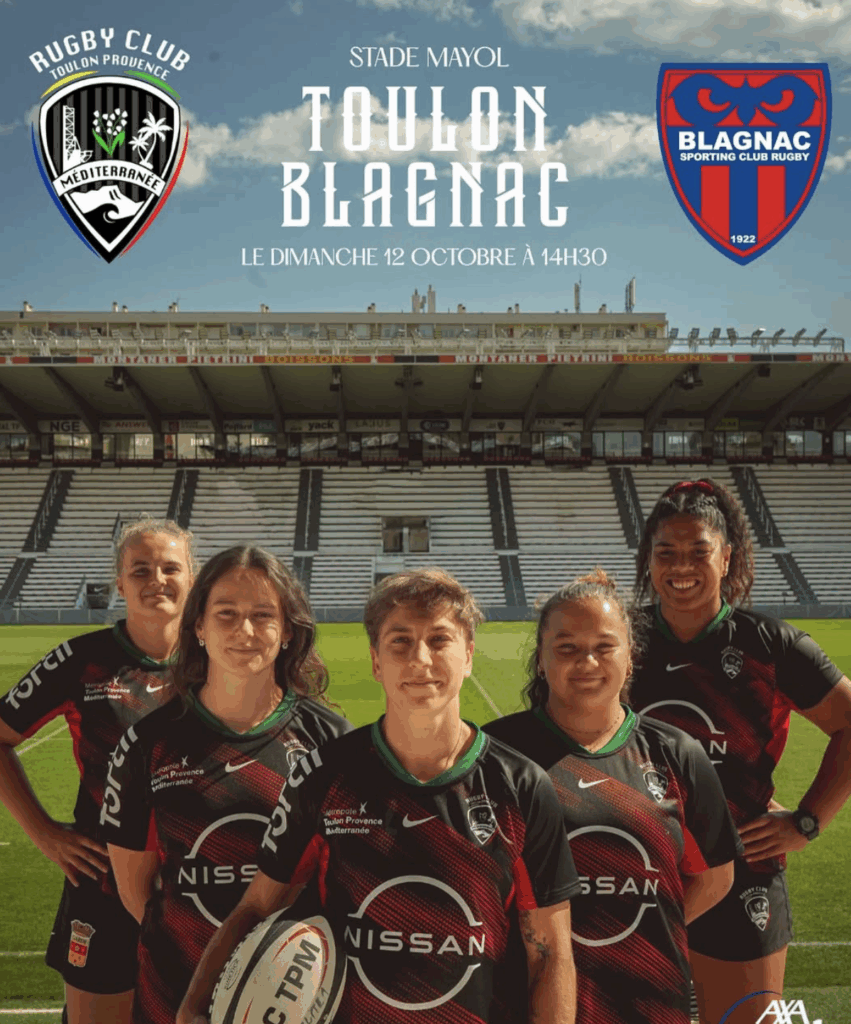
Isn’t it too hard not being professionals?
A. D.: We have everything within reach. It’s really cool. But of course, alongside it we work, we go to the gym, we work again, and in the evening we head off to training… So we put in long days and our bodies take the hits.
M. B.: Today, women’s rugby is a dual career. Only those who are in the France squad, who have contracts, can do nothing but that. But we can’t make a living from it. We can, but only in the short term.
Would you have liked to be professionals?
A. D.: It’s a dream. Training in the morning, recovery in the afternoon, like the professionals…
M. B.: It’s a goal, honestly. We play sport, we commit… We have a lot of ambition for that. Because we’re not here just to play rugby in a ‘relaxed’ way, or purely for fun. We do want it to move forward. There’s a cause to advance.
A.D.: I think we’re going to make sure the next generations get what we would have liked to have.
Is your club banking on youth this season?
M. B. We have a lot of young players, but we also have plenty of older heads who bring their experience and their standards. There’s a good balance.
How do you rate France’s performance at the last World Cup?
M. B.: We believed! Then again, right from the first warm-up match against England, we said it was going to be hard. But in the end they managed to fight. Obviously, the last matches were frustrating and not up to what we were expecting. They are still one of the four best nations. We’re a bit disappointed, but in fact we’re still very proud of our team and of what they were able to produce. They put stars in our eyes. A little frustration all the same, but that’s sport after all.
What is this team missing to go further?
A. D.: New faces! Léa Morland, for example, brought enormous freshness. She probably lacks experience, but I think those are the kind of players you have to start really holding on to. In a few years, they’ll be top players.
In audience terms, the World Cup was a smash hit. We imagine you’re hoping that carries over to you…
M. B.: Definitely. We’d love to have the same audience too. Then again, obviously it isn’t the same thing, it will develop. It’s thanks to them that it will happen. They did it really well.
A. D.: For a start, thanks to the World Cup, a lot of girls have taken up rugby. That in itself is a big step towards what’s coming later.
Is your team in contact with the RCT? Are there parallels between you?
A.D: After our title, a few of our players went to see the Espoirs because they were in a final too. We told them how it went for us, how you should approach a final… It was good. It’s a good start even if they lost the final.
Is this championship changing and becoming better structured?
M. B.: There are only 10 of us left now. For a start, that also moves the Elite 2 championship forward. Bordeaux, Toulouse and Clermont are clearly out in front. But those teams can still be beaten. Every year, big teams like Toulouse or Bordeaux get beaten by Lille, or by Stade Rennais in the past.
What was your biggest crowd last season?
A. D.: Our biggest attendance was 1,500 people at the Stade Mayol, in Elite 2. The problem is that we could play as a curtain-raiser or a closing act at Mayol with the men, except that there are only two changing rooms and it isn’t possible.
Can you have ambitions this season despite being a promoted side?
M. B.: The main thing is that we stay up as quickly as possible. That really is the coaches’ message. The aim is to stay up, and if we can do it as quickly as possible, that’s one less pressure and we’ll be free of everything. Every point is there to be taken. We have to hang in there.
What are your main strengths?
M. B.: Our forwards are solid but we also play a lot through our three-quarters. They guide us. We have three-quarters who play with the ball. And then, when we have to bring the power, we do it.
Amélie, what are your first impressions of the new signings?
A.D.: Honestly, I think the new signings have settled in far better than those of two years ago or last year. Faster, at any rate. There are a lot of young players we’re supporting. Then again, we’ve had three overseas players arrive. Three players who were at the World Cup. Two Italians and a Scot. So we’ll see how it goes. But it should go well.
So the club has the means to attract new players?
M.B.: In reality, the club does have the means. The club may well have the same means as the big clubs. Toulon have managed to fund things and to offer very attractive terms to new signings. That’s hugely interesting because with the project and the ambitions they have and set themselves, they have to match that. I think they’re right up there in terms of funding.
A.D.: We’re not going to complain.
Talk us through a typical week…
A.D.: On Monday morning there’s weights in the gym with a strength and conditioning coach. In the evening we have training. On Tuesday, weights. In the evening we have cryotherapy. Tuesday is the only day we don’t have a pitch session. On Wednesday it’s weights again and pitch work in the evening because we train at the RCT campus. On Thursday morning we have weights and training in the evening. And on Friday afternoon we have weights at the campus, same again with training in the evening.
Is it hard to find a job that fits around your rugby schedule?
AD.: You can’t fit a 35-hour week around what we do.
M.B.: The club also tries to get as many players as possible working with partner companies or with the president. That way we can manage our schedules more easily. Then again, obviously, no girl is going to look for a 35-hour week. But companies are generally quite understanding.
Isn’t going back to work or school after a big match too tough?
M.B.: Obviously, but it’s also the daily routine we chose. If some aren’t ready for it… Obviously, in the moment you’re tired, it’s hard, but really it’s a rhythm you get used to.
Comments