

RUCK ZONE. – You pulled off a real coup by signing Paul Willemse…
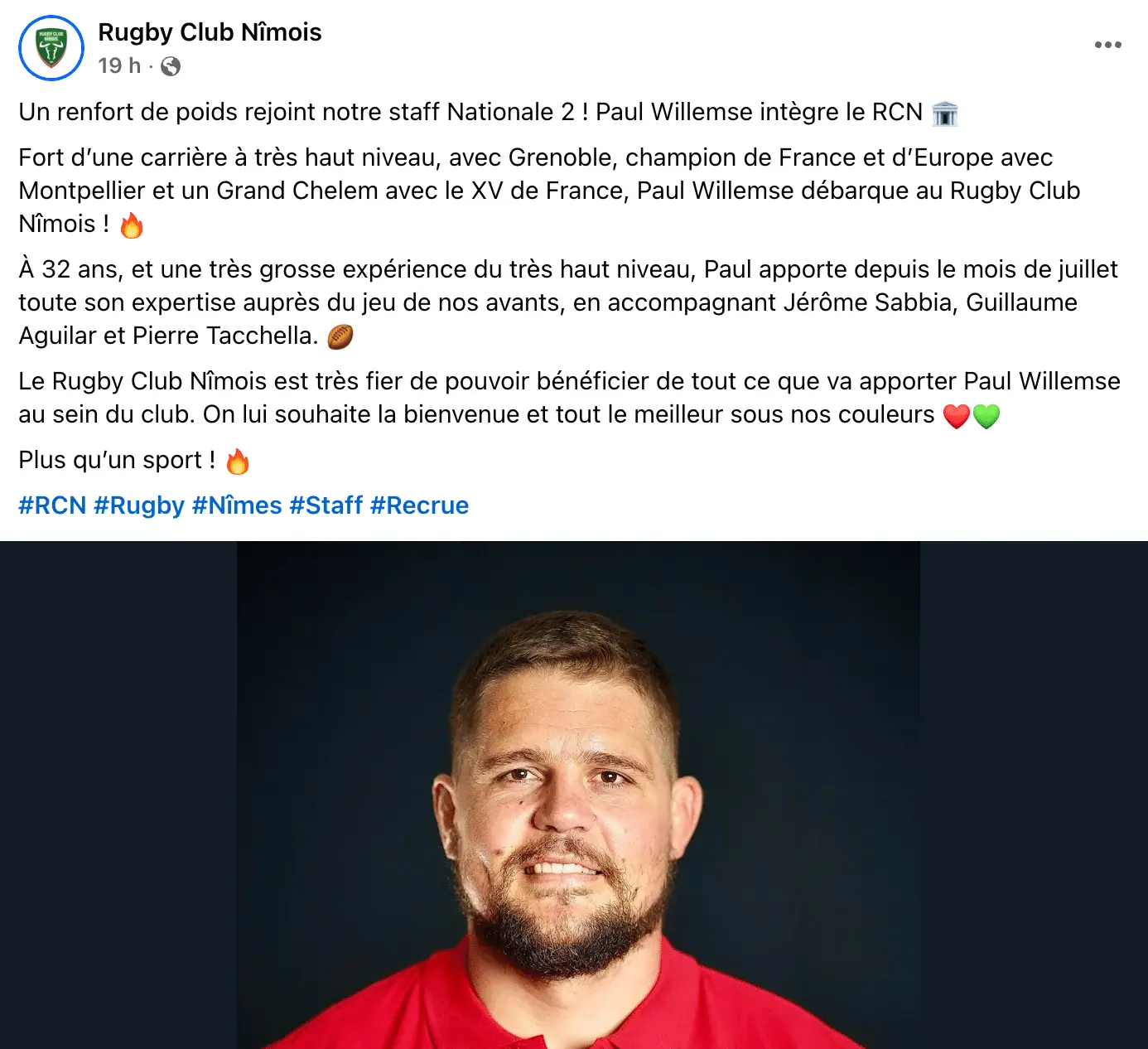
Steeve Calligaro : “Yes, it is a real coup. In media and sporting terms, having signed Paul Willemse is something that has given the Rugby Club Nîmois a fair bit of exposure these past few days. As is most often the case in rugby, it happened through people meeting each other. Paul Willemse was at MHR, a club we are partnered with since there are a number of player exchanges every summer, whether at academy level or with the first team. We also have a very good relationship with that club. We learned, like everyone else, that Paul was assessing with doctors his ability to keep playing despite serious concussions. And during that period, through vice-president Nicolas Ricome, whose wife is South African, we met up and shared a few meals. Then we suggested Paul join us to advise us.
Being on sick leave, he did not want to publicise the hand he was giving us, not at first. That is why we only went public a few days ago, even though the season began back in July. We are lucky enough to have Paul Willemse once a week to advise our forwards, mainly on attacking play and set-piece work. He brings us all his charisma, his love of the game. He really is someone who is passionate about this game, passionate about the men who play it, and who fits into any club. Obviously it is less glamorous than what he has known, but he has taken to it like a duck to water and is now an integral part of the staff.
One imagines his presence must have made an impression on the squad…
I don’t know whether you have to have been a great player to be a great coach. It is a debate that occasionally stirs sporting circles, as it happens… But in any case Paul is someone who is fundamentally passionate and of rare humility and kindness. He is not the type to impose, he is the type to suggest, to give advice, to be in the fine detail of driving angles and so on. Honestly, we could talk about it for hours, but he is not someone who shows off. He is someone who supports very humbly, who speaks calmly. When you have champions who are able, as people, to come down to the level of those they are talking to, that makes them people who are listened to, even admired. Of course, when you see him walking about among our players, the first thing you notice is the difference in physical stature. Willemse is a giant, quite simply. In a Nationale 2 pack we have a few fine specimens too, but with him it is first the physique and then the kindness and the technical know-how. His advice always hits the mark.
Can his presence bring you a bit more visibility?
We have had the best attendances in Nationale 2 for three years now. The ground is almost full. It is obvious that this will contribute to a certain media surge. I have had plenty of contact from journalists in recent days, and I have just received from Nicolas Ricôme, the contact who made Paul Willemse’s signing possible, a South African article. In South Africa there is an article in which the Rugby Club Nîmois is mentioned. It is funny, but it is also very good because it crowns a whole project. We took the club on four years ago and it is a club that is getting itself organised, that is ambitious in a mid-sized city but a historic rugby one. All these helping hands, whether technical or in the media, contribute to moving the project forward faster.
Is Nîmes an increasingly ambitious club?
You have to be careful with ambition. You know, we have a particular culture in this sport. We love ambition, professionalism and the glitzy side of things. And at the same time, we know the methods that lead to victory. They are collective, and made of humility. Those who think they are something they are not in our sport are quickly put back in their place. So yes, we are ambitious. The path is set out. The Rugby Club Nîmois should at the very least be in Nationale alongside clubs like Albi, Narbonne or Bourgoin. Over the past ten years, the club has climbed back up from the depths of the pyramid. That is not meant as a slight. It started again in Fédérale 3, I think, around ten years ago, after financial problems. It was still in Fédérale 1 three years ago.
Today it is in Nationale 2 with a semi-professional squad of 37 players. Half of them are full-time professionals. The other half are under contract but combine rugby with another job. We have doubled the club’s budget. It may sound presumptuous to say so, but it is the fruit of work with partners and local authorities. We have bought the brasserie next to the ground. We have set up a training organisation and a foundation. So there you go, it is not only vertical work with partners and the urban districts, the town hall, the department, the region, the conurbation authority, it is also horizontal work consisting of multiplying what we call ‘business units’. There are five companies that underpin the Rugby Club Nîmois and whose combined profits contribute to putting together the budget. That is the building of the base that will allow us to go higher, because the aim is not to go up, make a noise and pull in an audience only for the club to crash in mid-flight like others in two or three years. This is our club. I played at the club from the age of six. Romain Tissot, one of the vice-presidents, has a whole family that came through the Rugby Club Nîmois. Nicolas Ricome is a rugby man. It is the same for the board. We are building it with the skills that are ours, as business owners who love rugby, but yes, we are building to last. And we will go up when what happens on the pitch decides that we go up.
How do you get professional players and part-timers to live side by side?
I think it is the case in Nationale 2 and in Fédérale 1. If there are pros, there must be one or two per team, so that is not the problem. And I think that in Nationale, conversely, 95% of players are full-time pros. So we really are in that division straddling those two worlds. In our pool there are in fact squads that are 100% part-time and, at the other end, there must be the clubs of Orléans or Langon. Getting a professional squad and a part-time squad to coexist does mean having blocks of time during the week for collective training, when everyone is there, mainly in the evening, plus individual blocks focused on strength and conditioning or a number of things linked to treatment and specific workshops.
It is also the case for our staff. We have two coaches, the forwards coach and the backs coach, who are part-timers and hold down jobs. And we have Guillaume Aguilar, the manager, who is a professional. So they have managed to fit in collective sessions in the evening, with a day off on Wednesday. They have all agreed to train on Mondays from 11am to 2pm as well, so as to have one collective session during the day. Everyone gets stuck in. We know full well that to go up to Nationale you have to prepare the squad to be professional, because you do not find 40 pro players in a single summer. First, we do not have the means, and it is not what we want either, because we also want people who are connected to the area. It is important to have people who came through your academy, people who work in the town. That too contributes to the club’s standing and its identity.
“We also have half a squad of professionals because, at some point, our academy does not produce enough players for the first team. And so when you go looking for players on the market with agents, most of the time, and at that level, you only find professional players. It is something that is partly imposed on us and partly chosen. It has to be well managed day to day”
Steeve Calligaro, RCN president
The season has started and we are rather pleased with the team’s cohesion. It is something we worked very hard on this summer. We are only in year one of the project. Two or three years ago, we often found ourselves in one-to-ones with players hearing things like: « Yes, but him, he’s a pro, he doesn’t give enough », or: « him, he’s a part-timer, he doesn’t train enough ». Those labels are always there. I am not in Stade Toulousain’s inner circle, but I imagine Antoine Dupont does not have quite the same status as an Espoirs player making the odd first-team appearance. And yet, when you watch those teams, they have watertight collective units. So there you are. It is difficult, but it is a real concern. It is something you have to go through. And it is one of the most important points of attention for our staff and our directors.
Are you managing to keep up in terms of facilities?
That is probably what causes clubs like ours the most difficulty. But even clubs in Pro D2 or perhaps even in Top 14.,I was reading this summer the exchanges between Mohed Altrad, the MHR president, and Montpellier town hall about the run-down state of their stadium. These are, after all, big private companies whose main working tool is, most of the time, a publicly owned sports facility. That is a peculiarity of our sport. In Top 14 there must be three or four grounds that genuinely belong to the clubs. Otherwise they are public sports facilities. That is the case for Toulon or Montpellier. And it is the same for us. Our facilities are… what they are. You could describe the Nicolas Kaufmann stadium as ageing and, indeed, it is starting to lag a little behind the standards and expectations of professional rugby. What is asked of these grounds today is that partners can watch the matches while dining, with hospitality, with an experience at the ground, whether in catering, media, the PA system, the capacity to host people, parking spaces… things like that. We have a ground from the 1970s-80s. We are not the worst off, but it is a subject we are discussing with the council. Then again, we are heading into an election period, so it is complicated. The people we are dealing with today may not be the ones elected in six months’ time. We work every day to develop this ground. Today, one of the issues raised by the growth of the Rugby Club Nîmois is precisely the capacity to host its partners in good conditions.
There are a little over 360 companies in the Rugby Club Nîmois partner network. We run business breakfasts, or gatherings of 15-20 companies with overlapping interests. We ask them to introduce themselves, and that creates business between them. One of the sources of pride and one of the reasons this network works is that today there are companies in it that are not especially passionate about rugby. They come along to do business, to meet people, to have doors opened, to make use of a rugby club’s profile and image to handle their own communications. But you need the capacity to host them in good conditions. We have a limit on space. We are negotiating with the town hall for extensions to the partner decks, and to try to change the PA system too. The council has been receptive and we have always been able to count on it in terms of grants. I thank them for their support. That is also true of the conurbation authority, the department and the region. But that facilities problem is today preventing the club from moving as fast as it could in its development. Even if voting through a new stand or extensions to partner areas is not easy and takes time. You have to be determined, both on the club side and on the political side.
“Across four sessions a year, we were entrusted with 20 young people who had fallen out of the system personally, socially or at school, referred to us by the mission locale and France Travail. We looked after these young people, we got them through their driving test, we tried to give them the basics, we introduced them to the army, the gendarmerie, people we work in partnership with, we had them build CVs with professionals, we had professional photographs taken for their CVs, and little by little, with sport morning and evening of course, we brought them to a certain employability. We put them forward and introduced them to our partner companies at themed lunches, where these young people were able, for the first time, to converse with five, ten, fifteen company bosses”
Steeve Calligaro, RCN president
When you see that for two years now France’s rugby team has pulled bigger television audiences than the France football team, honestly, sometimes I have to pinch myself to be sure I am reading what I am reading. And so, when you have something like that in your hands, you want to share it with every audience. And indeed, two years ago we created a foundation called Rugby Coeur Nîmes, which is a project-based body and which allows us to respond to calls for projects, whether on the whole urban policy agenda, but also on integration, on disability, and so on. Let me give you an example. RCN Insertion is a programme led by the prefecture, but co-funded with the departmental council, the agglo’ and the town hall. Across four sessions a year, we were entrusted with 20 young people who had fallen out of the system personally, socially or at school, referred to us by the mission locale and France Travail. We looked after these young people, we got them through their driving test, we tried to give them the basics, we introduced them to the army, the gendarmerie, people we work in partnership with, we had them build CVs with professionals, we had professional photographs taken for their CVs, and little by little, with sport morning and evening of course, we brought them to a certain employability. We put them forward and introduced them to our partner companies at themed lunches, where these young people were able, for the first time, to converse with five, ten, fifteen company bosses. A number found internships, others found apprenticeships, and I believe there have been a few hires. But for us that really is the essence of our commitment, because it means taking rugby out of its cultural world, which is sometimes a bit closed, and bringing it to an audience that does not necessarily have that culture, in working-class neighbourhoods. In Nîmes it is mainly combat sports or football. Rugby does not exist. Handball is also doing fine work on that front, but these are sports that struggle to break through, because they require facilities that are not the same. We also have commitments on gender equality, on eco-development…
What do you make of your start to the season?
It is a fine start to the season. In sporting terms, we have been working to the same model for three years now, a team made up half of very good players, most of whom have played at the levels above. The challenge is to go and get professionals who can bring something to the team, and to marry that with an academy that has to be genuinely efficient. We are investing in the academy because the future of the rugby club runs through that alliance between pros and home-grown players. For three years now we have put together decent regular seasons but we come unstuck in the first play-off matches. That is frustrating. This season we have gone from a staff of two to a staff of three by promoting the Espoirs staff to the first team. In any case, we have made a good start to the season with a first block of two away trips and one home game. We finish the block with two wins and a losing bonus point, and we are second. We win at Rumilly, who are a fine team, and we win at home against Lannemezan and do it in style. This is a group that is in a good place.

Comments