
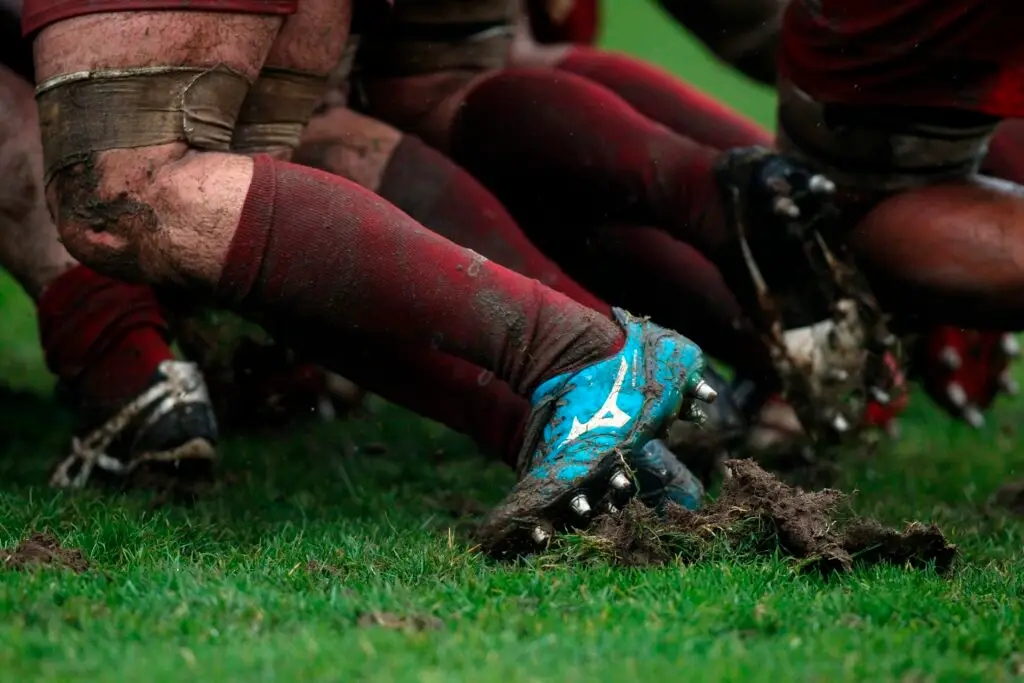
The winter rugby season opened like a soaked book on Sunday, at the Vidalie ground, on the outskirts of Aurillac, in the Cantal. One of those volumes with a rain-swollen binding, whose pages stick to your fingers and where every passage of play leaves a brown mark on the shirts. Arpajon-sur-Cère beat Belvès 30-8, in Fédérale 2, but it is an understatement to say that the weather played the leading role. This was not just a match: it was a fight against a climate, a mood, an angry sky. “The big lads love this, that’s for sure...”, sighed a wing from the second team, as the first XV came out onto the “paddock”. “But we won’t touch a ball all game.”
Biting cold, freezing rain
The wind, first of all, that “invisible back-rower” that turns trajectories upside down, slaps faces and turns up-and-unders into messages in a bottle. Then the rain, heavy, dense, stubborn, capable of erasing the white lines and weighing down every step. Finally the mud, that old ally of rural rugby, which swallows studs, clogs up good intentions and ends up covering everyone in the same fraternal shade.
You can no longer make out positions, barely even the teams: only stooped silhouettes, short breaths, and that shared stubbornness to get beyond the next puddle. “You can’t even see the players’ faces any more, it’s hell“, muttered René Lavergne, a little old regular, carefully wiping his glasses. And that is after the snow that fell midweek had melted. Leaving behind a biting cold and freezing rain.
In this late-November setting, Arpajon managed to impose a patient, almost agricultural form of dominance. The forwards ploughed the pitch the way you turn over a field, with the method of hard days: short movements, precision carries, hands clamped around a ball turned into a bar of soap. Belvès, gutsy but more brittle, tried to widen the game whenever a window cracked open – which is to say rarely – but winter does not forgive the approximate, nor handling errors. There were more whistles than points scored by the Périgord side.
Bar of soap
And the Cantal men left nothing to chance. Their rugby, compact and abrasive, seemed cut out for that particular sky. Counter-attacks from the far end of the pitch were even attempted, and pulled off. Chervié, Mourgues and Verouil launched one from their own 22 for an 80-metre try, proof that the bar of soap can be tamed and held. “You have to have a go and if it comes off, so much the better“, they said. One of their only finished pieces of play. “The rest of the time, you don’t get much ball and you don’t string three passes together.“
Vous êtes plutôt #rugby d’hiver ou rugby d’été ? ☃️☀️? pic.twitter.com/qMTS7YVO9z
— Les Coqs Festifs (@lescoqsfestifs) July 22, 2023
As the scoreboard swelled and the studs sank deeper, spectators pulled their collars tighter, slipped their hands into their pockets, shook out their umbrellas. And yet nobody left the ground. Because it is here, precisely, that loyalty to this sport is put to the test: in the slop, the headwind and the tingling fingers. “Winter rugby is also that, a shared ritual where the weather becomes a common dialect“, you could hear amid the din of the endless rain.
Rugby of the land
When the referee blew for full time, it was like closing the first page of a long, cold season. The players, washed by the rain more than by the showers, were smiling without anyone quite knowing whether it was the win, the tiredness or a mixture of the two that creased their faces. The crowd headed back to their cars, tracing fine mud signatures behind them.
Hier soir c'était marathon rugby avec #R92AB et #FRAvAUS pour finir sous la neige en rentrant ❄️? pic.twitter.com/DiJgr4RgCq
— Justine ❄️ (@ImmortanJuu) November 23, 2025
At La Vidalie this Sunday, there was not only a match, but a reminder that French rugby, far from the floodlights, still draws its truth from these afternoons of foul weather where you fight as much as you endure. Winter has arrived. And with it, that rugby of courage, of the land and of soil. The kind that, in spite of everything, warms you up. The kind you live and breathe, but a long way from your sofa.



Comments