
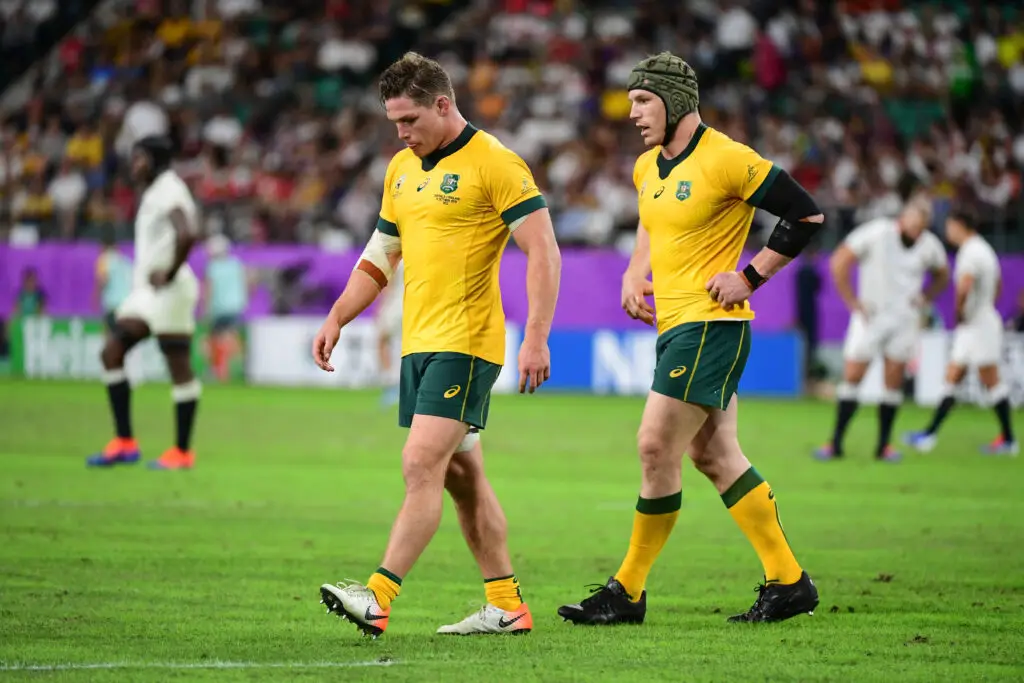
Five years after hanging up his boots, David Pocock has swapped the Wallabies jersey for a senator’s suit in Canberra. From the scrum to the parliamentary benches, his path is one of the most exemplary of this generation of committed sportspeople: a fight for the environment, for transparency, for politics done “differently” and for the LGBTQ+ community.
On the eve of a sparkling France – Australia, one question (as good as any other) arises: what has become of the former Wallabies flanker and captain? Some paths seem written in advance, others invent themselves through the fractures. That of David Pocock, 37 years old and three World Cups, belongs to the second category. For a long time we saw him with a knee in the dirt, fingers clawed into the turf, folded over a ball the way you shield a fragile truth. Today we find him in another chamber, bent no longer over a ruck but over draft legislation, driven by the same inner fever: to stop the world from sliding the wrong way.
David Pocock pic.twitter.com/LdkHTBhilK
— RuggerRed (@rugger_red) November 6, 2025
In rugby’s memory, Pocock remains that magnetic back-rower, born among farmers in Zimbabwe, shaped by exile and revealed by Australia. A telluric player, as dense as a block of rock, who always seemed to spring out of the ground to turn a match on its head. But behind the muscle and the scrum cap screwed onto his skull lay another strength: a political conscience, a worry for the planet, an unshakeable tenderness for living things.
Senator David Pocock presents a proposed logo for the Australian Centre for Disease Control. pic.twitter.com/mnhYUfmRwF
— Australians vs. The Agenda (@ausvstheagenda) November 5, 2025
The instincts of the pitch
Five years ago, he put his boots away for good. Some would have turned to a career as a pundit, an air-conditioned office, a settled life. Not him. He chose the most improbable and most demanding route: standing for election as an independent senator. Not to win a label, but to break the ones being pinned on him. His credo: reject the party machines, shake up habits, remind people that politics belongs to those who live it, not to those who lock it down.
“Not a single player in any of the “football codes” (soccer, Australian footy, rugby union and rugby league, editor’s note) was openly gay, David Pocock said in an interview with the newspaper L’Équipe last August. That is impossible, all the more so because some have come out in retirement. Why do we have a sport in which people cannot simply be themselves?“
Australia leads the world in rooftop solar, and the new Solar Sharing scheme builds on that success by allowing households without solar to benefit.
— David Pocock (@DavidPocock) November 5, 2025
But ACT residents are missing out for now. The ACT and federal governments should fix that. And fast.https://t.co/DdDv1CVZkM pic.twitter.com/Z1PMT8US7M
In the Senate, Pocock has kept the instincts of the pitch: the sense of the collective, the direct word, the courage to expose himself. They say he turns up with endless notes, carefully annotated, the way others break down scrums on video. He talks about the climate with the fervour of a man in love with the red earth of his childhood; he talks about social justice with the patience of those who have known uprooting.
In his speeches, you find something of rugby: a way of taking the line, of never going backwards, of carrying the debate all the way to the in-goal. “What sport taught me carries over into life, the senator told the national daily. Working as a team towards common goals, having a good work ethic, being able to take criticism on board… Like a player who has a poor match or loses a ball, you are constantly under attack, you have to accept it, not take it personally, still manage to sleep at night.“
“Not being a “professional” politician allows you to act according to what seems to you to be in the interest of the greatest number“
David Pocock
His political opponents are sometimes irritated by that rugged integrity. He is called idealistic, uncompromising, incapable of dealing. He answers that compromise has never won a match, let alone a country. He moves forward without a fuss, the way he used to tackle: with precision, with loyalty, with that stubbornness that looks like gentleness when conviction is carrying it. “Not being a “professional” politician allows you to act according to what seems to you to be in the interest of the greatest number, he has said on many occasions, because you don’t know how you are supposed to go about it. It is an asset when it comes to challenging the system.“
He tackles inertia
So why talk about David Pocock today, just as France prepare to take on Australia at the Stade de France tomorrow evening (9.10pm)? Because a country cannot be reduced to the fifteen men who will line up their boots on the green rectangle. Because a sport says something about those who have embodied it. Because a former player turned senator tells better than anyone the subversive power of rugby: that mixture of brutality and brotherhood, of solidarity and revolt.
Senator David Pocock presents a proposed logo for the Australian Centre for Disease Control. pic.twitter.com/mnhYUfmRwF
— Australians vs. The Agenda (@ausvstheagenda) November 5, 2025
Pocock, for his part, is still tackling. No longer opponents, but inertia, lobbies, political silences. He no longer runs on the grass, but he runs against time, the time of the climate, the time of democracy. And somewhere, in the murmur of a stadium, in the tension of a match to come, you can still hear the echo of his promise: rugby is not just a sport. It is a commitment. A threshold to cross. A way of standing tall.



Comments