
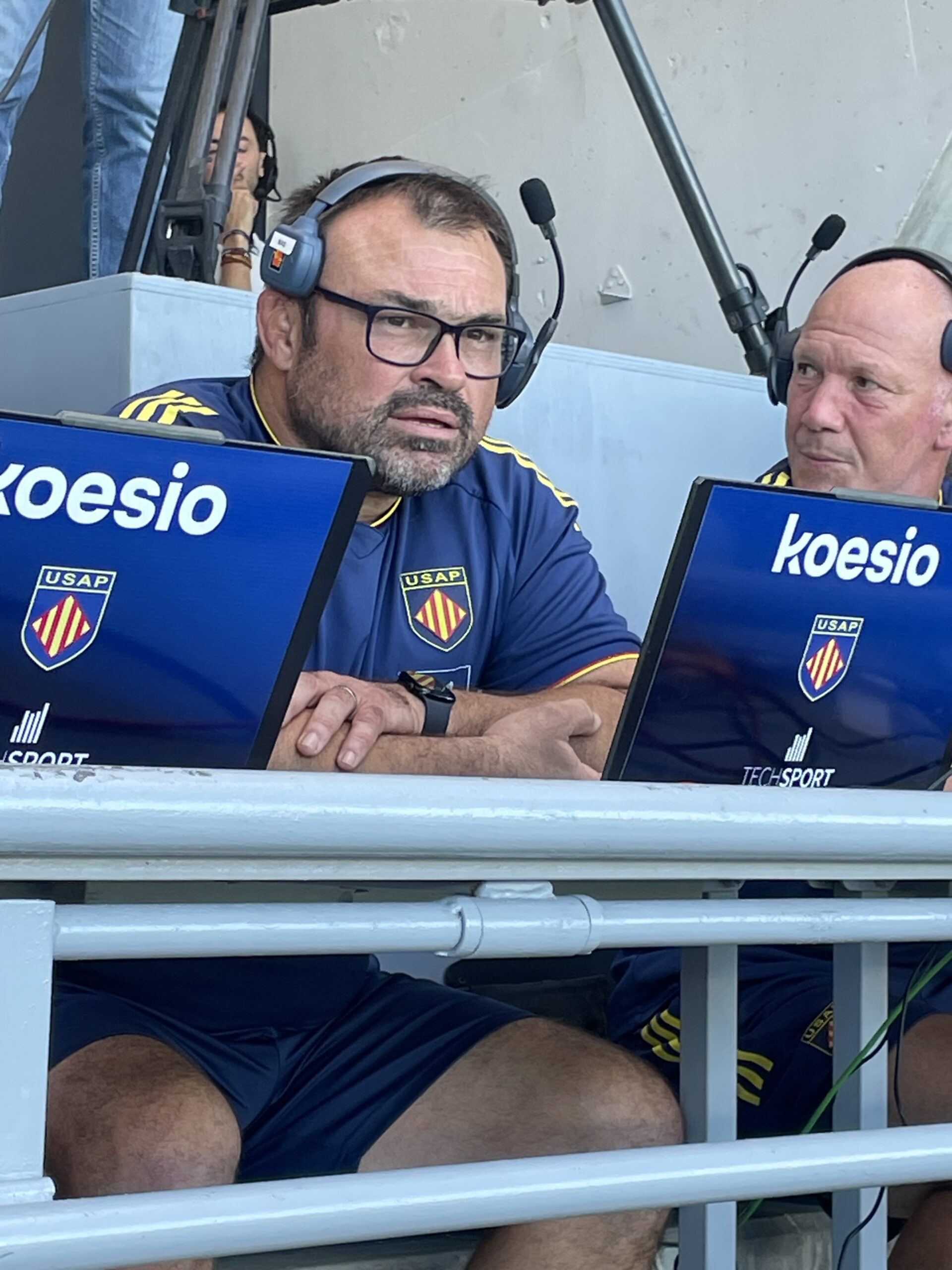
Three wins in nine rounds of the Top 14: Nicolas Mas’s second season on the USAP bench has started better than his first, which opened with eleven straight defeats. The 46-year-old Catalan tighthead, capped 85 times by France (2003-2015) and scrum coach since July 2025, looks back on his beginnings ahead of the trip to La Rochelle on Saturday 28 November (5.35pm local time).
After nine years away from rugby, what made you come back to the game as a coach?
It was a challenge built on emotion, with David Marty (former France centre and former USAP coach, editor’s note), whom I’m very attached to. I wanted to put the duo back together because we spent so many years together, we know each other inside out. I thought: why not set off with him again in a different way? I wanted to play a part, because people often say there aren’t enough former players at USAP. There’s a lot of criticism, maybe, and it’s better to get involved if you want things to change.
“I wanted to throw it all away”
Did you feel like throwing in the towel after starting the job with eleven straight defeats last season?
Yes, of course, it was very complicated, with a lot of turbulence, including the resignation of David (Marty, on 6 October 2025, editor’s note) and of Gérald Bastide (former Perpignan defence coach, who left in October 2025, editor’s note), a passionate man with his club. That phase was hard. Then Franck Azéma resigned (the director of rugby left on 27 October 2025, editor’s note). Luckily there was Mathieu Cidre (forwards coach when he arrived in July 2025, promoted to head coach this season, editor’s note), with whom I started. He had the courage to go with a guy who had zero coaching experience. I can say I had a lot of doubts at times, and wanted to throw it all away. Lots of things were very hard. I’m a man of my word: when I commit, I commit. I had a two-year contract and I’d said I would see it through. I carried on and Mathieu and I stuck together.
That nightmare start gave you a crash course…
You could say that. It wasn’t quite traumatic, because that’s a strong word, but quite uncomfortable, gruelling. When you see David (Marty), who only ever played for this Perpignan club, leave like that, it’s sad. It was a fine challenge with local guys. It was very rough, very complicated, like being in a washing machine. The enjoyment doesn’t come straight away.
“There’s the weight of history”
Does coaching USAP as a Catalan add suffering to the job?
Yes, coaching means suffering. Even if there are far more serious things, there’s the weight of history. Rugby is changing compared with the history of the clubs, things are changing a lot, but we have this responsibility to the previous generations who left this club where it is. You want to do your best to put this club where it belongs, even if it isn’t easy. With the money around rugby, it’s a lot of business, and some clubs are really struggling because there are two championships. For now, the first part of my second year is a bit better than last season, but it remains fragile.
Doesn’t the difficulty also come from the fact that rugby and its environment changed a lot between your retirement and your return?
It’s a different rugby, you mustn’t compare. If I came back, I knew the rules. You also make this rugby your own, because you build with the men at your disposal. You want the players to be like you, and that’s very difficult. That’s the area where I struggled most when I arrived. You have to be very good at explaining, understand the guys and a way of working that isn’t yours, which doesn’t mean they don’t want to be good. I learned by coaching.
“I’m more about everyone taking part”
For you, does coaching necessarily mean the forwards?
It’s true you get a label. I’m currently studying for the coaching diploma, which isn’t easy on top of training sessions, and the instructors are trying to change that, to open minds. Obviously I played prop, so I have front-row and scrum experience. I think that for my beginnings it’s good to start there. Maybe in the future I’ll try to do something else. For now, I’ll try to do my best in this role. At the moment I’m really in training, discovering this job and everything around it: the pressure, you always have to adapt, there are the new generations. You’re constantly questioning yourself.
What kind of coach are you, and what kind would you like to be?
My role is specific, even if I also handle the rucks a bit, so am I really a coach given that specificity? First, I try to be myself, to give the players the best tools to perform. I’m an open person after all, even if I’m a bit closed at first. I let people speak, I let the guys get on with it. I’m more about everyone taking part. I was a player, I know what a coach can bring. He holds part of the solution, but it’s the players who have to build and create between themselves.
Did you have a reference coach, someone who left a mark on your career?
Olivier Saisset (USAP coach from 2000 to 2004, editor’s note). I wonder how he managed to do everything he did. He had an impressive way of working. He was on his own, coached the forwards, the backs, the defence, ran the video sessions. I’ve always been impressed by that man, by the work he did. He had a tough shell, but he’s a reference. I hold him in high esteem, he’s the one who threw me in at the deep end, who trusted me. After that there’s Jacques Brunel (coach from 2007 to 2011, French champion in 2009, editor’s note), but with a different way of working.
The scrum, “a puzzle you have to put together”
Since you’re also a mechanic, can you draw a parallel between the precision mechanics of the scrum, the heart of the machine, and an engine?
Yes, of course. I love restoring old cars. You start from nothing, you rebuild the vehicle. A scrum is a bit like that, even if it doesn’t have the impact it had several years ago. There’s an effort to sanitise it as much as possible, to have fewer of them, to play them faster. The scrum remains important, even if less so than the lineout. In a match there are 30 lineouts for 12-13 scrums. This area can give a team confidence. It’s a bit like mechanics: everyone, every part has to find its place. It’s a puzzle you have to put together and fine-tune. It’s quite similar.
Nicolas MasIt’s a puzzle you have to put together and fine-tune.
Out of contract in June 2027
Do you still see yourself coaching in ten years?
No. No. To stay, you have to be tough. I say that, but ten years ago I was saying I’d never come back to USAP. I have to think short term.
You’re out of contract in June 2027. What next?
For now we haven’t discussed it with the club, and we’ll see how it goes. I’m staying open… Otherwise I’ll go back to work at Jeep in Perpignan, since I didn’t resign.
Key figures
85 Caps won by Nicolas Mas for France, from 2003 to 2015
11 Straight defeats for USAP to open the 2025-26 Top 14, before their first win against Clermont (26-20) on 20 December
3 USAP wins in nine Top 14 rounds this season, against Castres, Bordeaux-Bègles and Vannes
Comments