
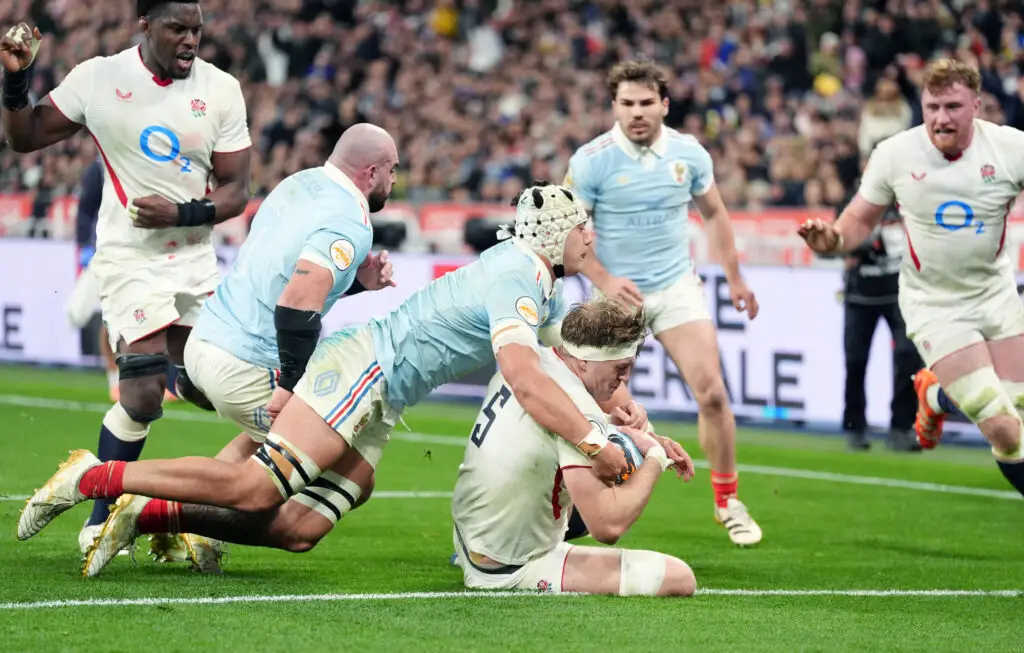
In the collective memory, one image will remain: a penalty rising into the Saint-Denis night, struck by Thomas Ramos, and a Stade de France erupting as the ball sails between the posts. France have just beaten England 48-46 and snatched the Six Nations in a deafening din, at the end of a match already destined for the archives of the Crunch and of the tournament.
But once the racket dies down and you look at the scoreboard a second time, another reality appears. Forty-six points conceded. Seven England tries. Just as many the week before at Murrayfield. A defence too often overrun, cracked open, at times completely disorganised.
Le type est meilleur en drop qu’avec le tee pour l’instant pic.twitter.com/VU3wWS2s8Q
— Gauthier Baudin (@GauthierBaudin) March 14, 2026
Modern rugby loves open matches, breakaways and flourishes. Yet the great sides build their titles on solidity first. On Saturday night, France experienced the exact opposite. They won thanks to their attacking fire, to the constant spark of Louis Bielle-Biarrey and to the accuracy of Ramos off the tee. Defensively, though, they spent the evening chasing England.
The verdict leaps out at you when you watch the passages of play again. Too much space around the rucks, hesitant defensive line speed, missed tackles in the outside channels. England barely ever stopped finding gaps. With every acceleration, the blue line seemed to wobble, sometimes to come apart altogether. One, even two beats behind…
A brutal arm-wrestle
In the stands, the intensity of the game was dizzying. On the pitch, it also exposed an imbalance. France were scoring plenty, but conceding almost as much. A sort of permanent arm-wrestle in which the attack kept repairing what the defence had just given away. Not something France have accustomed us to…
Thomas Ramos himself made no attempt to hide the problem. The last-minute hero, the Toulouse full-back was clear-eyed when speaking to France Télévisions.
Thomas RamosIn a big competition (the World Cup, editor's note), if we defend like that, it will be without us.
The line landed like a call to order in the middle of the euphoria. Because the international calendar does not forgive that kind of generosity for long. The big nations watch, analyse and learn quickly. And they now know that this France team can be shaken if the tempo runs away. England, for their part, must have worn out the video in the days leading up to the match.
Monsieur Thomas Ramos. ?#GreatnessM6N #Since1883 #FRAANG pic.twitter.com/G3Zm8NP8Zk
— Six Nations (FR) (@SixNations_FR) March 14, 2026
The flaws were numerous and often repeated. In midfield, the backs sometimes struggled to slide and drift towards the outside, leaving gaping intervals between defenders, and that against attackers who are far from the sharpest in their positions. On several sequences, the aggressive line speed meant to cut England’s attacks off turned into a badly synchronised rush defence, handing over almost instant overlaps out wide.
Up front, the forwards also suffered against the speed of execution of England’s game. Rarely did the French manage to slow the ball down at the breakdown. The rucks were cleaned out efficiently by England and the French jackals were almost never able to contest on the ground. The exception was that priceless turnover from Gros in the closing minutes to save the nation. As a result, the England scrum-half had an armchair from which to launch his side’s attacks.
Caught for pace
In the one-on-ones too, France were often caught for pace. Several duels lost in the channels, tackles missed or made too high, sometimes simply half a second late. At this level, that is enough to turn a neutral situation into a clear-cut chance.
The speed of England’s game kept the French line under constant pressure. Quick transfers and changes of rhythm forced France to defend while going backwards, always a perilous position. And when the line bends, the whole structure becomes fragile.
Paradoxically, this historic evening nonetheless comes in a golden period for French rugby. With this win, France have claimed a third title in five years and, above all, their eighth since Italy joined in 2000, which now makes France the most decorated nation of the modern era of the tournament.
Cadan Murley never gave up! ?#FRAvENG | #GuinnessM6N pic.twitter.com/mKOnFGIJs5
— England Rugby (@EnglandRugby) March 14, 2026
But this apotheosis also flirted with trauma. For long spells England led and believed they would spoil the party, at the end of a match of crazy intensity in which every attack seemed capable of swinging the scoreline. A rare thing at this level.
None of that takes away from the beauty of the evening. This Crunch will go down as one of the most spectacular matches in the recent history of the tournament. But it also acts – and above all – as a warning.
France have proved they can win a mad match. Whether they can also lock down the next ones remains to be seen. Because in the rugby of the very biggest occasions, attack makes the stadiums shake. Defence wins the titles.

Comments