

The week starts with rough drafts. Sometimes on paper for the “old school” journalists. Angles, questions, anecdotes, statistics… Everything goes under the microscope. The phone runs hot, like those of the press officers fielding a pile of interview requests. You write, you delete, but above all you wait impatiently for the big moment.
The alarm goes off early on the Saturday morning. No official car, and no private driver either. You take the metro like the supporters, backpack firmly on, laptop fully charged. Around the stadium you sniff the air, you listen out and you watch, the reflexes of the job.
You line up at a window, hand over your press card, collect a meal ticket (that matters) and, after your equipment has been searched, you step inside the ground. Destination: the media centre.
Stress and tension
Rest assured, there is no duck breast, no caviar and no canapés. Just plain sandwiches with a handful of unsalted crisps and a muffin for the greedier among us. But let’s be honest, with the current temperatures, we are not about to complain about being in a big air-conditioned room… Rows of tables with power sockets, television screens showing matches in progress, greetings all round. A few young faces appear among the most experienced journalists. There is coffee to get you through the long night ahead. You check the connection too, that matters. And you grumble, obviously. Around us, conversations overlap. Predictions, the temperamental weather forecast for the evening: we are already in the mood.
As kick-off approaches, you head up to the press box. As it happens, the stand where the journalists sit has been renamed “Tribune Thierry Roland”. Seats are decided in advance, so you have to read your number carefully on your accreditation. You feel very small climbing the first few steps. And, like a good old reflex, you get the phone out to capture the moment. assigned in advance. You often find yourself next to colleagues and not far from a team’s staff.
Last night it was the assistants of Joan Caudullo, the Montpellier manager, who sat alongside us. There too, you often prick up your ears to catch what is being said… For us, there is no screen. Only our laptops, slowed by a much-coveted connection. Out comes the notebook, the binoculars to see better, you plug in all your devices and you grumble again about the failing Wi-Fi. That’s the game.
You take notes, by hand or on a computer. Names, incidents, substitutions. As the minutes tick by, and depending on how the match is shaping up, tension and adrenaline rise. Some may have started their match report at half-time after a Toulouse masterclass, but others wait, because in sport nothing is decided in advance. And so it proved, with a Montpellier comeback in the second half. But you always have to stay alert and think ahead. Particularly when the match was interrupted for a few minutes after several flashes of lightning in the Saint-Denis sky. The information had to go out fast.
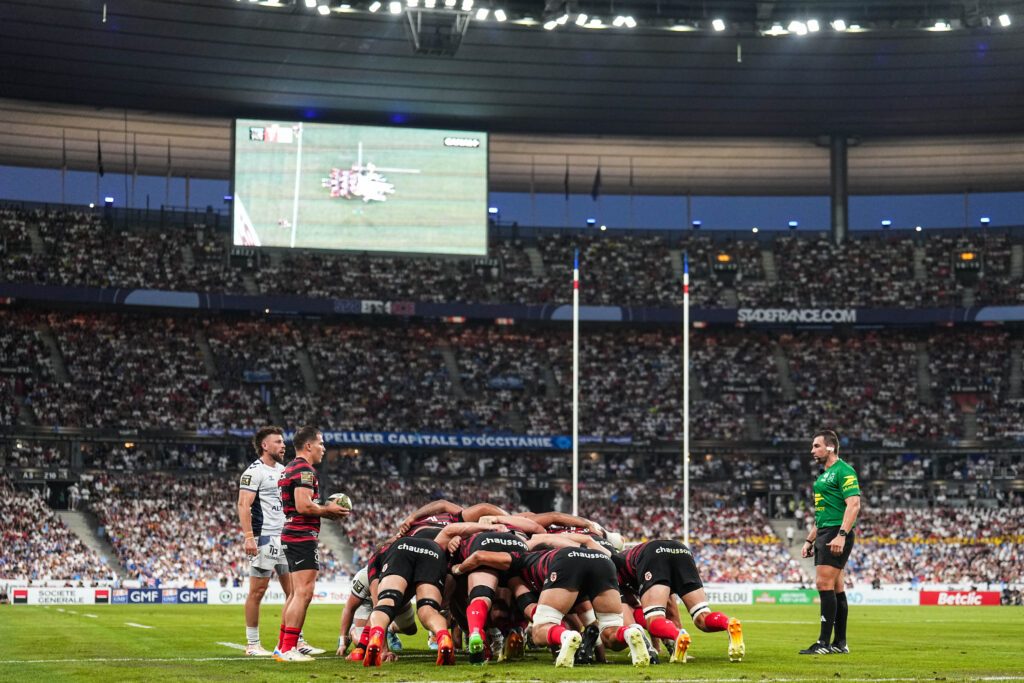
Listening to the crowd, seeing the beauty of the arena, you know you are privileged and you know why you chose this job. The final whistle, though, sets off another kind of machinery. The stands erupt, but in the press box fingers go wild on the keyboards. The conversations are over – except to compare notes with colleagues – and faces tighten. Nobody really has time to watch the celebrations about to unfold. You slot in the last statistics, sometimes out of date, you skim back over your copy, you file.
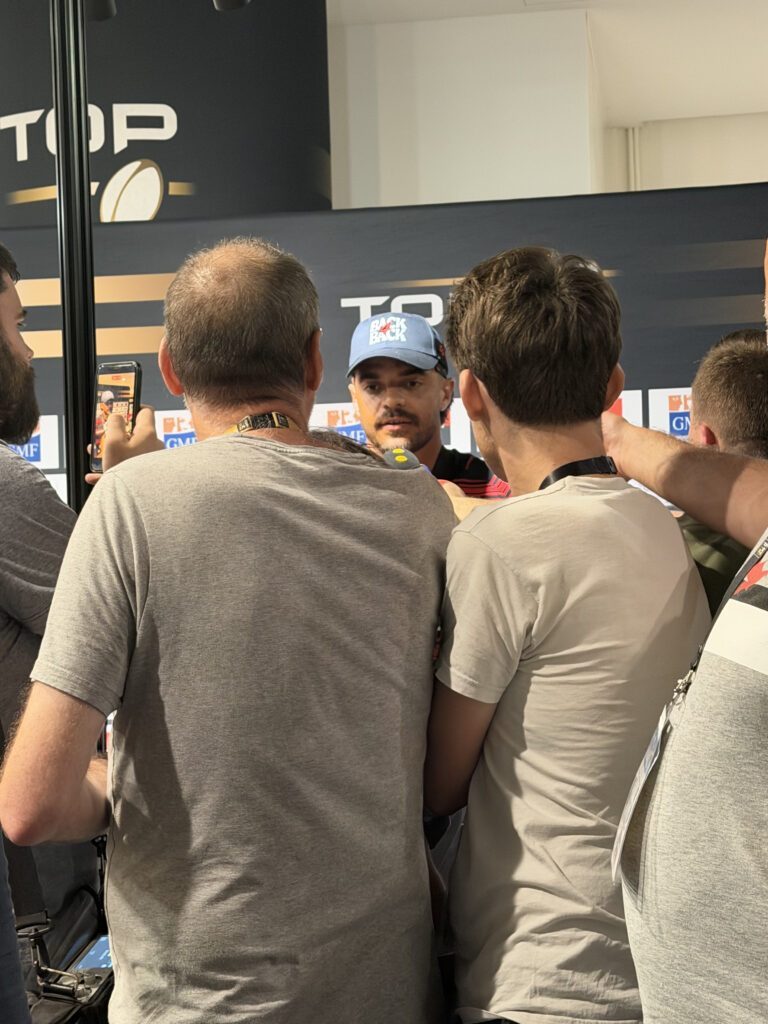
Time to breathe, to drink another coffee, to go to the toilet. A short-lived rest. The mixed zone is in the basement, under the stands. The journalists line up on one side and the players file past on the other, under the watchful eyes of the press officers. You wait. It is hot. On the request sheet, a good many journalists had asked for Antoine Dupont and Ugo Mola. But they did not come. Joan Caudullo was the first to show up, wearing a face for bad days. Then came the abrasive Lenni Nouchi, lifelong mates Baptiste Erdocio and Auguste Cadot, and also the Toulouse men Romain Ntamack, Kalvin Gourgues, Virigile Lacombe and Paul Graou. The questions fly, the answers follow, the dictaphones do their job.
Then it is back to finishing the night behind the screen, with content to dissect, sentences to rework, a punchy headline to find… We did not see the end of the party. But we are not going to complain about it.
Comments