
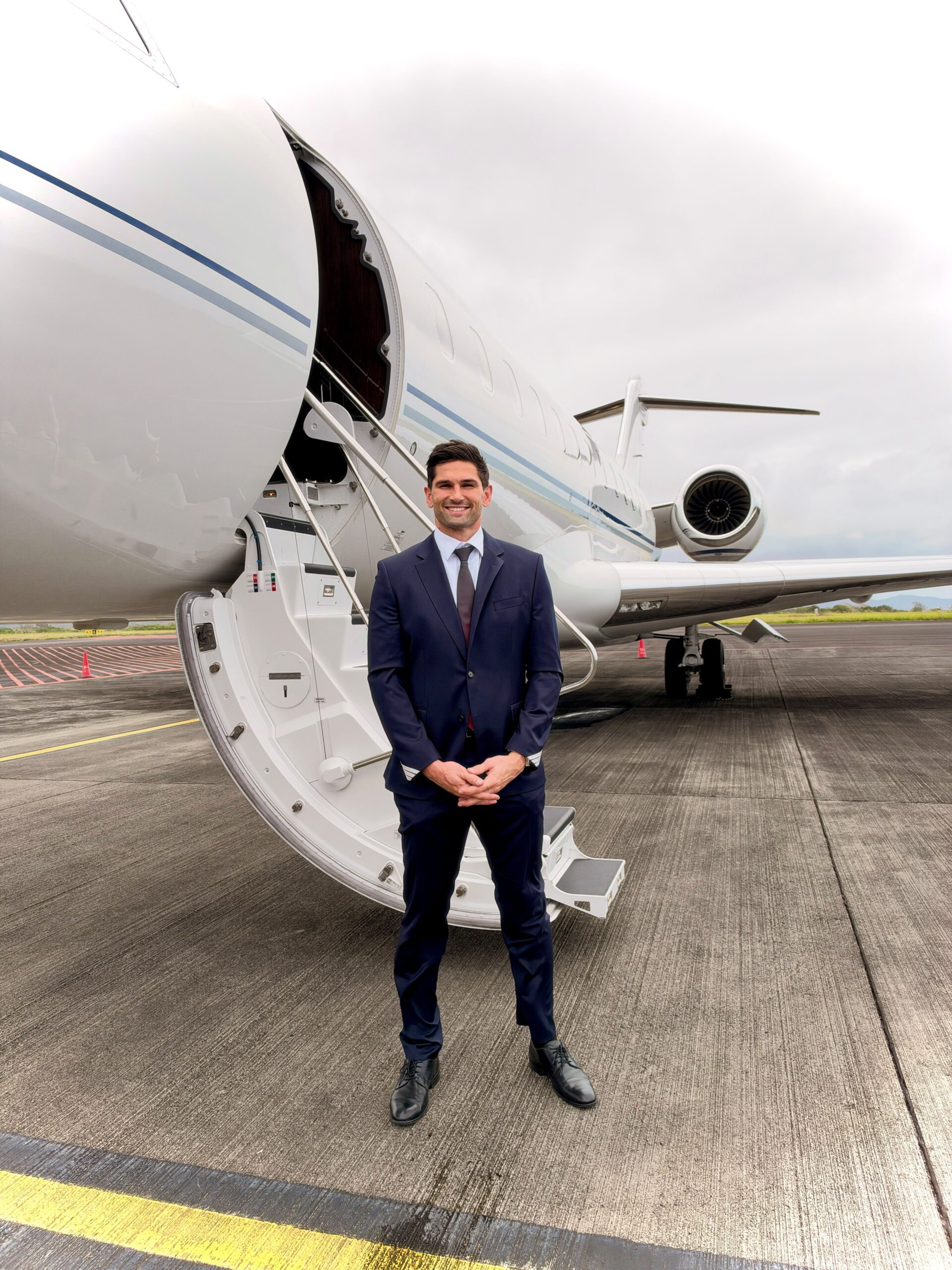
After hanging up his boots at the end of last season with Valence-Romans, Xavier Mignot has taken his career in a new direction. The former wing, whose clubs included LOU and FC Grenoble, has turned a childhood passion into a job: flying. Now a first officer with a business aviation company in Switzerland, he is discovering a new working world, with the same appetite for learning and for a challenge that drove him on the rugby pitch.
Trained at Bourgoin and capped once by France, he explains how he prepared for life after rugby and why he chose the cockpit. An interview with a man who has his head in the clouds and his feet firmly on the ground.
IT’S RUGBY. – Xavier, you retired last August after a final season in Pro D2 with Valence-Romans. How did the decision to hang up your boots come about?
Xavier Mignot. – It was a combination of things. I had chosen to keep living in Lyon, so I was driving to Valence and back every day. On top of that, I started getting little aches, a few physical problems, some inflammation. Put it all together and it starts to weigh on you. I had always told myself that rugby had to stay, above all, something I enjoyed. But I had reached the point where I wasn’t enjoying it as much. At some point I told myself there was no use lying to myself just to carry on. Rugby is about enjoyment first and foremost, and I wasn’t getting enough of it any more.
IT’S RUGBY. – Did already having a career plan outside rugby help you make the jump?
Xavier Mignot. – Yes, of course. It was a bit of a gamble. I was already in touch with two or three companies while I was still playing. At the time, I thought I could wait two or three years once I had my qualifications, or find a company that would let me fly part-time, once a week, on my days off. That would have let me do both at once. In the end, it didn’t happen. Once my career was over, I started actively looking for a full-time position, which can be very hard when you have only just left flight school with no flying experience.
IT’S RUGBY. – Do you owe that forward planning partly to your upbringing and your father’s advice?
Xavier Mignot. – I was lucky to have a father who ran the Bourgoin academy back then. Training and supporting players was really his field. Growing up, he always told me to have a dual project. Making a living from your passion through rugby is a privilege, but not everyone manages it. And even when you do, it stays precarious. Contracts last two or three years, you never know what tomorrow holds. An injury, a contract that isn’t renewed or plenty of other reasons can leave you out of work overnight. My father always stressed how important it was to do something else alongside rugby, out of personal curiosity and to grow as a man.
IT’S RUGBY. – So you always kept up your studies alongside your sporting career?
Xavier Mignot. – I never stopped studying. Even when I was at Grenoble, I did a two-year technical diploma, then a bachelor’s degree in marketing and sales. After that I went on to a master’s in management at Grenoble business school. I even followed it with a certified course in corporate finance at HEC Paris, because my master’s was missing that part: it was fairly general and adapted for athletes. In total, I spent eight years combining studies and rugby. Once I had finished, I thought maybe I should take a breather. But after six months I was going round in circles. Coming home in the afternoon and doing nothing, not having another activity, I missed that.
IT’S RUGBY. – And that other activity had always been in the back of your mind: flying.
Xavier Mignot. – Yes, I’ve always been passionate about aviation, ever since I was little. I told myself I shouldn’t have any regrets and that I had to take the plunge. I went and knocked on the door of a flying club to ask for information. I met someone who took me up in a small plane and then gave me two or three contacts. That’s how it all started. At first it really was a hobby. I didn’t necessarily see myself making it my job. But the more flights I did, the more the idea of a new career took hold.
IT’S RUGBY. – Today you are a first officer with a business aviation company in Switzerland. What does your new job actually involve?
Xavier Mignot. – I work for a business aviation company. The idea is that clients charter a plane to travel wherever they want. The company sells flight hours and we, the pilots, share out the trips according to our schedules. It can take us anywhere in the world. I can just as easily end up in Brazil as in Barcelona. That’s what makes it exciting: there’s no real routine and the destinations keep changing.
IT’S RUGBY. – You’ve also been lucky to join a company that lets you learn a huge amount from day one.
Xavier Mignot. – Yes, I found a great opportunity, with a very good company and colleagues who teach me a lot. When you come out of flight school, you still have an enormous amount to learn. It’s a big step up because you’re thrown straight in at the deep end. A lot of pilots start on small planes before gradually moving up. Here, you arrive on a bigger, more demanding aircraft, with procedures to master for flying internationally. A lot of new things come at you all at once. I know I still have a lot to learn and I’m very much in that phase.
IT’S RUGBY. – When you’re a first officer, are you still in training to become a captain?
Xavier Mignot. – Not exactly. In English, you talk about the “captain” and the “first officer”. In French, it’s the commandant de bord and the copilote. The captain really is the boss of the aircraft. He is responsible for it and he makes the final decisions. The first officer is there to back him up. Then, in the cockpit, we work as a pair. On every flight, one pilot flies and the other monitors the parameters, and we swap roles on each leg. But even when I’m the one flying, the captain always has the final say. When you join a new company, especially early in your career, you usually start as first officer.
IT’S RUGBY. – You also made the most of your season in the United States to build up flying hours. What are your memories of it?
Xavier Mignot. – It was exceptional. I used it to fly small planes and log hours as part of my training. The scenery was magnificent. Over there I was flying under visual flight rules, what’s called VFR. That means you have to stay out of the clouds and fly by looking at what’s around you. It’s different from instrument flying, used in particular by commercial aircraft, which lets you fly through cloud thanks to navigation instruments and radio aids. Visual flying is much more restrictive, especially in a region with a lot of thunderstorms. But I have very fond memories of it.
IT’S RUGBY. – Could this passion for flying have been an obstacle in your rugby career, especially in terms of contracts?
Xavier Mignot. – Not at all. The contracts I signed never banned me from that kind of activity. I wasn’t even banned from skiing. That said, you have to distinguish between players’ contracts and the insurance policies taken out by clubs, which can include certain restrictions, particularly on risky activities.
IT’S RUGBY. – Have you also talked with other players who share this passion?
Xavier Mignot. – Yes, a few amateur players got in touch and I was able to talk with them. Among the professionals, I believe Andrés Zafra has his PPL, his private pilot licence. I think Sekou Macalou and Tristan Tedder fly too. It’s quite funny to see other players drawn to this world.
IT’S RUGBY. – Aviation is regularly questioned over its environmental impact. How do you see the issue, given that you also care about nature?
Xavier Mignot. – I grew up in the countryside and I still live there, so I’m very attached to nature. I also take a pragmatic view. Yes, aviation emits CO2, but I think you have to look at the whole picture and compare emissions on a global scale. There are technological developments on the way, notably electric and hydrogen. But today aviation has to meet an enormous number of constraints, especially in terms of safety and range. Electric planes already exist for training, but they remain very limited. You have to be able to carry passengers over long distances and guarantee their safety. I think things need to move forward collectively, rather than pointing the finger at one country or one industry in particular.
IT’S RUGBY. – What is it about aviation that has fascinated you so much all these years?
Xavier Mignot. – What has always amazed me is the physical feat: managing to make so much mass fly, to lift so much weight into the air. It’s incredible to think that people developed this technology and that engineers today can design ever more efficient aircraft. I’m passionate about aviation, even if I don’t spend my time reading books about its history. What interests me most is what it is today and everything that allows it to keep evolving.



Comments