

On 15 October 2023, the Stade de France held its breath: France, hosts and the hope of a nation, went down by a single point (28-29) to the Springboks, who would be crowned world champions two weeks later. A detonation! Two years on, and on the eve of meeting their Springbok executioners again (Saturday 8 November), that quarter-final remains a collective wound across the whole of the rugby world. More than a mere sporting setback, it is a story that continues to work away at the conscience and the memory of French rugby.
Some defeats fade away, others are carved out in relief. This one belongs to the second category, because it brings together several ingredients of a lasting pain: the highest possible stakes – a World Cup played at home -, the dramatic brutality of the script – a breathless, see-sawing contest – and the stubborn feeling of a rendezvous missed, or stolen, snatched from the throat of a crowd that never left its seat. The spectacle matched the tragedy; the fall was all the crueller because France had led for long stretches. That wafer-thin failure became far more than a defeat: a collective trauma, a story left hanging, and an open scar in the memory of French rugby.
“It was our dream too”
We may have watched those passages again, analysed them, picked them apart, found explanations for that nightmare, and tried to soothe the heartbreak of the script… Just as the players have done. The page has been turned, but the book has not been closed, not quite. The amateur world, which lives and breathes to the rhythm of France’s performances, is still feeling it. “There is the 2011 final, but that one… It will stick in the throat for life, really for life, with even more intensity, laments Mathieu Pennezzi, a Fédérale player near Aurillac. It was our dream too. There weren’t just 23 players in blue on the pitch, but a whole country. Everything was there to win it…“
??? FLASH – Le #XVdeFrance est éliminé de la Coupe du monde de rugby après sa défaite 28 à 29 face à l’Afrique du Sud. #FRAvRSA pic.twitter.com/Vg1z9PJgQH
— Mediavenir (@Mediavenir) October 15, 2023
On the emotional side, the defeat grew out of closeness. Players, staff and supporters shared a common horizon: making 2023 the year of a national achievement. When that project vanished in a breath – one point, one kick, one (or several) contested refereeing decisions – the disappointment did not only touch sportsmen, it touched a nation that had invested its dreams in the jersey. The public confessions of captains and coaches, voices cracking in press conferences, prolonged that narrative of loss. Even today, when the very players who lived through that heartbreak talk about it again. The words of Labit or Ramos in recent days point that way…
“Dramatic and cruel”
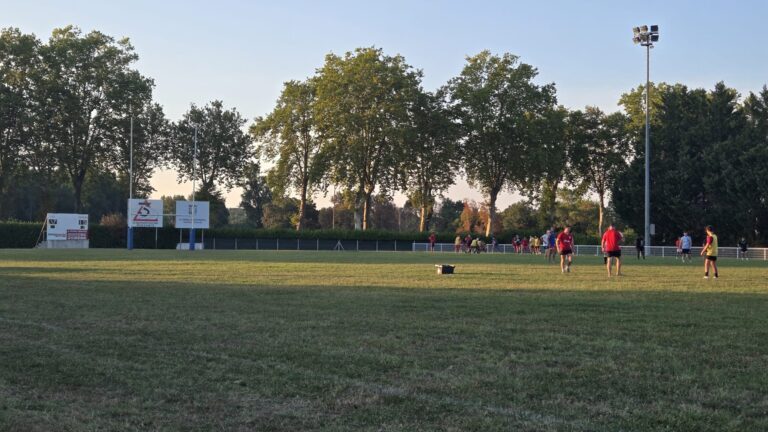
Politically and culturally, rugby occupies a singular place in France: a sport of “bodies”, of combat, but also of sociability, it acts as a mirror for collective expectations. Losing at home, the story turned into a question: what needs reviewing? What demand for change? Editorials and the foreign press did not fail to seize on the “dramatic and cruel” nature of the match, making the echo more universal and the wound less private. Two years on, and before meeting the “Boks” again this Saturday (8 November, 9pm), the trauma resurfaces. In a gym in Aurillac, where the players of Arpajon-sur-Cère and Saint-Simon train, the file comes back out. “There is a sort of tension as this match approaches… Watching it won’t be easy, it brings back the grief and the sadness of a missed opportunity“, you can hear. “And what’s more, there are almost the same players on the pitch.“
La Fédération internationale de rugby reconnaît 5 “erreurs majeures” d’arbitrage lors de France – Afrique du Sud ? pic.twitter.com/lsRLfBmTQw
— Views (@viewsfrance) October 20, 2023
Finally, there is sporting memory: it feeds on sequences, on images – the silence of the stadium, the distress of the players, the commentary on a loop – and is reactivated at anniversaries, at “commemorations” or during episodes that recall that evening. When the same players, or their successors, come back onto the pitch, the event resurfaces, not as a page turned, but as an imprint. Retrospective analyses, sometimes sharp, breathe in a sense of unfinished business that makes rebuilding slower and more demanding.
“We sometimes talk about that match at the rugby school with the youngsters… For the smallest ones, it will be a landmark”
Éric Morzine, coach
The French frustration takes on sharper relief when you glance at the grey areas hanging over the South Africans. Several South African players have been sanctioned or placed under investigation for doping: Aphiwe Dyantyi, the former Springbok wing, was banned for four years after testing positive for several anabolic steroids. Former fly-half Elton Jantjies received a four-year ban after testing positive for clenbuterol in 2023. More recently, Asenathi Ntlabakanye was the subject of an “adverse analytical finding” brought by the South African anti-doping body, having already been selected with the Springboks. That accumulation of scandals could stoke a certain muted resentment. For France supporters as for the whole French rugby community, losing to a side modest in its triumphs but tainted by these affairs certainly leaves a bitter taste.
#ENGvRSA
— Cédric (@Inimre) October 21, 2023
Ben O'Keeffe offre la finale aux Sud Af, pitoyable… pic.twitter.com/8V9K7Xd97h
Recovering is not just a matter of correcting tactical habits; it also means learning again how to turn the wound into a driving force. For France, the road long ran through unspoken words, before a clear-eyed reading of the mistakes and patient work on the collective imagination: converting frustration into the story of a possible future. As long as the “country” keeps re-reading that quarter-final as a stolen promise, the pain will remain raw, but it can, if it is worked on, become the raw material of a renewed project. “We sometimes talk about that match at the rugby school… The youngest ones ask questions, about the script, the refereeing, the context, concedes Eric Morzine, a rugby coach in the Clermont area. Even for the little ones, that match will be a landmark. A moment that will shape their development and their future as rugby players (male and female).”
Repair and rebuild
The story goes on, because it is often out of a wound that a defining trait is forged. The challenge for France was, and still is today, not to let that scar close in on itself, but to convert it into an open, deliberate suture, the sign of a future. In the end, we will never know exactly what impact that failure – because a failure is what it is – had on the France players. But for some of those involved in the amateur game today, the heart of the problem is not only the defeat, but the apparent impossibility of digesting it. It sometimes lingers like a cast shadow, in training sessions, in choices, in glances. The challenge is twofold: repair and build.
That one-point defeat is not behind them, behind us: it is beside us, within arm’s reach, like a tide that has not yet given everything back. Recovering does not simply consist of moving on for good. It means looking at the sea, picking up what it took from us, and deciding, together, to rebuild on that shifting sand. Two years, and a Six Nations in the cabinet later, the road has been taken. “Sometimes you have to look back in order to move forward“, Fabien Galthié confirmed in a press conference on Thursday, as he named the 23 who will take on… the Springboks on Saturday evening.

Comments