
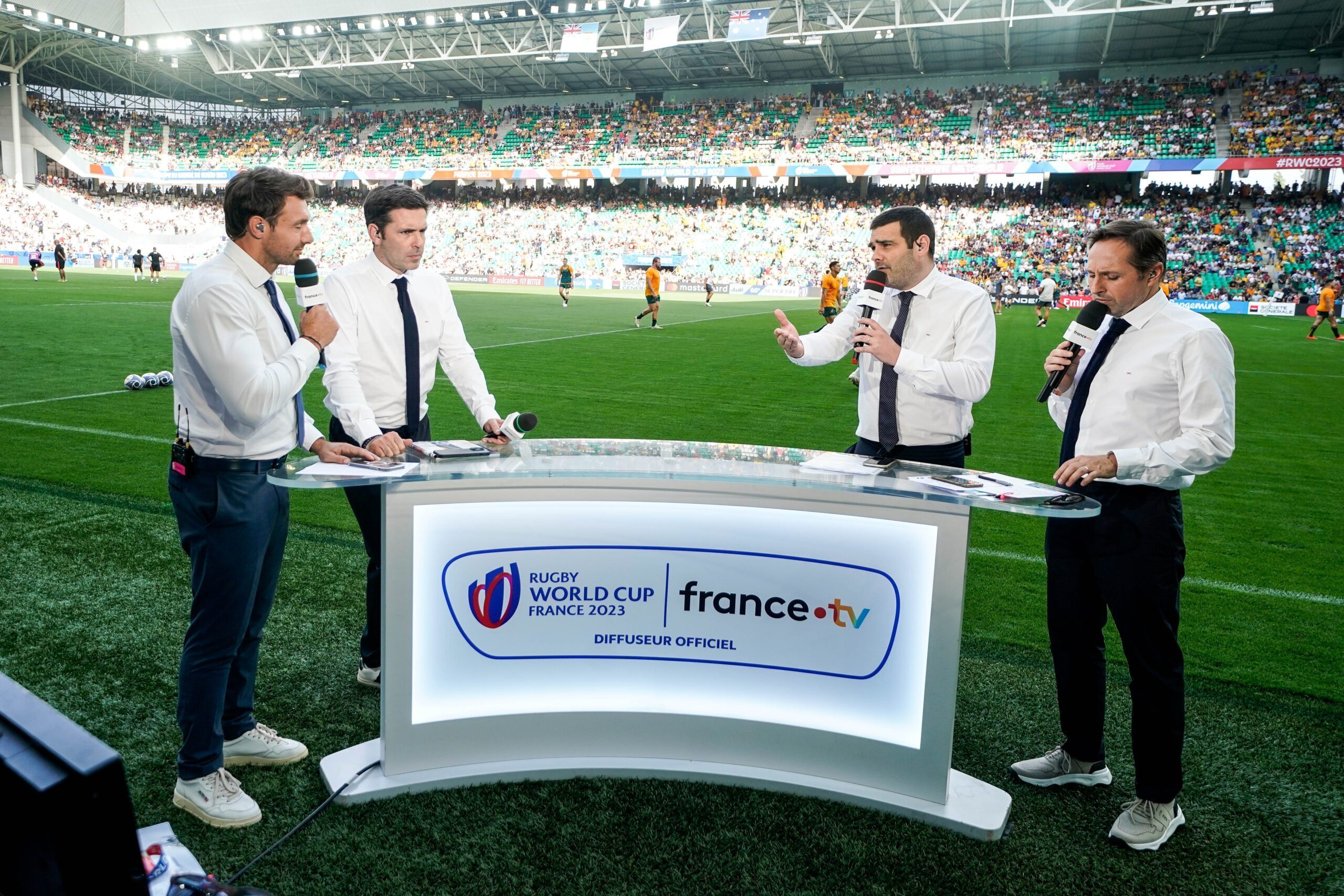
France’s test matches, historically shown on France Télévisions (France 2), are being broadcast by TF1, which bought the rights to the 2024 and 2025 autumn tours. That change of channel, and therefore of commentary duo, has triggered a wave of “regret” and “attachment” on social media.
There comes a moment when the picture stays the same, but the sound is no longer there. For many oval-ball fans, France’s autumn tour being shown on TF1 rather than on France Télévisions has set off an unexpected emotion: a sense of loss. The loss of Matthieu Lartot’s voice, the loss of Dimitri Yachvili’s eye. Match after match, the commentator and the pundit had seemingly woven a familiar presence into the living room. Today, “their absence can be heard and felt“, as you can read on social media.
Rendez le rugby à Mathieu lartot svp #FRAAFS pic.twitter.com/UwJvdhygUg
— SANG-BLEU (@Mo7814809500) November 8, 2025
“At every kick-off, those two voices did far more than commentate, they inhabited the match“, wrote one internet user after Saturday night’s France-South Africa. Matthieu Lartot, a journalist welded to rugby since his teens, himself a former scrum-half until illness forced him to change pitch. Dimitri Yachvili, a former France player, his hand on the scrum, his feel for the game turned into analysis on air. Together, on France Télévisions, even if they do not always win everyone over, they embody an era: “Rugby’s hour as we love it, between fervour and knowledge, between emotion and intelligence.“
But a turning point, and not a recent one, came along (there is no question here of drawing the slightest comparison). The broadcast rights to France’s big international matches partly changed hands. France Télévisions lost coverage of the autumn tour for 2024 and 2025, which goes to TF1 (as do the World Cups) and to its duo of Stephan Etcheverry and Thomas Lombard, both former players and shrewd judges. Not forgetting the presence of Isabelle Ithurburu, who moved across from Canal + in 2023, in the studio or on the touchline. Plenty of competence and fine expertise there too. But for many viewers, that symbolic shift onto free-to-air television is also the sign of another shift: “that of a landmark that has become uncertain.“
Deux êtres vous manquent et tout est dépeuplé ?#FRAAFS @lartot @DimitriYachvili pic.twitter.com/lmLOJAZKRT
— Peter Ball (@PeterBall_TwT) November 8, 2025
And yet rugby is also shared live on air. When broadcasters move, when faces change, habits are thrown off. The viewer settles down to “recognise” a world: from the channel’s logo to the commentator’s timbre. And when the channel slides, what seemed immovable can wobble.
Yachvili’s expertise, his sometimes firm and often spot-on voice, meets Lartot’s verve, capable of a pun on a player’s name or on a piece of skill, but also of a solemn silence when the ball was trembling. A different style and a different register on TF1, but no less impactful, no less effective. Many supporters are therefore adamant: “The France TV pairing has that rare quality: making the supporter in front of his screen exist, not as a mere spectator, but as an accomplice in a story. The set piece, the scrum drawing breath, the try that flies off the hooker’s hand: everything takes on a particular relief in their words.“
Un match de rugby sans @lartot c’est terrible !!! Le Rugby c’est sur la France Télévision ! #FRAAFS
— Antoinee? (@Antoinee_B) November 8, 2025
Today, that shift in landmarks goes straight to the emotional bond. The word “nostalgia” is not too strong, because part of the collective imagination seems frozen on that absence. The change of broadcaster is a reminder that, in our supporter’s heart, television is not neutral, but very much a matrix of expectations, habits and rituals.
And yet, beyond the emotion, what remains is the image of France itself, the scrums, the mauls, the autumn sky above the stadium, the fervour of “Allez les Bleus !“. But “watching without their voices is like drinking a bordeaux with no memory of the first glass. You recognise the colour, you appreciate the bouquet; but that bit of bite is missing“, as you can read on X.
Un match de rugby sans @lartot c’est terrible !!! Le Rugby c’est sur la France Télévision ! #FRAAFS
— Antoinee? (@Antoinee_B) November 8, 2025
In an era when broadcast rights are traded, when the channel becomes an object of nostalgia, the Lartot-Yachvili figure embodies what the supporter loves, namely stability, familiarity and depth. So this is not really about the abilities of one commentary duo or another (that is for each of us to judge), but rather about a change of on-screen companions that reassure.
And just as autumn arrives, with its dead leaves and its stadiums heavy with damp, the absence of those familiar voices is a reminder that rugby is also a shared breath in the moment, yes, but also in the memory of a living room, of a sofa, of a ball that we applauded in chorus.
Je n'ai rien contre @stefetche, mais la voix du rugby ? en France, c'est @lartot, c'est desservir ce sport que de le proposer sur @TF1, @IsaIthurburu par contre, est très légitime, oreilles @canalplus
— boukli nassim (@NassimBoukli) November 8, 2025
2 comments
apart from isabelle ithurburu, the commentary on tf1 is RUBBISH AND THE PICTURES are even worse, since the world cup it’s enough to put viewers off completely
Automatically translated
I’m so disappointed not to hear that legendary duo any more! I miss them terribly! I hope the Six Nations will be broadcast on France TV….
Automatically translated