
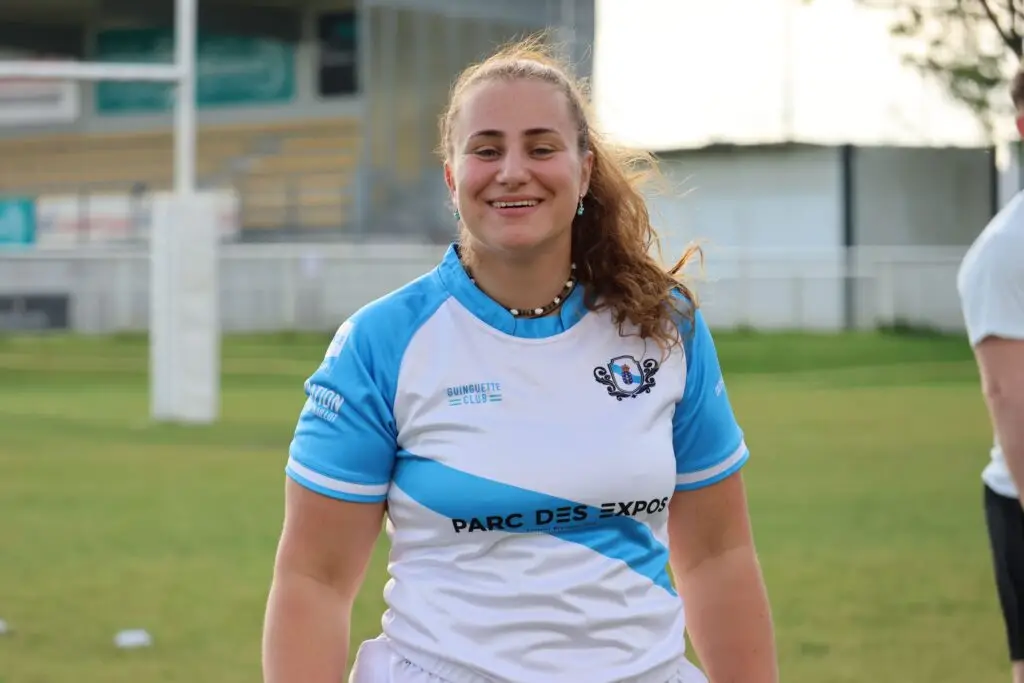
Coralie Bême, 21, is a student in sports science, is playing her 3rd season with RC Vannes, as a prop or a lock or a number 8. Quite a number.
To begin with she was a gymnast, with more than 15 years in the sport, family environment obliging: her parents are in the gymnastics world and so are her sisters.
Coralie explains: “I’ve got my whole family in it, in fact, because I started with gymnastics. Well, we have one thing in common, we come from the Paris region, from the 95, not far from Argenteuil, or rather between Argenteuil and Cergy.”
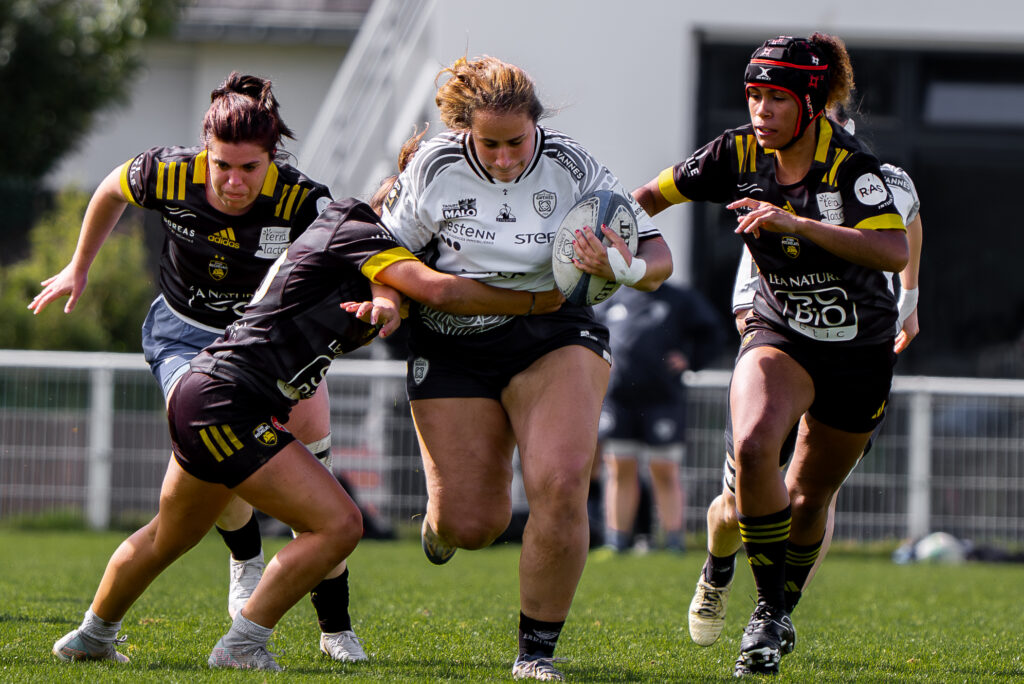
Not far from Colombes, but how does a gymnast from the Paris region end up in Morbihan rugby? “Well, it was my dad who put me into it, for several reasons, I had the choice between boxing and rugby, the psychologist told me that, and my father said to me, it will be very good, you’ll play rugby, and my father played rugby for a very, very, very long time, he played for Stade Français. So I had the choice between an individual combat sport and a collective combat sport. I had a lot of problems coming out of Covid, and so my mother made me go and see a psychologist, and I had enormous problems with anger, and so it was the psychologist who told me, “you have the choice, to burn it off publicly and let your emotions out, between boxing and rugby.” An outlet, yes. A genuine outlet.
For her third season at Vannes, the sports science student trains with the 45 other registered women: rugby-specific work on Tuesdays and Thursdays, weights and structured team work on Wednesdays and Fridays at Jo-Courtel.
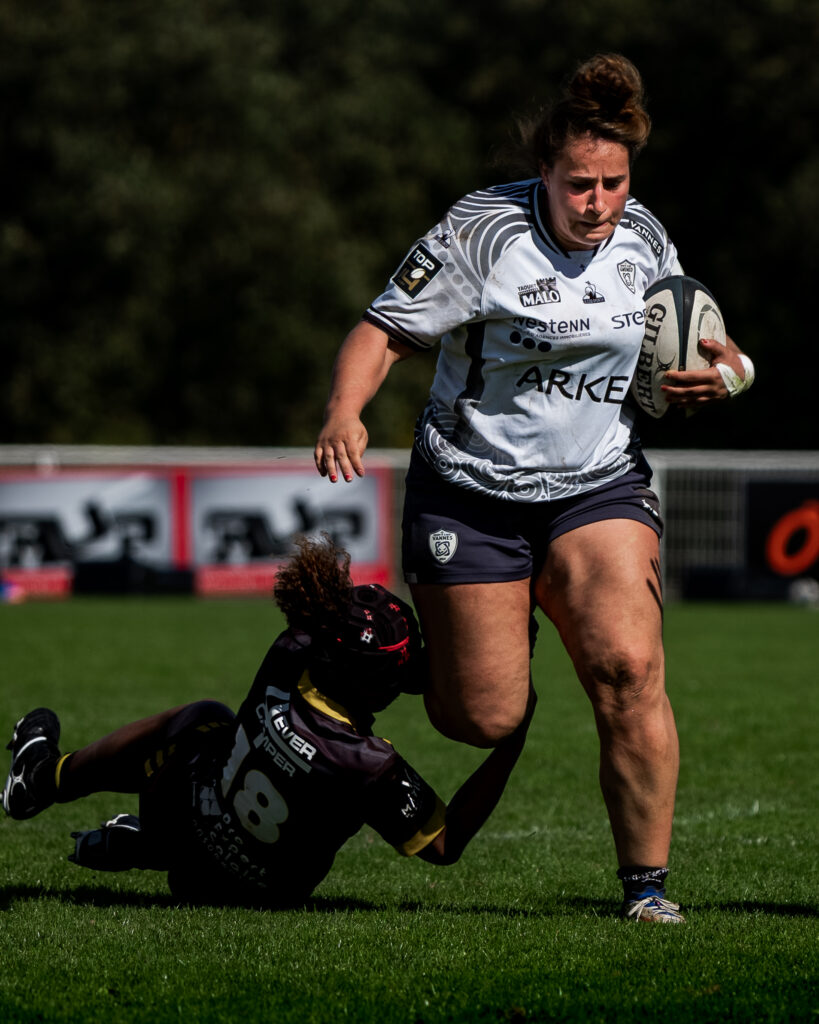
Not straightforward every day, especially with the ups and downs: “Since I arrived, we have had changes of coach every single year, so we have to build a new game plan, find our bearings again. It isn’t easy, but there is still plenty of ambition, there are resources.”
Does Coralie feel, young as she is, that she is a pioneer and has a small duty towards the Cadettes and the Juniors coming behind her? “Yes, inevitably, because if we want women’s rugby to grow, we as seniors have no choice but to make sure we get female recruits from the rugby schools. With my course, I am often inside schools, in educational establishments. I do a huge amount of placements. The aim is to bring as many girls, or even players in general, into rugby, as soon as we see they have a bit of quality.”
Rugby is no longer seen as a truly boys’ sport, even if it still is, given the number of male registered players compared with the women, but it is changing.
Long gone are the days when a president of the Federation said of women’s rugby that “It’s neither rugby, nor feminine”… Things have moved on a lot, and all the better.
And then Brittany has two wonderful ambassadors, Caroline Drouin and Sandrine Agricole, who have done a great deal and continue to do a great deal for rugby. Coralie: “Exactly. It is thanks to those women that today we can claim that at some point there will be as many women as men.”
At the ground, there are the mates, male and female. Coralie meets up with them, they have a coffee, an orange juice or a beer. It stays rugby: “Oh yes, of course, there is always that mentality, I don’t really know how to explain it, and it is even more developed in Brittany compared with Paris, There is always that idea of a party. And passing it on: “I also look after the U13s, I have coached from U6 to U10 and now I have moved up to U13. So inevitably the expectations are not the same and I used to have very few girls. Now there are three or four of us, which is already a lot at that age. They are coping and sticking at it.
The final word? A plea for this strange sport: “My rugby, I think it is one of the best sports there is.Whether in the mentality, in its values or in the physical activity in general.

Comments